








- CRED iQ re-sized $136B of agency and CMBS apartment debt maturing through December 2028 and found 23% of loans, or 31% of the balance, need $6.8B of new equity.
- Loans written in 2021 and 2022 carry the worst gap, with 46% of loans and 57% of balance short, while San Francisco (70%), Atlanta (55%) and Denver (51%) lead metros.
- Each further 25 basis points of rate hikes adds roughly $1B to the gap, and two more would leave 39% of maturing multifamily debt unable to refinance.
Nearly one in four maturing multifamily loans can’t refinance without new equity after September’s rate hike, according to CRED iQ.
The firm re-sized $136 billion of Fannie Mae, Freddie Mac and CMBS apartment debt due from October 2026 through December 2028 at current coupons. Loans holding 31% of that balance fall short and would need $6.8 billion of fresh capital.
Get Smarter about what matters in CRE
Stay ahead of trends in commercial real estate with CRE Daily – the free newsletter delivering everything you need to start your day in just 5-minutes
A 767-Unit Example
CRED iQ highlighted 20 Exchange Place, a 767-unit tower near Wall Street. The property was 94% occupied as of Q2. Its $246 million Freddie Mac loan carries a 4.01% coupon and matures in February 2027.
However, refinancing could leave a sizable gap. The property’s 2025 NOI of $15.5 million supports about $183 million in new debt at current agency rates. That leaves roughly $63 million to cover. According to servicer commentary cited by CRED iQ, the borrower has been drawing investor capital to cover operating shortfalls.
What the September Hike Did
The Secured Overnight Financing Rate rose from 3.62% to 3.85% on Sept. 17, CRED iQ reported. As a result, 178 additional loans fell below a 1.25x debt coverage threshold. Those loans carry $4.0 billion in outstanding balance. Together, they expanded the refinancing shortfall by $846 million.
The median shortfall equals 15% of a loan, or roughly $25,000 per apartment, according to CRED iQ. Before the rate increase, 21% of loans and 28% of outstanding balance already fell short. Those loans needed $6.0 billion in additional capital.
Each further 25-basis-point increase could add about $1.0 billion to the gap, CRED iQ estimated. After two more hikes, 39% of maturing loan balances would fall short.
The 2021 and 2022 Problem
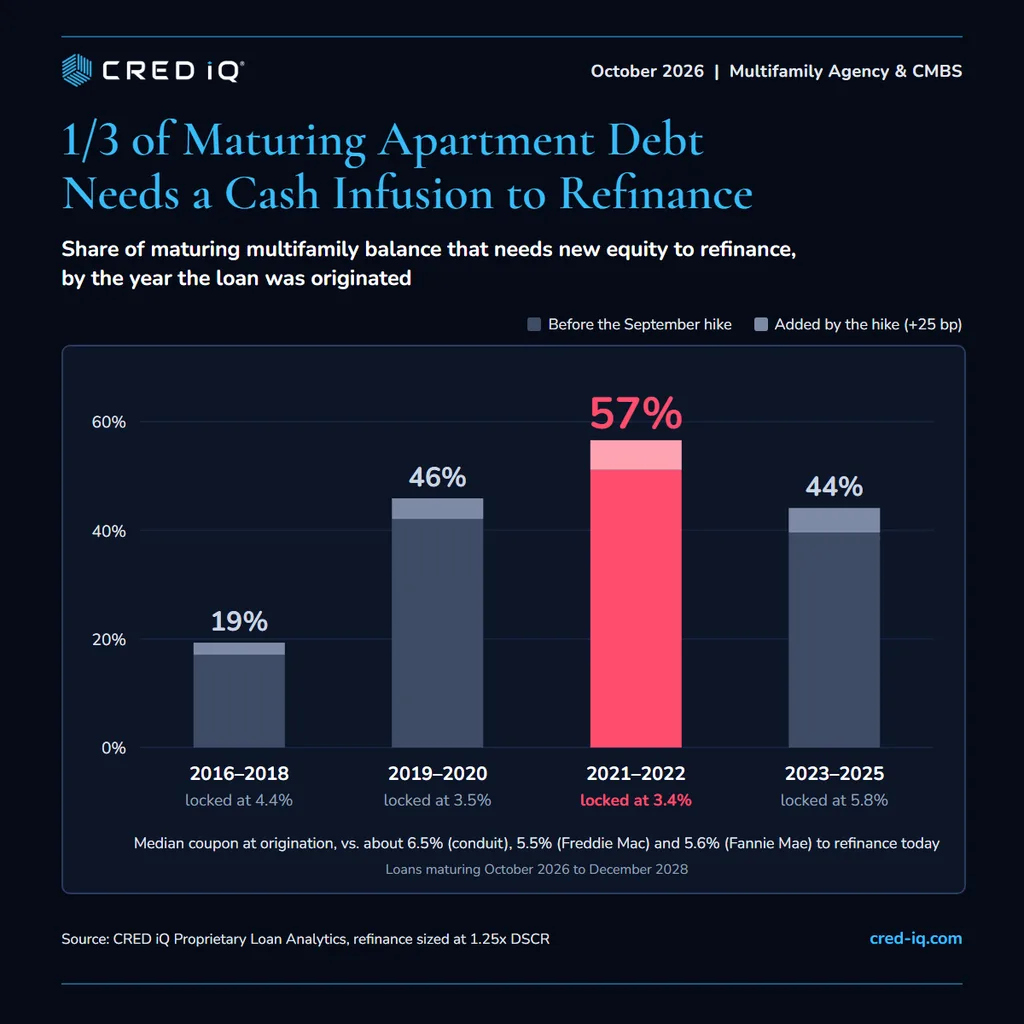
Loans originated in 2021 and 2022 carry a median 3.35% coupon. Now, they face rates two to three percentage points higher. Consequently, 46% of these loans need fresh equity, CRED iQ found. They represent 57% of the vintage’s total balance.
By comparison, only 15% of loans originated from 2016 to 2018 need additional equity.
Income trends help explain the difference. Among loans that pass CRED iQ’s refinancing test, median net operating income has risen 31% since underwriting. However, among loans that fail, NOI has fallen 12%.
Where the Gap Is Widest
Western and Sunbelt markets face the largest shortfalls, CRED iQ reported. San Francisco leads, with 70% of maturing loan balances falling short. Atlanta follows at 55%, while Denver stands at 51%.
By contrast, Chicago’s shortfall is just 13%. Los Angeles also fares better, at 24%.
Park West Village in New York shows how quickly coverage can deteriorate. According to CRED iQ’s servicer data, the 850-unit property had 1.34x coverage at underwriting. By year-end 2025, that figure had dropped to 0.61x. As a result, its special servicer modified the loan in November. The loan matures in August 2027.
How CRED iQ Sized the Gap
CRED iQ estimated refinancing capacity using each property’s 2025 net operating income. The analysis assumed a 30-year amortization schedule and a minimum coverage ratio of 1.25x.
It also applied the average 2026 coupon for new loans, plus 25 basis points. Those rates were 6.21% for conduit and SASB deals, 5.21% for Freddie Mac and 5.34% for Fannie Mae.
However, the sample excludes floating-rate SASB, CRE CLO and co-op loans. CRED iQ also labeled its September figures preliminary.
Dollars by Metro
New York has the largest refinancing need in dollar terms. CRED iQ estimated a $739 million shortfall against $10.8 billion in maturing loans.
Dallas-Fort Worth also faces significant pressure. The market has $5.2 billion in maturing loans, with 42% of the balance falling short. That translates to a $478 million gap. Meanwhile, Los Angeles needs about $352 million.
At the other end of the spectrum, Chicago needs just $68 million. This contrast highlights how local rent growth and loan vintage can influence refinancing outcomes.
Why It Matters
CRED iQ said most maturing loans can still refinance without additional support. However, borrowers with loans originated in 2021 and 2022 increasingly need to contribute fresh equity.
That pressure deepens the equity gap CRE Daily has tracked. This is happening even as debt capital remains available.
What’s Next
CRED iQ expects paydowns, extensions and rescue capital to become more common through 2028. Meanwhile, each additional rate hike could widen borrowers’ funding gaps.
Owners approaching refinancing deadlines in 2027 may face the most immediate pressure. Therefore, their ability to secure fresh equity or negotiate extensions will be critical.