



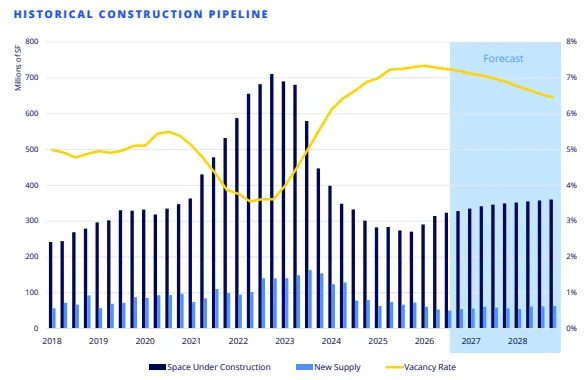
- Colliers says space under construction is up 16% from its 271M SF low at year-end 2025, and starts reached 158M SF in the first half of 2026.
- Buildings delivered in 2022 are 84% occupied, but space completed in 2025 and the first half of 2026 is only about 49% occupied, leaving more lease-up ahead.
- Midwest markets lead absorption, while Sun Belt and Western markets such as Austin at 19.3% vacancy still work through new supply, so the next cycle will be selective.
The U.S. industrial development market is moving from correction toward a new cycle, according to a Colliers research report published in October 2026.
Nearly 1.9B SF has been delivered since the start of 2022, expanding inventory by about 11%. After peaking at 711M SF at the end of 2022, the pipeline fell to a 271M SF low at the end of 2025 and has started to rebuild.
Get Smarter about what matters in CRE
Stay ahead of trends in commercial real estate with CRE Daily – the free newsletter delivering everything you need to start your day in just 5-minutes
The Pipeline Turns
Developers cut starts quickly as vacancy rose. By 2025, both starts and new supply were less than half their peak levels.
Space under construction has since risen 16% from that year-end 2025 low, and starts reached 158M SF in the first half of 2026. Activity remains well below the prior boom, but Colliers says the direction has clearly changed.
Older Space Leases Faster
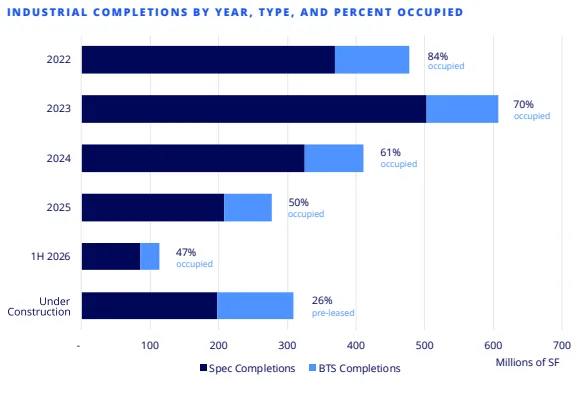
Occupancy improves with building age. Space delivered in 2022 is 84% occupied, compared with 70% for 2023 deliveries and 61% for 2024. Overall, 73% of the 1.5B SF delivered from 2022 to 2024 is occupied.
Buildings completed in 2025 and the first half of 2026 are only about 49% occupied. Speculative projects were roughly three-quarters to four-fifths of annual deliveries, but make up 64% of space now under construction, with build-to-suit at 36%.
The Midwest Outperforms
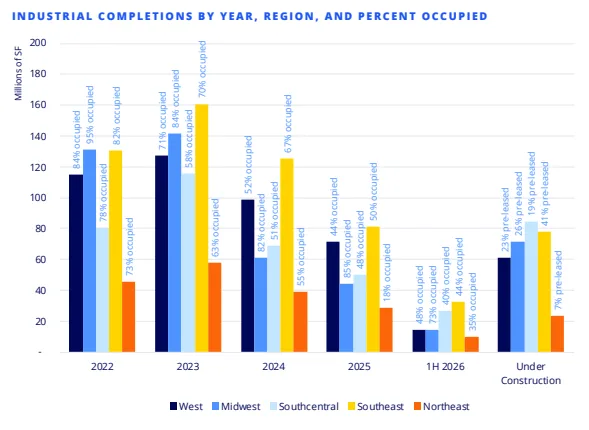
The Southeast delivered the most space from 2022 to 2024 at 416M SF, ahead of the West at 342M SF and the Midwest at 334M SF. The Midwest led lease-up, with 88% of those deliveries occupied versus 73% in the Southeast, 70% in the West, 64% in the Northeast and 62% in the Southcentral region.
Dayton leads at 98% of post-2022 completions occupied, followed by Birmingham at 96%, Columbus and Detroit at 95%, and Columbia at 94%. Columbus added 47.2M SF and expanded inventory 15%, yet 95% of it is occupied. Vacancy in all 10 top markets is below the 7.3% national average.
More recent deliveries show the same split. Combining 2025 and first-half 2026 completions, 82% of the Midwest’s 58M SF is occupied, versus 48% in the Southeast, 45% in both the West and Southcentral, and 22% in the Northeast.
Sun Belt Still Absorbing
The fastest-growing markets are still working through supply. Austin added 54M SF since 2022, essentially doubling its inventory, and posts 19.3% vacancy. Charleston is at 18.7%, the Treasure Coast and Reno-Sparks at 12.0%, Boise at 11.7% and Phoenix at 10.3%.
Indianapolis and Greenville-Spartanburg are exceptions, with at least 20% inventory growth, 87% and 83% occupancy of new supply, and vacancy at or below the national rate. Large hubs also vary: Dallas-Fort Worth delivered 181M SF, and Indianapolis, Chicago, Houston and Atlanta have absorbed new space better than Phoenix or Austin.
Why It Matters
The active pipeline looks more disciplined than the last cycle. Southcentral has the largest pipeline at 84M SF and the highest preleasing at 41%, while the Northeast sits at 7%. Midwest build-to-suit projects make up 54% of its pipeline.
Building sizes differ by region. Southcentral build-to-suit projects average about 743,000 SF versus 137,000 SF for spec, while the Midwest gap is narrowest at 294,000 SF versus 229,000 SF.
Specialty development is concentrated in the Midwest, with 22.5M SF of manufacturing, 29.4M SF of data centers and 5.3M SF of cold storage underway. The Southeast has the next-largest manufacturing pipeline at 14.4M SF, and the Midwest data center pipeline is nearly two-and-a-half times the Southeast’s 12.0M SF. That shift matters for the construction pipeline nationally and for industrial rents.
What’s Next
Colliers expects new construction to move first where vacancy has stabilized, modern spec buildings are leasing steadily and competing supply has receded. As those conditions spread, the next cycle could gain momentum.
For developers and investors, the question is where construction can be supported without recreating the imbalances of the last cycle.