



- National in-place industrial rents averaged $9.31 per SF in August 2026, up 5.4% year over year, while vacancy held at 9.3%.
- New leases now carry just an 88-cent premium over in-place rents, down from $2.45 two years ago, though Bridgeport, Boston and Miami still command spreads above $2.
- Sun Belt markets keep outperforming oversupplied coastal ports, and trade policy and energy costs could widen that split in the coming quarters.
National in-place industrial rents averaged $9.31 per SF in August 2026, up 6 cents from July and 5.4% year over year, according to Yardi Matrix’s September national industrial report. The national vacancy rate held at 9.3%, up 60 basis points from a year earlier.
Yardi describes a sector moving from the post-pandemic supply boom toward balance, though industrial rents and vacancy are diverging sharply by market.
Get Smarter about what matters in CRE
Stay ahead of trends in commercial real estate with CRE Daily – the free newsletter delivering everything you need to start your day in just 5-minutes
Coming Off a Record Supply Boom
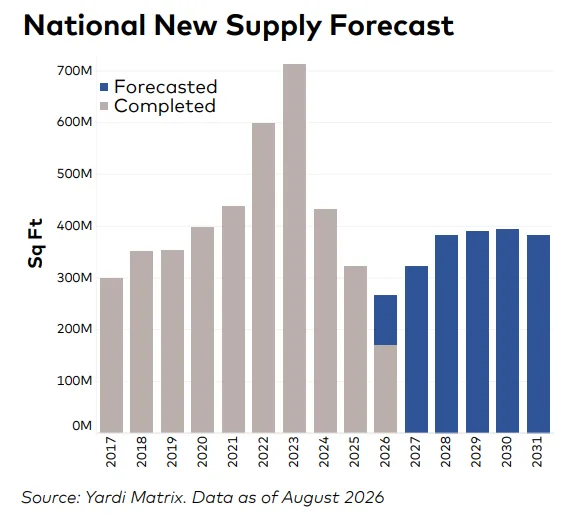
Developers started 1.5 billion SF of industrial space from 2020 to 2022, the largest supply wave in the sector’s history, per Yardi. Rising capital and construction costs, slowing rent growth and climbing vacancies have since forced a pullback in speculative building.
Demand has held up through tariffs, economic uncertainty and an energy price spike, as firms keep investing in distribution networks and supply-chain resiliency. New supply no longer outpaces demand at a rapid clip, and Yardi says the development trough appears to have passed.
The Details
Atlanta led top markets with 7.9% annual rent growth, followed by New Jersey and Miami at 7.6% and Dallas at 7.5%. Denver (2.1%), Detroit (2.7%) and Memphis (3.0%) posted the weakest gains.
The premium for signing a new lease has shrunk. Leases signed over the past 12 months averaged $10.19 per SF, 88 cents above in-place rents, compared with a $1.43 spread a year ago and $2.45 two years ago.
Some markets still command big premiums. Bridgeport led with a $3.52-per-SF spread, followed by Boston ($3.02), Miami ($2.97), Nashville ($2.52) and Dallas ($2.33).
Sun Belt Strength, Coastal Softness
Sun Belt markets including Dallas, Phoenix, Atlanta and Houston have kept posting solid rent growth with only modest vacancy increases despite historic supply waves. Coastal port markets, which had red-hot rents and minuscule vacancy a few years ago, are now firmly tenant markets as they work through the supply boom.
Seattle shows the strain. Its vacancy rate has jumped 500 basis points to 13.6% and rents are up just 4.5%, after 44.2 million SF of deliveries since 2020, equal to 14.1% of stock. Relief is coming, with only 1.1 million SF started in 2026.
Construction is picking back up nationally, with the industrial construction pipeline near 447 million SF, or 2.1% of stock, and 230 million SF of starts so far in 2026, the most since 2022.
Why It Matters
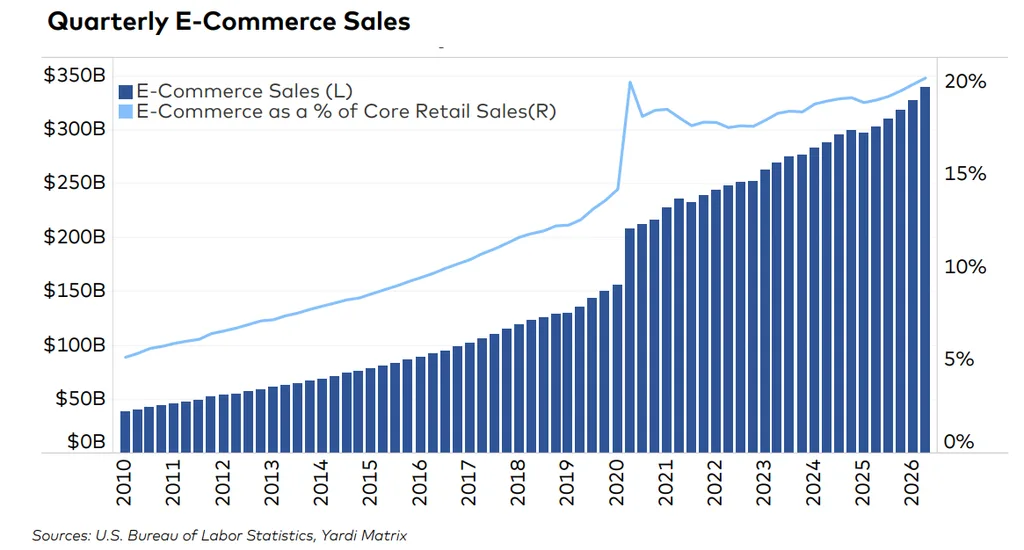
E-commerce remains a key tailwind. Online sales hit $340.2B in Q2 2026, up 12.2% year over year, and reached a record 20.2% of core retail sales, per Census Bureau data cited by Yardi. Online sales are estimated to require three times as much logistics space per dollar as brick-and-mortar.
The record edges past the 20.0% share set in Q2 2020 at the height of the pandemic, and Q2 2026 marked the fifth straight quarter of online sales gaining share.
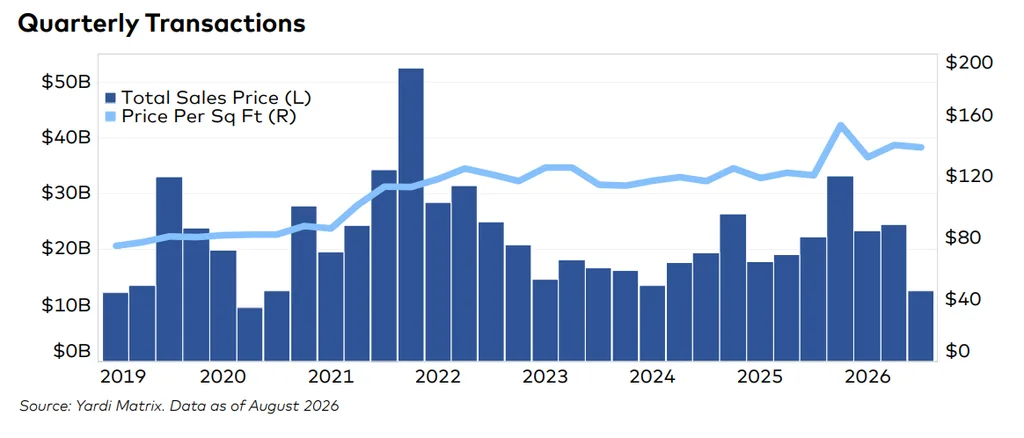
Investors are still active. Yardi logged $60.5B in industrial sales through August at an average $138 per SF, adding to signs of strong CRE property demand.
Los Angeles averaged $297 per SF, up nearly 9% from 2025, and its largest deal was Netflix’s $400M purchase of the foreclosed CBS Studio Center in Studio City. Netflix, which until recently leased its production space, is also building a $1B, 292-acre studio campus in New Jersey.
What’s Next
Yardi expects industrial markets to stay bifurcated in the coming quarters. The uncertain future of the U.S.-Mexico-Canada trade agreement and a brewing trade war with Canada could hit markets tied to cross-border manufacturing, especially automotive, metals and intermediate goods.
Sustained high energy prices could also put a premium on location, raising the value of properties close to ports and other key logistics hubs.