




- At the $40T debt mark in August, apartment cap rates of 5.39% sat only about 0.7 points above the 4.71% 10-year yield, the thinnest cushion of four milestones.
- The 10-year hit 5.29% by Sept. 30 and mortgage rates reached 7.28% on Oct. 1, with deal volume running a little over half its 2022 pace.
- About 13% of multifamily mortgage balances mature in 2026, versus about 4% of agency and government-backed balances, with many loans made when the 10-year was below 2%.
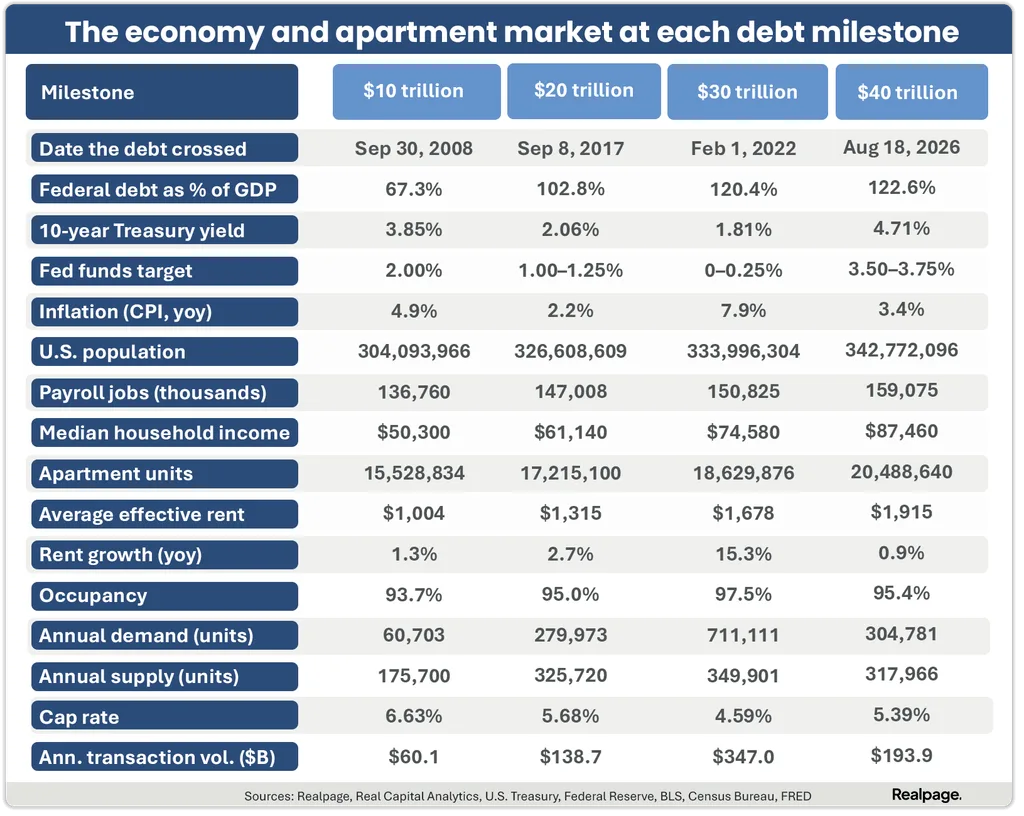
Apartment cap rates sat only about 0.7 percentage points above the 10-year Treasury yield when federal debt crossed $40 trillion on Aug. 18, according to RealPage.
That is the thinnest cushion of the four $10 trillion debt milestones RealPage reviewed, going back to 2008. Debt matters to apartments through interest rates, and yields have risen since.
Get Smarter about what matters in CRE
Stay ahead of trends in commercial real estate with CRE Daily – the free newsletter delivering everything you need to start your day in just 5-minutes
$10T in 2008: Demand Falls
Federal debt crossed $10 trillion on Sept. 30, 2008, two weeks after Lehman Brothers failed. Renters absorbed only about 61,000 units against 176,000 delivered.
Demand was negative in 20 of the 50 largest metros, and occupancy slipped to 93.7%. Deal volume fell to $60B and cap rates stood at 6.63%, per Real Capital Analytics, while the Fed’s target rate went from 2% to nearly zero by December.
$20T in 2017: Building at Full Speed
Developers delivered about 326,000 units in the year ending Q3 2017, nearly twice the 2008 pace, with 586,000 more under construction. Renters absorbed 280,000, which held occupancy at 95% and rent growth at 2.7%.
With the 10-year near 2%, the 5.68% average cap rate gave investors a cushion of roughly 3.6 points, the widest of the four milestones.
$30T in 2022: Record Demand, Cheap Money
Renters absorbed 711,000 units in the year ending Q1 2022, twice the 350,000 delivered, and occupancy hit 97.5%, the highest in RealPage data since 2000.
The Fed’s target rate was near zero, the 10-year yield was 1.81% and the 30-year mortgage was 3.55%. Deal volume reached $347B and cap rates fell to 4.59%. The Fed began raising rates six weeks later.
$40T in 2026: Higher Borrowing Costs
The latest $10 trillion took about four and a half years, and the apartment stock grew by 1.86 million units, more than in either earlier stretch. Renters absorbed 305,000 units in the year ending Q3 2026 against 318,000 delivered, a sign that apartment demand is nearly keeping pace.
Occupancy is 95.4% and rents are up 0.9% year over year. The difference from 2022 is the cost of capital: the 10-year yield is 4.71% and cap rates are 5.39%.
Rates Have Moved Since August
The Fed raised its target range a quarter point on Sept. 16, from 3.75% to 4%. By Sept. 30 the 10-year reached 5.29%, which on paper leaves cap rates barely above Treasuries, RealPage says, though cap rates usually take a few quarters to catch up.
Freddie Mac’s 30-year mortgage rate hit 7.28% on Oct. 1. At that rate, the monthly payment on a median-priced home is well above the cost of renting an average apartment, giving many would-be buyers a reason to keep renting.
Debt in Perspective
Per household, debt has more than tripled since 2008 while median income is up 74%, from about $85,800 (1.7 years of income) to about $297,100 (3.4 years).
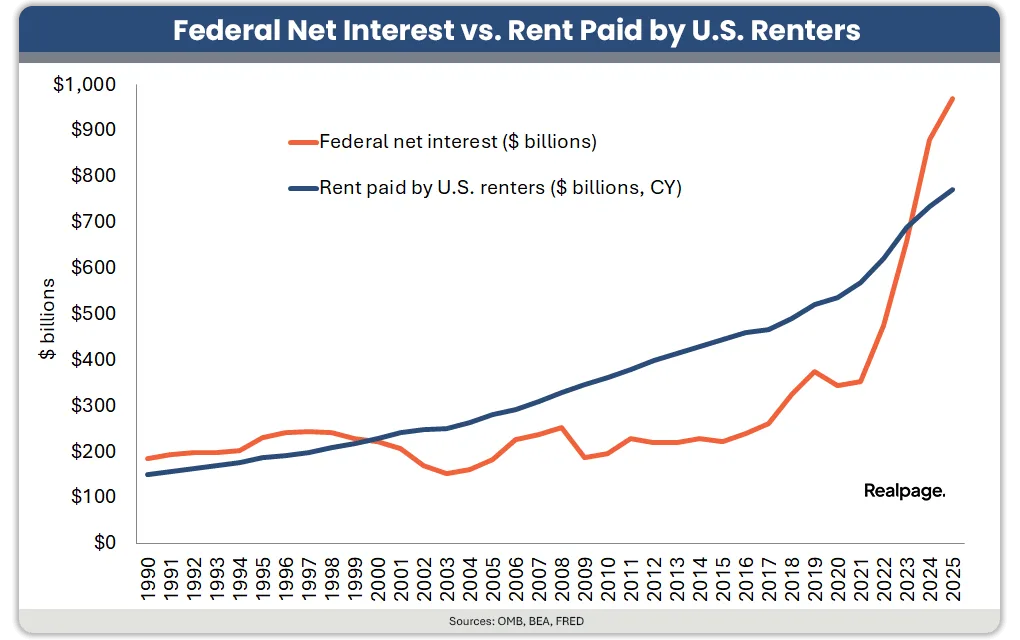
Interest came to about $7,200 per household in fiscal 2025, or $600 a month. That equals roughly 3.8 months of average apartment rent, up from about 2.2 months at the $10 trillion mark.
Where Developers Built
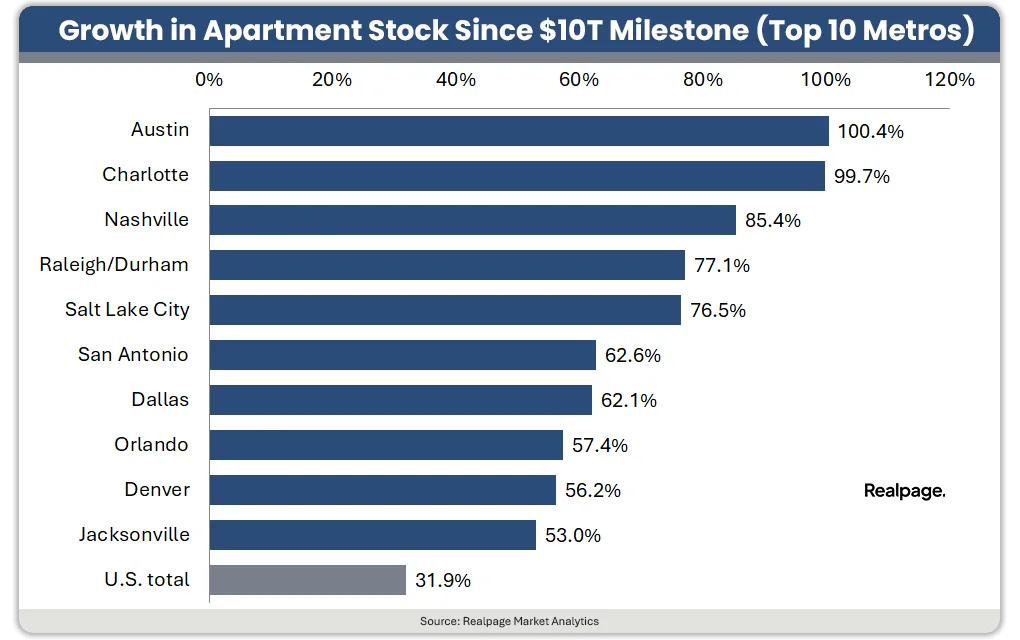
The apartment stock has grown by roughly 5 million units since 2008, one for every 4.5 new jobs. Nationally the stock is up 32%, but Austin and Charlotte roughly doubled, and Nashville, Raleigh/Durham and Salt Lake City each rose more than 75%.
Rent growth eased where deliveries over the past year topped 2% of stock, including San Antonio, Denver and Charlotte. Rents are firmest in San Francisco and San Jose, where deliveries were under 0.5%, while Phoenix, Austin and Fort Worth still show the strongest demand relative to size.
Why It Matters
A cushion that thin usually means investors are counting on income growth to close the gap, or that prices still have some adjusting to do. Deal volume is running near $194B a year, a little more than half the pace of the $30 trillion mark.
Higher rates are also catching up with loans made near the 2022 peak, many when the 10-year was below 2%. The Mortgage Bankers Association estimates about 13% of multifamily mortgage balances mature in 2026, but only about 4% of balances held or guaranteed by Fannie Mae, Freddie Mac, FHA and Ginnie Mae.
Most 2026 maturities therefore came from banks, life insurers, debt funds and CMBS, and owners there usually must add equity, extend at a higher rate or sell. That feeds the multifamily distress lenders are already working through.
What’s Next
Skivjani says the 10-year yield is the number to watch, since it drives apartment loan costs and, over time, building values. If yields keep climbing, financing costs and cap rates will feel it. If inflation cools and the Fed does not need to hike again, long-term yields could fall and widen the cushion.
Supply is thinning, with units under construction down from a 1.1 million peak in early 2023 to about 550,000. Demand faces a headwind too: net international migration fell from 2.7 million to 1.3 million in the year ending July 2025, and the Census Bureau projects about 321,000 by July 2026.