



- Virginia Beach’s council voted 9-2 to sell its roughly 350-acre municipal course to Dragas Companies for $17.9M, with 659 homes planned, a federal lawsuit pending and rezoning still required.
- Golf courses drew 31,064 mentions across 2,805 jurisdictions from July 2 to Oct. 2, 2026, and housing tied to redevelopment, rezoning or sale surfaced in 369, led by Florida, Texas and Minnesota.
- Cities are weighing sales to homebuilders against subsidy burdens, flooding fears and conservation limits, so each course becomes a one-off land-use fight rather than a national trend.
Virginia Beach paid about $8M to own a golf course. Now the city has voted to sell the roughly 350-acre property to a homebuilder for $17.9M, and 659 homes are on the table.
It is one of 369 jurisdictions where golf course redevelopment into housing came up in local meetings between July 2 and Oct. 2, 2026, according to GatherGov’s analysis of local meeting transcripts. Each case turns on the same question: what should a city do with a big patch of open land that some cities subsidize and many neighbors want protected?
Get Smarter about what matters in CRE
Stay ahead of trends in commercial real estate with CRE Daily – the free newsletter delivering everything you need to start your day in just 5-minutes
Where the Mentions Concentrate
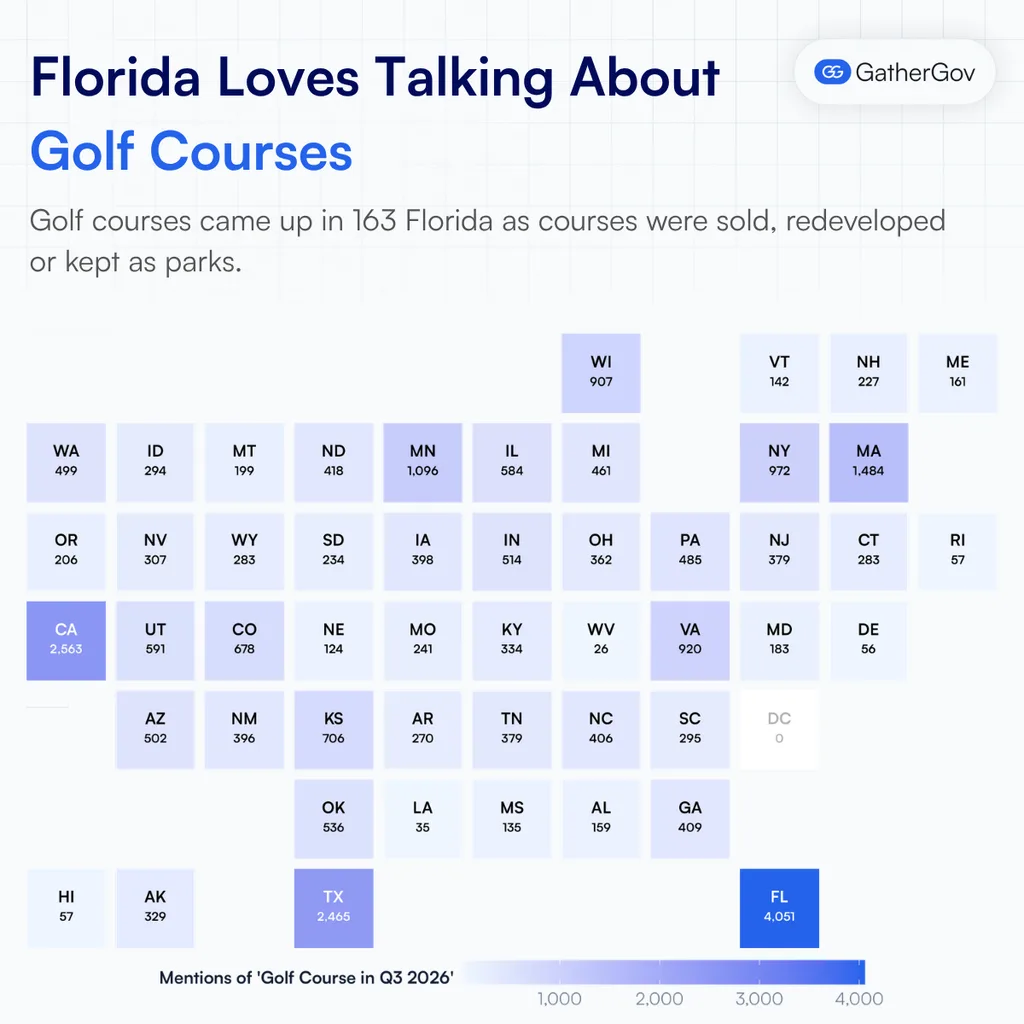
Golf courses are a bigger local agenda item than most people assume. “Golf course” came up 31,064 times across 9,322 meetings in 2,805 jurisdictions and all 50 states, more meetings than any other term in the analysis.
Florida leads with 4,774 mentions across 163 jurisdictions and 875 meetings. California follows with 2,803 mentions, then Texas at 2,753, Massachusetts at 1,552 and Minnesota at 1,192.
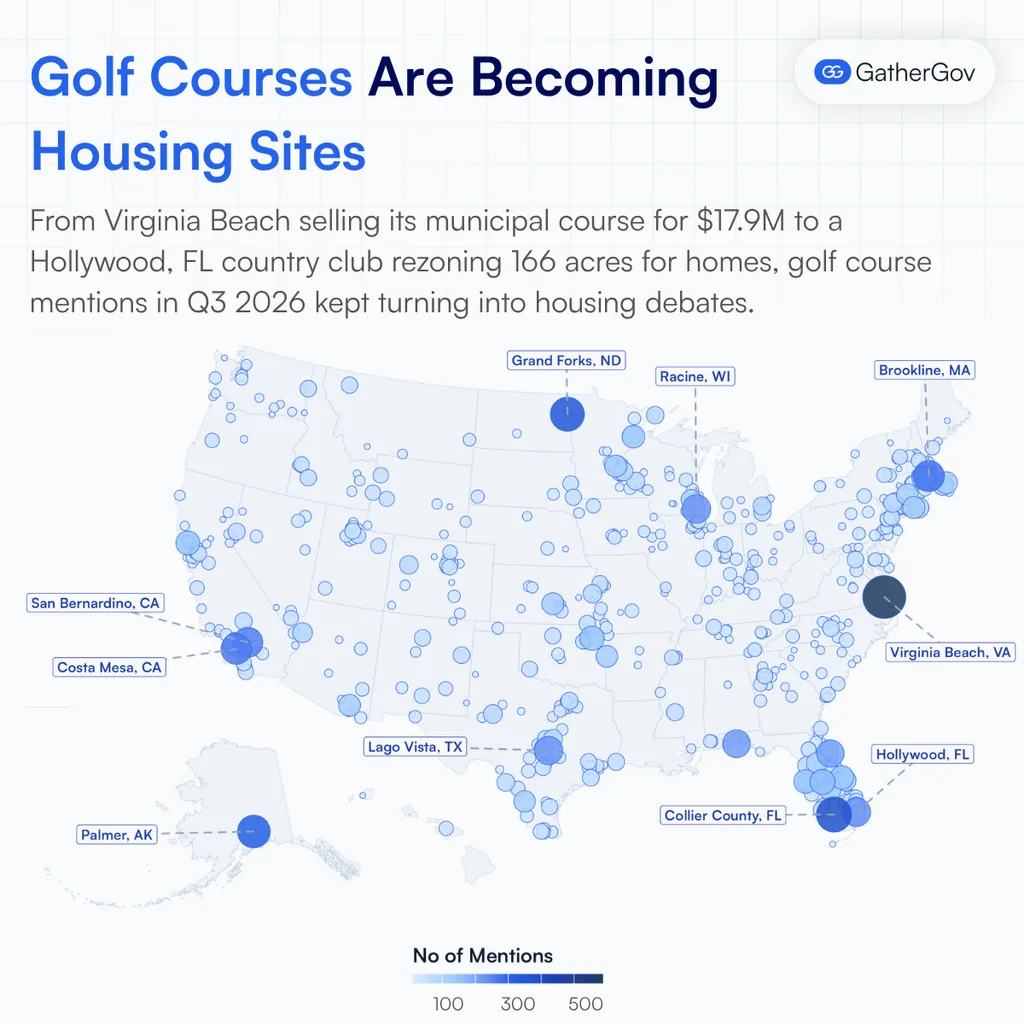
The hotspots are mostly single courses: Virginia Beach, Va. (717 mentions), Collier County, Fla. (523), Grand Forks, N.D. (478), Palmer, Alaska (312) and San Bernardino, Calif. (295).
Parks Business, Money and Housing
Most of the volume is routine. Parks, open space, conservation and trails language appears in 51% of meetings, spanning 1,740 jurisdictions.
Course finances, including revenue, deficits, subsidies and fees, appear in 34% of meetings, and subsidy, deficit or general-fund language shows up in 440 jurisdictions.
Housing language appears in 27% of meetings. Pairing housing with redevelopment, rezoning or sale language narrows to 369 jurisdictions and 584 meetings, led by Florida (44 jurisdictions), Texas (31) and Minnesota (23).
Virginia Beach Sells to a Homebuilder
Virginia Beach National is the biggest example in the data. The city built it in 1999 with $3.5M in public money and bought it outright in 2006, bringing total public investment to about $8M.
After a 2023 condition report and rising capital costs, the city issued an RFP in September 2025 and received nine responses, four with a housing component. The council voted 9-2, the supermajority required to sell city land, to sell to Dragas Companies, with the $17.9M to be reinvested in the course.
The plan includes 659 for-sale homes, including price-targeted units, plus a child care facility and a reconfigured course. A conservation group’s federal lawsuit is pending, and the housing still needs rezoning.
The arithmetic drove the vote. Development Authority staff said the course has generated about $220,000 a year in taxes and operating payments over 19 years, or roughly $4.4M, leaving the initial investment unrecouped.
Private Clubs Turn to Planned Development
In Hollywood, Fla., the 166-acre Emerald Hills Golf Course sought a rezoning from Country Club to Planned Development. First Eagle LLC and PPG Development propose single-family, multifamily and townhomes on eight sites, plus a clubhouse and 40 lodging units.
Neighbors’ objections focused less on golf than on what the course does for them now, with residents raising flooding concerns. Flooding and stormwater language appears in 14% of golf course meetings overall.
In Oregon, Wis., the owner of Foxboro Golf Course, who bought it in 2022, proposes shrinking it to 10 holes, building single- and two-family homes on the southern phases and selling the rest to its operator. A standing-room-only crowd was mostly opposed.
Why It Matters
For cities, selling a course can turn a subsidized amenity into cash and homes. For homebuilders, it can mean a large parcel in an already built-out neighborhood. But approvals remain local and contested. Resident concern language appears in 30% of meetings, and each deal turns on rezoning, stormwater and conservation questions rather than national trends, much like the local buy-in debates elsewhere.
Conservation can also cut the other way. In Collier County, Fla., commissioners heard two days of testimony in September on a proposed private course with cabins inside a rural conservation area. Residents noted the county already has about 90 courses, only seven of them public, and that 76.5% of voters backed Conservation Collier in 2020.
Municipal Courses Look to Pay Their Own Way
Fort Walton Beach, Fla., shows another path. A 2020 consultant study flagged the city course and the cemetery as non-core services, but the council now faces a $440,000 equipment request and a plan to move golf into a special revenue fund this October, a restricted fund in 2027 and a full enterprise fund in 2028.
City Manager Jason Davis noted the study relied on six-year-old data and cited a dramatically improved financial picture.
What’s Next
Watch the Virginia Beach rezoning and the pending federal lawsuit, plus the Collier County decision on the Sabal Palm petitions. Local rulemaking like this also shapes other land uses, as with data center moratoriums, so course-by-course outcomes could set precedent for how cities treat large green-space parcels.