






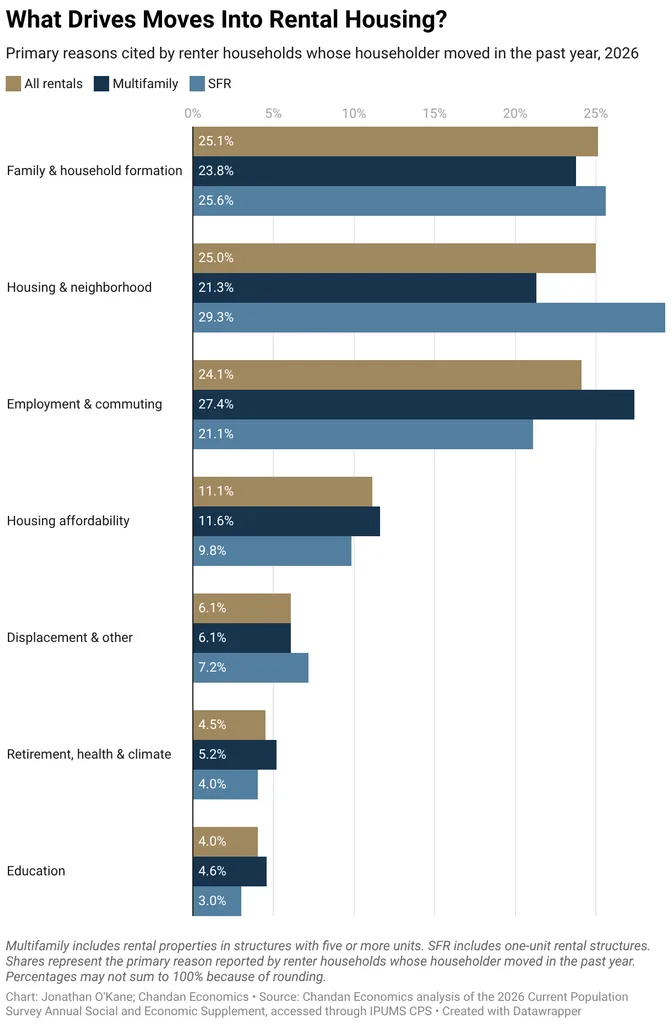
- Family and household formation drove 25.1% of rental moves, housing and neighborhood reasons 25.0% and employment and commuting 24.1%, per Chandan Economics’ analysis of 2026 Census survey data.
- Multifamily movers cite jobs most often at 27.4%, while single-family rental movers lead with housing and neighborhood reasons at 29.3%, versus 21.3% for multifamily.
- Cheaper housing is a motive for only 11.1% of renter moves overall, suggesting affordability alone does not explain demand for apartments or single-family rentals.
Roughly equal shares of households move into rentals for family, housing and job reasons, according to a Chandan Economics analysis of the 2026 Current Population Survey. Family and household formation accounted for 25.1% of moves, housing and neighborhood factors for 25.0% and employment and commuting for 24.1%.
The study covered cash-renting households whose householder lived at a different address a year earlier.
Get Smarter about what matters in CRE
Stay ahead of trends in commercial real estate with CRE Daily – the free newsletter delivering everything you need to start your day in just 5-minutes
Inside the Family Category
Within family and household formation, setting up an independent household led at 9.8%. Other family reasons made up 6.7%, changes in marital status 4.4% and moves tied to unmarried partners 4.2%.
Multifamily vs. Single-Family Rental
Property type changes the story. Employment and commuting is the top driver for multifamily movers at 27.4%, compared with 21.1% for single-family rental movers.
Single-family renters flip that order, with housing and neighborhood reasons at 29.3% versus 21.3% for multifamily.
Affordability Is Not the Main Story
Seeking cheaper housing accounted for 11.1% of all moves, at 11.6% for multifamily and 9.8% for single-family rentals. Price matters, but far less than life events, location and work.
Why It Matters
For operators, the split affects how to market and where to build. Multifamily demand tracks job centers and commute access, while single-family rental demand leans on neighborhood and home features such as space.
The findings also add context to recent CRE Daily coverage of how renter affordability is shifting across metros.
What’s Next
Chandan Economics’ broader multifamily research also tracks rent growth and on-time payments, including a read on mom-and-pop on-time rent. Watch whether job growth in major metros keeps multifamily move-ins steady as rental choices diversify.