





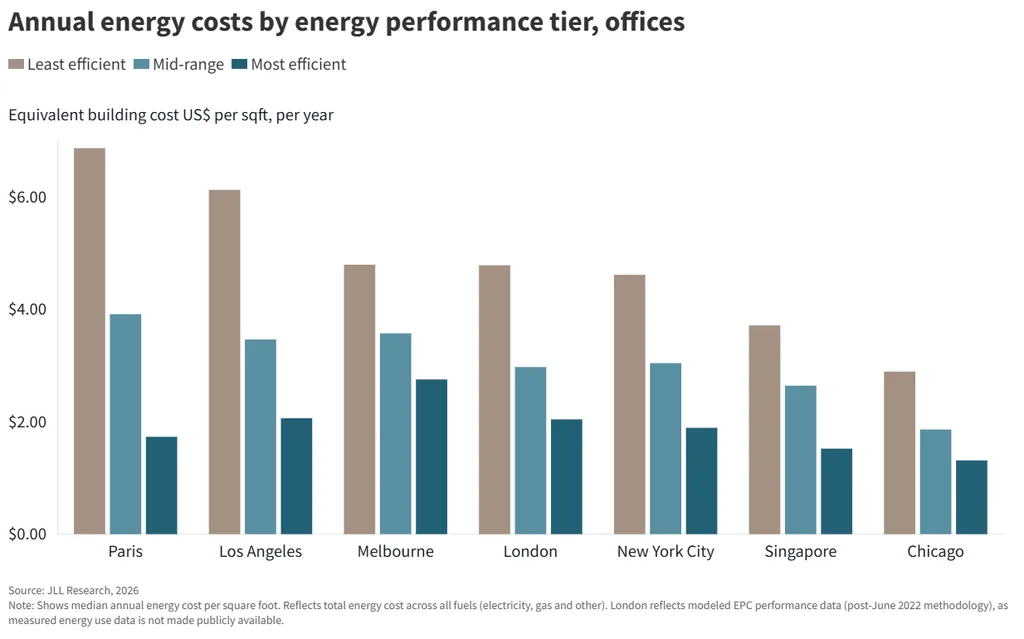
- JLL found the most efficient offices cost 43% to 75% less to run annually than the least efficient peers.
- Commercial electricity prices rose 11% to 91% more than local inflation across six markets from 2020 through 2024.
- CRE teams rank energy-efficiency preparedness seventh of eight priorities even as executives rank its impact fourth.
JLL says rising power costs and tighter building-performance rules are changing building economics. Its research on the energy efficiency premium measures the operating gap across major markets. JLL studied 4,437 offices across seven global markets. The most efficient buildings cost 43% to 75% less to run than the least efficient local peers. The annual gap equals $1.58 to $5.13 PSF.
Get Smarter about what matters in CRE
Stay ahead of trends in commercial real estate with CRE Daily – the free newsletter delivering everything you need to start your day in just 5-minutes
The Details
Electricity costs have become a larger operating variable for owners and occupiers. JLL found commercial electricity prices rose 11% to 91% more than local inflation across six markets between 2020 and 2024. That reverses the 2016 to 2019 pattern, when real electricity costs ranged from 14% below inflation to only 13% above it.
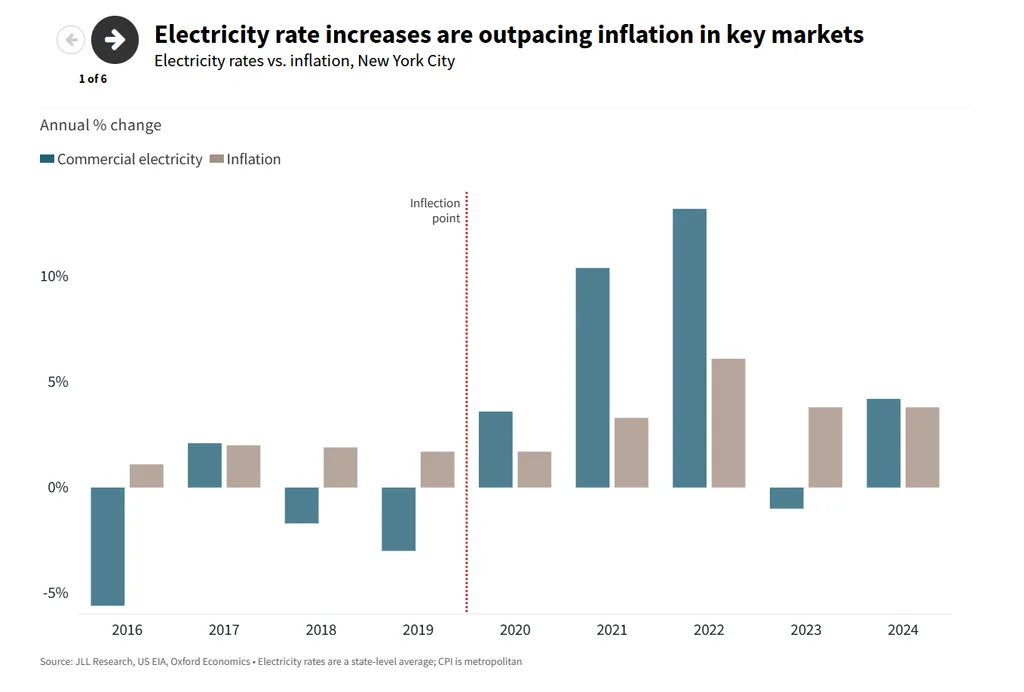
JLL client data showed electricity costs rising 37% to 45% in the UK and Australia from 2021 to 2026. Inflation was roughly 26% over the same period. The widening spread increases the financial value of better-performing buildings and shortens the payback period for operational improvements.
JLL framed efficiency as both an operating-cost tool and a resilience measure. JLL said buildings account for roughly 30% of final energy consumption. They also produce about 37% of global carbon dioxide emissions. Lower consumption can therefore reduce bills while also easing demand on increasingly constrained grids.
Performance Rules Tighten
Governments are also moving from disclosure toward enforceable building performance. JLL tracks 75 major cities in its City Climate & Resilience Policy Tracker and found 41% reference enforceable building-performance standards. JLL said only about 20% of covered New York City properties currently meet the 2030 to 2034 limits.
The EU is following a similar performance-based approach. JLL said the revised EU directive targets the worst-performing nonresidential buildings. It requires renovation of 16% by 2030 and 26% by 2033. JLL said 85% of EU buildings were constructed before 2000. About 75% of those buildings perform poorly.
Readiness Gap Persists
The operational opportunity remains large. A prior JLL study of 46,600 buildings across 14 markets found about 66% performed poorly against leading standards. JLL found Los Angeles savings rose from $2.78 PSF in 2019 to $4.06 PSF in 2024. That increased the value of efficiency by 46%. New York’s comparable savings rose 19% to $2.69 PSF.
Yet JLL’s 2026 Future of Work survey found a gap between executive concern and CRE preparedness. JLL surveyed more than 2,200 executives and CRE leaders across 21 countries. They ranked energy efficiency fourth among the most transformative portfolio scenarios. CRE teams ranked their preparedness seventh out of eight.
Why It Matters
Energy efficiency standards are increasingly becoming enforceable operating requirements rather than optional sustainability targets. For owners, that turns underperformance into a financial, regulatory and operational issue at the same time. For occupiers, power cost and reliability are becoming more important in site selection and lease decisions.
JLL also highlighted low-cost operating changes that can produce material savings. One LaSalle office reduced energy-use intensity by 27% through HVAC temperature and schedule optimization, saving about $100,000 annually without capital investment. A London office portfolio using JLL’s Smart Building Platform cut electricity use 31% within five months.
What’s Next
JLL recommends that owners prioritize operational improvements before major capital projects and treat power access, intensity and sources as standard diligence items. The firm also sees more value in buildings that can shift or generate power after basic efficiency improvements are in place.
The economics can also compare favorably with new supply. JLL cited International Energy Agency findings that saving 1 TWh through efficiency in major emerging economies costs $10M to $50M. Building equivalent generation and grid infrastructure costs $30M to $110M, according to the same findings.
The broader backdrop is rising electricity demand and grid investment. JLL cited an International Energy Agency projection for global electricity demand to increase at least 40% by 2035. As power becomes more constrained, efficient buildings can reduce operating costs while also easing pressure on energy infrastructure.