



- Rental concessions appeared on 43.5% of listings across the 50 largest US metros in August, up from 40.4% a year earlier.
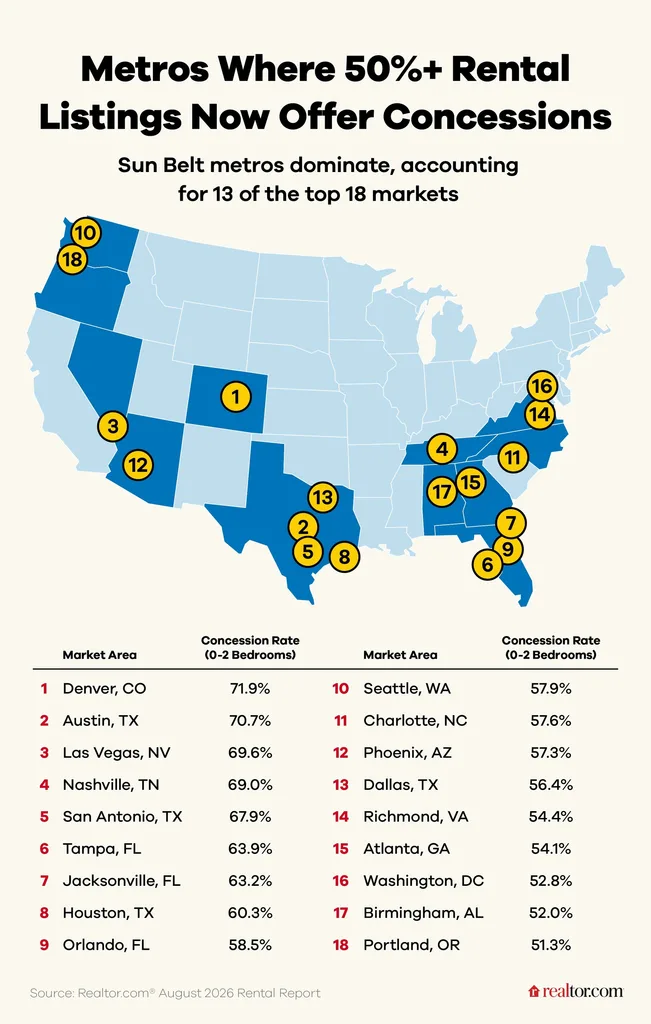
- Denver led at 71.9%, followed by Austin, Las Vegas, Nashville, and San Antonio, all markets with heavy rental supply.
- Owners are using free rent, fee waivers, and other perks to protect occupancy, while security-deposit waivers remain uncommon.
Apartment owners are offering more incentives as new supply and vacancies increase competition for renters. Realtor.com says 43.5% of listings across the 50 largest US metros carried some form of concession in August. That was up from 40.4% a year earlier. Meanwhile, the median asking rent was $1,699, or $65 below its summer 2022 peak.
Get Smarter about what matters in CRE
Stay ahead of trends in commercial real estate with CRE Daily – the free newsletter delivering everything you need to start your day in just 5-minutes
Rental Concessions Shift Leverage to Renters
The highest concession rates are concentrated in well-supplied Western and Southern markets. Denver led the country at 71.9%, followed by Austin at 70.7%. Las Vegas reached 69.6%, Nashville hit 69%, and San Antonio came in at 67.9%. In each case, owners are competing with a large pool of available units.
Realtor.com senior economist Jiayi Xu said softer asking rents and rising concessions give renters more negotiating power. Brokers in Denver and Nashville pointed to construction as a major source of that pressure. Nashville also has single-family homes entering the rental pool after owners failed to sell at desired prices.
Nashville brokers described a similar buildup. New apartments have opened while some unsold single-family homes have shifted into rentals. One local property manager said the current concession pressure reflects unusually high inventory rather than only the normal seasonal slowdown.
The Details
An Avail survey of independent landlords found more than 67% felt market pressure to offer discounts. Among owners facing a possible vacancy, one-third offered concessions and more than one-quarter considered them. Reduced or waived fees were the most common choice at nearly 38%. Upgraded amenities followed at 30.7%, while 25% offered a period of free rent.
Some offers are becoming unusually aggressive. A Nashville property manager said certain apartments have advertised up to four months of free rent. In Denver, one management company offered one free month for every year of lease commitment. By contrast, smaller landlords often use rent discounts because they cannot absorb several free months.
Free rent is especially visible in Nashville, where some apartments have advertised up to four months at no charge. Avail found 6.4% of landlords that offered or considered concessions used gift cards or moving assistance, making those incentives much less common.
Security Deposits Remain a Line Owners Resist Crossing
Landlords appear less willing to waive security deposits. Brokers interviewed by Realtor.com said deposits remain a key protection against damage or nonpayment. That risk makes deposit waivers less attractive than rent credits, fee reductions, or amenity upgrades.
Concessions are also lasting longer in some communities. Realtor.com found more than 5% of institutionally managed rental communities offered perks continuously during the past 12 months. Phoenix had the highest share of communities with yearlong concessions at 14.9%, followed by Austin at 13.8% and Denver at 13%.
Avail’s survey also suggests incentives are not always purely cyclical. Nearly one-third of respondents who offered concessions said they did so regardless of market conditions. That supports the idea that some owners now treat perks as a standing leasing tool.
Why It Matters
The national pattern shows how quickly supply can change apartment pricing power. Concessions increased year over year in 39 of the 50 largest metros. The shift also matches broader rental concession trends in markets where new inventory has intensified competition.
Realtor.com’s interviews show why owners accept those costs. Landlords would rather offer a discount than absorb the longer-term loss from an empty unit. That tradeoff becomes more common when similar properties compete for the same renters.
What’s Next
Conditions are already diverging by market. Concession rates fell in 11 of the 50 largest metros. San Jose and San Francisco posted the steepest declines, while median rents in both markets rose more than 4% from a year earlier. In oversupplied metros, owners will keep watching vacancies and new deliveries to determine how long aggressive incentives remain necessary. Realtor.com attributed the Bay Area pullback partly to stronger rent growth associated with the AI job boom.