



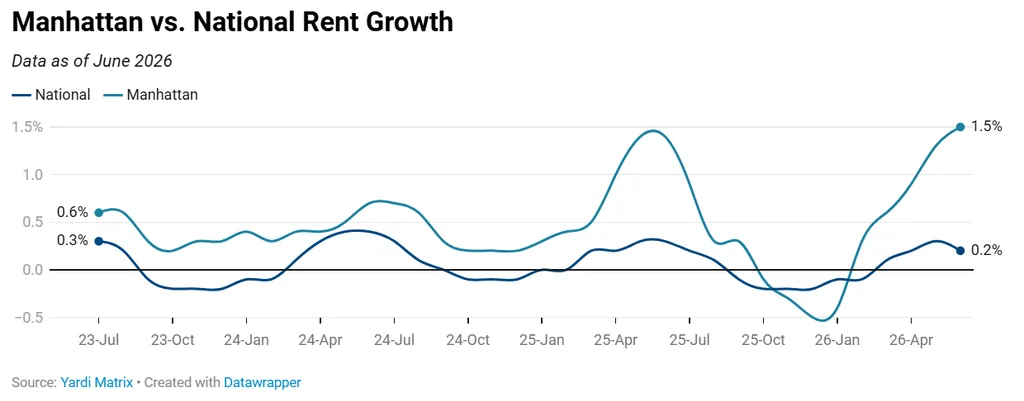
- Manhattan multifamily rents rose 5.6% year over year through June, the fastest pace among major U.S. markets, pushing trailing three-month growth to 1.5%.
- Investment sales totaled $582 million in the first half of 2026, dominated by renter-by-necessity deals, while the average per-unit price fell to $270,864 from $413,342 a year earlier.
- A bifurcated job market, with steady gains offset by losses in leisure, hospitality and manufacturing, and 5.3% unemployment point to uneven demand drivers ahead.
Manhattan’s multifamily rents climbed 5.6% year over year through June, the fastest pace among major U.S. markets, according to a Yardi Matrix report published by Multi-Housing News. Trailing three-month rent growth reached 1.5% as of June, 130 basis points above the national rate, as limited new construction collided with some of the highest occupancy levels in the country. Should current conditions hold, Yardi Matrix expects Manhattan asking rents to close out 2026 up 3.1%.
Get Smarter About What Matters in New York
Subscribe to our free newsletter covering the biggest commercial real estate stories across the five boroughs — delivered in just 5 minutes.
A Tale of Two Job Markets
The rent growth comes against a mixed employment backdrop. NYC’s core sectors posted gains through June, but leisure and hospitality and manufacturing together shed 10,900 positions, pushing citywide unemployment to 5.3%, per preliminary Bureau of Labor Statistics data, 70 basis points above the New York State rate. That split matters for multifamily demand: renter households tied to higher-wage sectors are still forming and competing for units even as lower-wage job losses weigh on the broader labor market. Major infrastructure spending, including the Hudson Tunnel Project and the Port Authority’s $45 billion capital improvement plan, is expected to keep supporting job growth in key sectors over the long term, which Yardi Matrix flags as a structural tailwind for rental demand well beyond this cycle.
The Details
Manhattan investment sales totaled $582 million in the first half of the year, with renter-by-necessity properties dominating activity. The borough logged more single-asset multifamily sales through the first half of 2026 than in all of 2025 combined, Yardi Matrix found. But pricing told a different story: the average per-unit sale price fell to $270,864, down from $413,342 a year earlier, a decline of roughly 35%. That divergence between rising rents and falling per-unit values suggests deal volume was driven less by trophy-asset trades and more by smaller, workforce-housing buildings changing hands at more modest valuations.
Zooming Out
Manhattan’s outperformance builds on a trend CRE Daily has flagged before, as the borough has repeatedly led the nation in rent growth alongside occupancy rates that rank among the tightest in the country. That’s a sharp contrast to Sun Belt metros, where new supply has cooled rent growth over the past two years. New York’s limited construction pipeline and high barriers to entry continue to insulate it from the oversupply dynamics playing out elsewhere, a structural advantage that has held up across multiple economic cycles and continues to draw capital even when other gateway markets cool off.
Why It Matters
For investors, the combination of strong rent growth and falling sale prices is a signal, not a contradiction: in-place income keeps climbing even as acquisition costs fall, an increasingly rare pairing as Sun Belt markets contend with oversupply pressures of their own. The dominance of renter-by-necessity deals suggests investors are prioritizing stable, workforce-level housing over higher-risk luxury product, a defensive posture that lines up with a bifurcated local job market and elevated financing costs. For owners already holding Manhattan multifamily assets, the widening gap between rent growth and sale pricing effectively raises the bar for anyone looking to sell, since buyers can now point to falling comparable values even as the underlying cash flow keeps improving.
What’s Next
With major infrastructure investment underway and multifamily construction still constrained, Yardi Matrix’s own forecast points to continued, if more moderate, rent growth through year-end, with full-year 2026 asking rents projected to finish up 3.1%. Watch whether the pricing gap between rent growth and per-unit sale values narrows as more investors return to the market, or whether renter-by-necessity assets continue to absorb the bulk of deal volume. The direction of the local job market, particularly whether leisure, hospitality and manufacturing losses stabilize, will also shape how much further occupancy and rents can climb from already-elevated levels.