






- Manhattan asking rents climbed 5.6% year-over-year to $5,651 per month in June, the strongest growth among major U.S. multifamily markets, with occupancy above 98%.
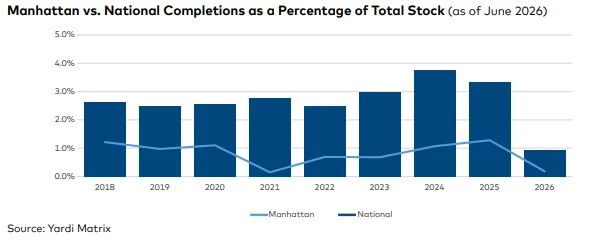
- New deliveries made up just 0.2% of Manhattan’s multifamily inventory in the first half of 2026, far below the 0.9% national average, even with 18,805 units under construction.
- Manhattan investment sales jumped to $582 million in the first half even as price per unit fell 35%, as buyers pivoted toward lower-cost, rent-stabilized assets.
New York City’s multifamily market keeps tightening, with Manhattan posting the strongest rent growth of any major U.S. market even as occupancy holds above 98%, according to GlobeSt. A new Yardi Matrix report found asking rents climbed to $5,651 per month in June, underscoring how limited new supply keeps landlords in control.
The data points to a market where demand keeps absorbing whatever comes online, leaving little room for renters to find relief and giving landlords continued leverage heading into lease renewal season.
Get Smarter About What Matters in New York
Subscribe to our free newsletter covering the biggest commercial real estate stories across the five boroughs — delivered in just 5 minutes.
Years in the Making
New York’s rent growth streak comes from a long-running supply shortage. The problem began well before this year’s report. Just 0.2% of Manhattan’s multifamily inventory delivered new units in the first half of 2026. The national average was 0.9%, according to Yardi Matrix.
Still, 18,805 multifamily units remain under construction across the borough. The Financial District leads all submarkets with 7,828 units underway. This shows that supply remains years away from catching up with demand.
The construction pipeline has grown for years. However, higher costs and tighter financing have slowed new deliveries. As a result, supply has not increased enough to put meaningful pressure on rents.
The Details
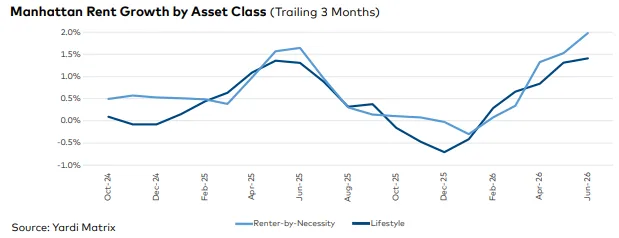
Rents rose 5.6% year-over-year in June to $5,651 per month. That was the strongest growth and highest asking rent among major multifamily markets nationally, according to Yardi Matrix.
Trailing three-month rent growth reached 1.5%. Only four of the city’s 19 submarkets posted rent declines. Occupancy at stabilized properties fell 20 basis points year-over-year but remained high at 98.2%.
“Demand is strong across the metro, and limited deliveries have done little to make a dent in the overarching trend,” Yardi Matrix said.
Another 44,000 multifamily units remain in Manhattan’s prospective and planning stages. That pipeline could eventually ease rent pressure. However, typical entitlement and construction timelines can take several years.
Zooming Out
The tight market is also changing investment activity. Manhattan multifamily transactions increased by $400 million year-over-year in the first half. Total volume reached $582 million.
At the same time, the average price per unit fell 35% to $270,864. Investors have shifted toward lower-cost, rent-stabilized properties. In fact, 16 of the 20 tracked trades involved rent-stabilized assets.
That trend extends CRE Daily’s previous coverage of Manhattan multifamily performance.
The largest deals included Naftali Group’s $810 million purchase of 800 Fifth Avenue. The 208-unit property was one of the biggest trades. Summit Properties also paid $451.3 million for a rent-stabilized portfolio. Pinnacle Group had taken the portfolio into bankruptcy the previous year.
Together, the deals show a split in the market. Investors are targeting trophy free-market assets on one side. Others are buying distressed rent-stabilized portfolios at deep discounts to replacement cost.
Why It Matters
Rent growth continues despite a weaker local labor market. Yardi Matrix put the metro’s unemployment rate at 5.3%. That compares with a 4.6% average for the state.
The leisure and hospitality sector lost 9,000 jobs over the past year. Manufacturing also cut 1,900 positions. This gap between strong rents and weaker employment could test landlords’ pricing power if hiring continues to slow.
The supply shortage also comes as rent freeze proposals create new risks for lenders. Those measures could make underwriting harder for rent-stabilized buildings.
For free-market landlords, however, the data offers some support. Pricing power has held up despite years of affordability concerns from tenant advocates and elected officials.
What’s Next
Yardi Matrix expects Manhattan asking rents to finish 2026 up 3.1% if current conditions continue.
The borough has 44,000 units in the planning pipeline. Construction is also concentrated in the Financial District. Watch to see whether that supply starts catching up with demand in 2027.
If supply remains tight, rents could keep rising. However, the metro’s labor market remains a key risk. A deeper slowdown in hiring could eventually weaken rental demand even if new supply stays limited.