







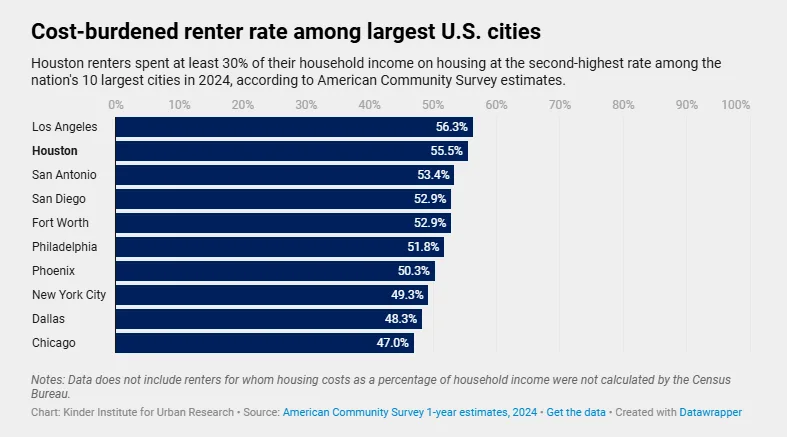
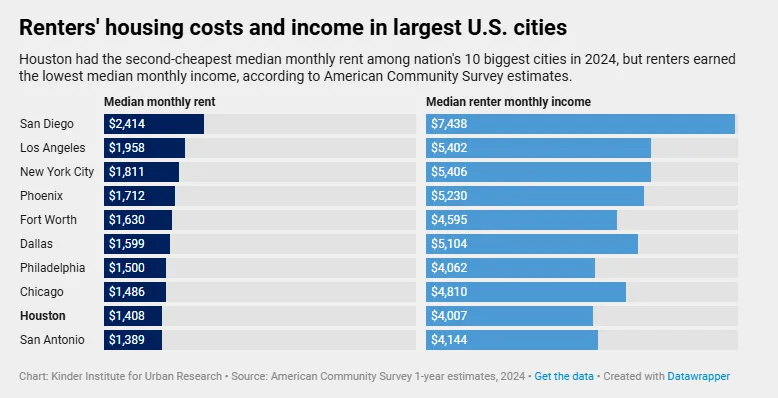
- Houston’s median rent of about $1,400 a month ranks as the second-lowest among the 10 largest U.S. cities, yet affordability keeps eroding for renters.
- The share of cost-burdened Houston renters jumped from 50.9% in 2022 to 55.5% in 2024, even as roughly 90,000 more households shifted from owning to renting.
- Without rent control or robust housing subsidies, Houston’s low-wage job base leaves renters more exposed than peers in cities with higher rents but stronger income growth.
Houston rents remain among the lowest of the nation’s 10 largest cities at roughly $1,400 a month, but that low price tag is masking a deepening affordability crisis, according to a Kinder Institute analysis. More than 55% of the city’s renters, or roughly 293,000 households, are now cost-burdened, spending over 30% of their income on housing, the second-highest rate among the 10 largest U.S. cities. That share has climbed steadily since 2022, even as thousands of Houston households shift from owning into renting.
Get Smarter about what matters in CRE
Stay ahead of trends in commercial real estate with CRE Daily – the free newsletter delivering everything you need to start your day in just 5-minutes
A Widening Gap
Houston has long marketed itself as an affordable alternative to pricier coastal metros, but the Kinder Institute for Urban Research found the city’s renters earn the least of any major market, with a median household income of about $48,100, more than $10,000 below renters in comparable cities. Unlike New York and Los Angeles, Houston has no rent control policies to slow displacement, and the city has historically directed less public money toward housing than peers like Chicago and Philadelphia. Those gaps compound in a metro where low-wage sectors such as construction, food service and transportation make up a disproportionate share of the job base, leaving many households with little cushion when rents or costs of living tick upward.
Researchers say the disconnect between headline affordability and lived affordability is part of what makes Houston’s numbers deceptive to outsiders comparing median rents across cities. A renter paying $1,400 a month in Houston can still be more financially strained than a renter paying twice that in a higher-wage market, simply because incomes haven’t kept pace.
The Details
The cost-burdened share of Houston renters rose from 50.9% in 2022 to 51.2% in 2023, then jumped to 55.5% in 2024, according to the Kinder Institute’s review of the latest Census data. Houston’s renter population grew by roughly 90,000 people, a 7.5% increase, in 2024 alone, while the city’s homeowner population fell by about 13,500, a 1.2% decline. Median renter income dropped 3.8%, or roughly $2,600, over that same year, even as the citywide median two-bedroom rent rose $26 a month, a 1.8% increase. Black homeownership in the city fell 15.6% over the period, one of the steepest declines tracked in the report.
The data suggests the shift from owning to renting isn’t simply a lifestyle preference but is being driven, at least in part, by affordability pressure pushing households out of homeownership. That dynamic adds new renter demand to a market already struggling to keep housing costs aligned with what a large share of its workforce actually earns.
Zooming Out
The pattern echoes broader affordability concerns playing out nationally, even as apartment rent growth has cooled across many Sun Belt markets that added heavy new supply in recent years. Houston’s reliance on low-wage employment leaves many renters exposed to cost burdens that falling or flat rents alone can’t offset, particularly with the federal minimum wage still fixed at $7.25 an hour, well below the $15-plus floor in five of the nation’s 10 largest cities.
Why It Matters
Michelle Smirnova, director of Rice’s Center for Housing and Neighborhoods, said Houston’s overall economic growth obscures how poorly the city serves its lowest earners, calling the disconnect a core blind spot in how the metro measures its own success. The divide also shows up in state-level renter rankings, where Texas suburbs increasingly outperform the state’s largest cities on affordability metrics that investors and lenders track when underwriting new multifamily supply.
For multifamily owners and developers, the data is a signal that rent growth alone won’t fix Houston’s affordability optics, and that projects targeting workforce-level incomes could see steadier demand than those chasing top-of-market rents in a metro where wage growth is lagging.
What’s Next
Nicole Cassier of the Houston nonprofit Avenue said the city can’t build its way out of the affordability problem while simultaneously losing existing affordable units to renovation and rent hikes, framing preservation as the next battleground alongside new construction. Housing advocates are expected to push for expanded subsidies and preservation funding as the 2024 income and cost-burden data feeds into upcoming municipal budget debates and future Census releases test whether the trend keeps worsening.
Watch for renewed calls at the city and county level for targeted rental assistance and preservation financing, particularly if the cost-burdened share climbs further in the next annual data release.