








- US hotel RevPAR posted its 18th straight weekly increase, with a 7.2% jump for the week of Aug. 2–8, per STR.
- Philadelphia and Chicago led top markets, posting RevPAR gains of 27.4% and 23.8%, respectively, on robust group demand.
- Broader market strength signals ongoing resilience but hints at a seasonal softening ahead as summer closes out.
US Hotel Recovery Maintains Momentum
The US hotel market’s climb continued for a record 18 weeks as revenue per available room (RevPAR) advanced 7.2% for the week ending August 8, according to CoStar and STR. Market leaders like Philadelphia and Chicago posted double-digit gains, largely from a surge in group bookings. Average daily rate (ADR) was a major factor, rising 4.1%—outpacing recent periods, including the World Cup bump. Even as overall hotel occupancy edged down to 70% from its summer peak of 72.4%, demand reached some of the highest weekly totals recorded in the past six years.
This run follows a strong seasonal peak, with occupancy hitting 73.6% during the same week in July 2024. Notably, both the top 25 US hotel markets and several secondary destinations outperformed, with 51 markets outside the major metros seeing weekly RevPAR spikes of 10% or more. As the World Cup effect fades, both group and transient segments continue to drive gains.
Get Smarter about what matters in CRE
Stay ahead of trends in commercial real estate with CRE Daily – the free newsletter delivering everything you need to start your day in just 5-minutes
The Details
STR and CoStar report that during the week of Aug. 2–8, Philadelphia saw RevPAR increase 27.4%, driven mainly by a resurgence in group demand. Chicago trailed closely, posting a 23.8% gain. Other leading markets included Boston, Las Vegas, Minneapolis, New York, San Diego, and Washington, D.C., each with notable double-digit increases, often on the back of group business. Miami, Nashville, New Orleans, and Seattle were the few among the top 25 to report declines. Outside the largest metros, secondary markets such as Texas North, Texas Panhandle, and Macon/Warner Robins, GA posted RevPAR gains exceeding 30%—a five-week high for regional performance.
Group demand across luxury and upper-upscale hotels grew 5.7%—though considerably less than the 12% seen the week prior—with transient bookings accounting for roughly 60% of demand growth. Meanwhile, nearly every hotel class saw occupancy, ADR, and RevPAR climb for the second consecutive week. ADR growth played an outsized role, as group ADR rose 3.7%, and transient ADR grew 6.8%.
Regional and Market Segmentation Fuel Gains
The recent RevPAR rally is tracking ahead of increases observed during July’s World Cup and the preceding weeks, per STR’s analytics. This momentum extends earlier hotel strength, when weekend demand helped lift RevPAR despite uneven weekday performance. In World Cup host markets, RevPAR rose 9.4% over two weeks, down from the 15.5% surge during the games. However, non-host markets accelerated, with recent fortnightly RevPAR growth of 6.7%, outperforming prior growth rates. Multifaceted demand, especially from transient travel, is evident: transient bookings accounted for most new demand, even as group business remained solid.
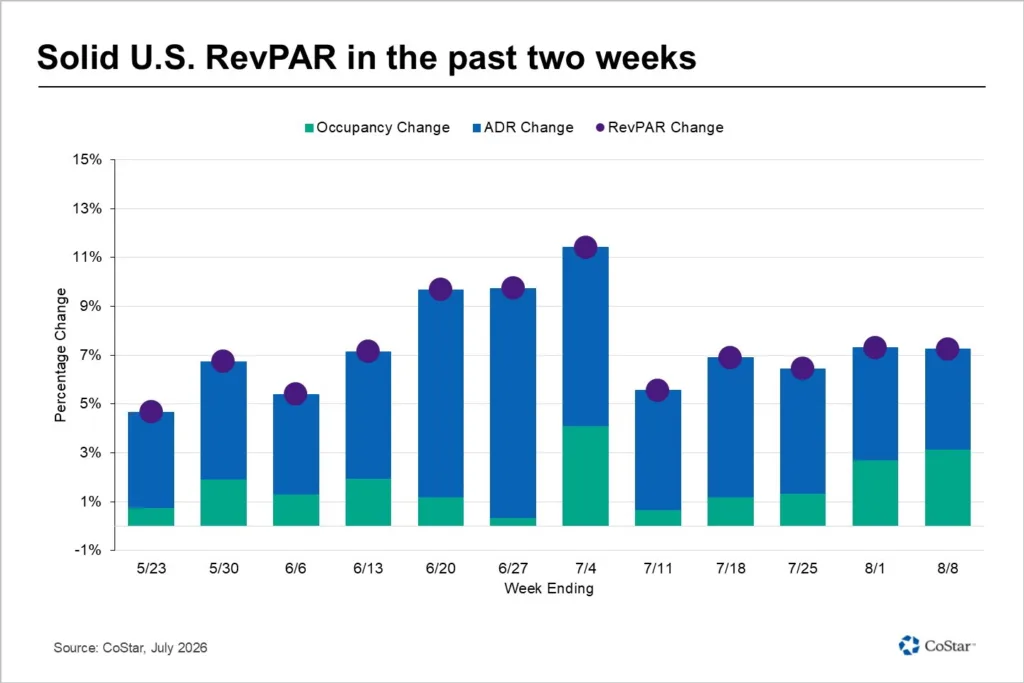
Performance was not limited to large metros or luxury product. The upscale and upper-midscale segments, which saw more than 4% growth in room demand, made up a majority of this week’s demand gains. Still, luxury (up 10.9%) and upper-upscale (up 7.9%) segments captured over half of RevPAR improvements. Weekend performance slightly outpaced weekdays—up 7.7% vs. 7%—marking the first instance in seven weeks when weekend metrics outperformed weekdays on all major counts.
Why It Matters
The 18-week streak of RevPAR growth underscores the resilience of the US hotel sector even as industry watchers anticipated a steeper seasonal drop-off. According to STR, demand over the last three weeks hit individual weekly highs not seen in six years, despite a post-peak slip in occupancy. This is notable as ADR, rather than pure occupancy gains, is providing much of the momentum. Hotels are not just luring more guests—they are commanding and holding higher rates, a signal that pricing power is still strong well into late summer.
Segment-level trends reveal that while luxury and upper-upscale hotels continue to drive revenue performance (accounting for 52% of total RevPAR gains), the broad-based demand surge in upscale and upper-midscale properties is critical. These segments provided nearly 60% of total demand growth. Group business remains robust in gateway cities, but pure leisure and transient traffic now constitute the lion’s share. For markets outside the top 25—many of them secondary or tertiary—double-digit revenue growth is yet another indicator that travel trends are spreading beyond primary urban cores.
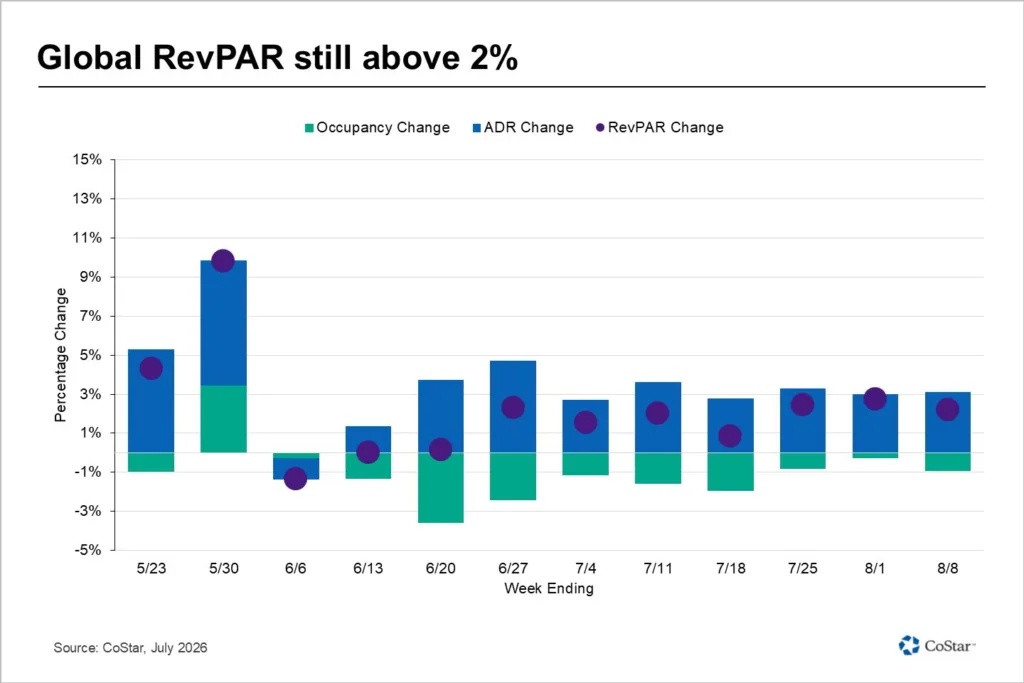
Globally, hotel performance is more mixed. While India and Canada saw strong double-digit RevPAR growth, other regions like the Gulf Cooperation Council (GCC) and Mexico reported notable declines (down 16.8% and 13.4% respectively). This divergence reinforces the US market’s current outperformance and the varying pace of recovery in international hospitality.
What’s Next
STR projections indicate further cooling as the summer travel season closes, with both ADR and demand likely to soften in the next two weeks. Still, summer-to-date US hotel RevPAR is up 7.4%, the best showing since 2022 and notably above the 5.5% pre-World Cup trend. As business travel enters a seasonal lull and consumers return to fall routines, market watchers will be focused on whether transient demand can sustain the gains achieved this summer or if lower seasonal occupancy will curb further growth. Secondary and regional markets are expected to continue outperforming national averages as group and leisure demand remains geographically dispersed.