





- Multi-tenant light industrial assets led the US industrial market in Q2 2026, with leasing velocity exceeding any quarter in the past three years.
- Net absorption surpassed new deliveries for the first time since 2022, and small-bay assets now command a 36% pricing premium over larger properties.
- Investor demand is fueling robust transaction activity, even as new construction remains historically constrained for small-bay assets.
Normalization Resets Demand Drivers
US industrial fundamentals have recalibrated in 2026 after several years of rapid expansion, according to BKM Capital Partners’ August market update. Geopolitical uncertainty and shifting economic conditions have prolonged occupier decisions. As a result, companies increasingly prioritize operational resilience and supply chain efficiency. While uncertainty remains, more tenants must address expiring leases. They now prioritize space supporting resilience rather than pure cost efficiency.
Leasing velocity validates this shift. Per JLL, companies signed 175M SF of new industrial leases during Q2 2026. That marked the strongest quarterly figure in more than three years. Leasing volume also jumped 49% from Q2 2025. The rebound shows companies can no longer defer commitments. Consequently, industrial fundamentals continue moving toward broader normalization.
Get Smarter about what matters in CRE
Stay ahead of trends in commercial real estate with CRE Daily – the free newsletter delivering everything you need to start your day in just 5-minutes
The Details
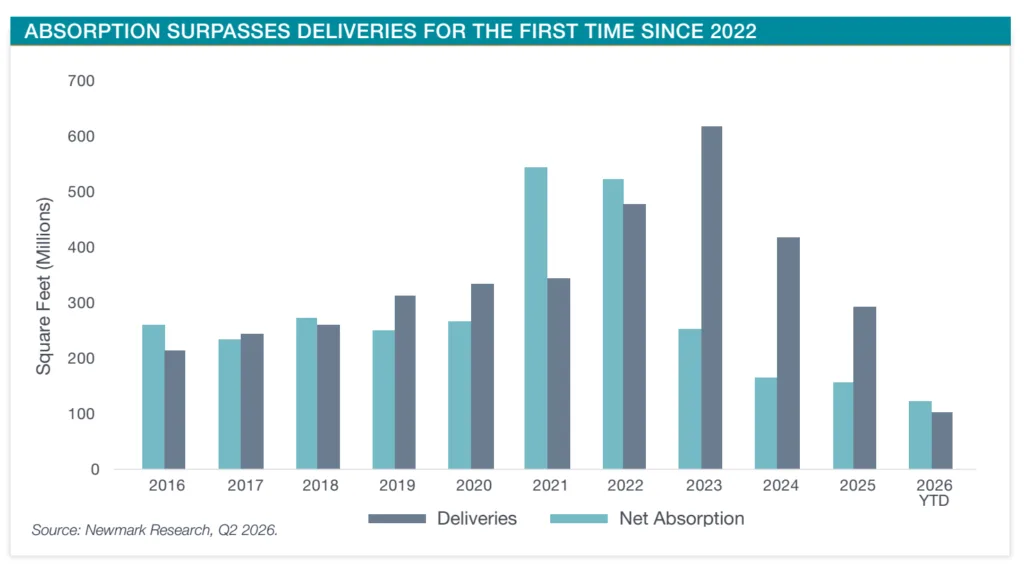
Sector-wide absorption surged to 167M SF during Q2 2026, nearly doubling the previous quarter, per Newmark Research. Speculative completions contributed significantly, signaling broad tenant demand beyond build-to-suit and owner-user deals. Net absorption also outpaced new deliveries for the first time since 2022. That performance helped reduce vacancy for a second consecutive quarter.
Capital markets are responding accordingly. Industrial remains the only major CRE sector with transaction volumes above pre-pandemic averages. Q2 sales increased 37% year-over-year, according to Savills. Meanwhile, Newmark reported cap rates around 5.5% for the highest-quality deals during Q2 2026.
Small-Bay Assets Take Center Stage
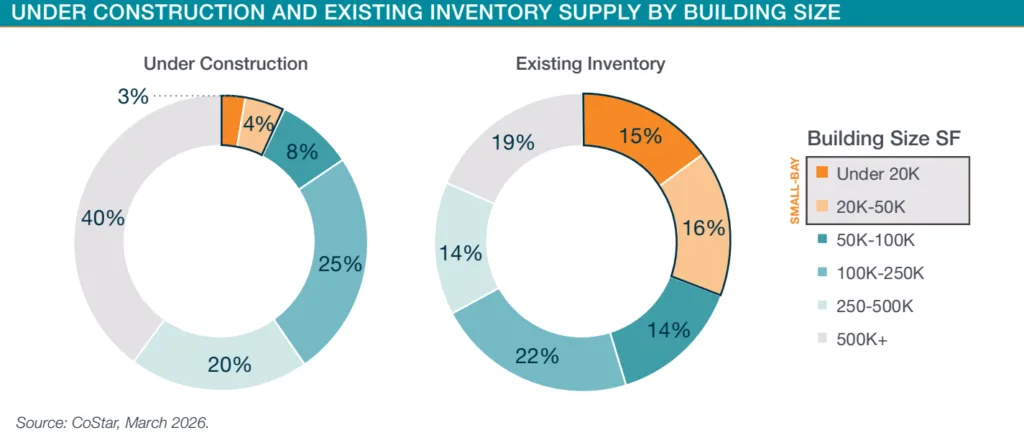
Big-box industrial continues recovering, but multi-tenant light industrial assets are outperforming across several key metrics. Roughly 70–80% of leases cover spaces below 50K SF, according to CoStar’s Q1 2026 data. Yet, these assets represent only 31% of national industrial inventory. New construction also remains limited, with just 7% of new supply below 50K SF.
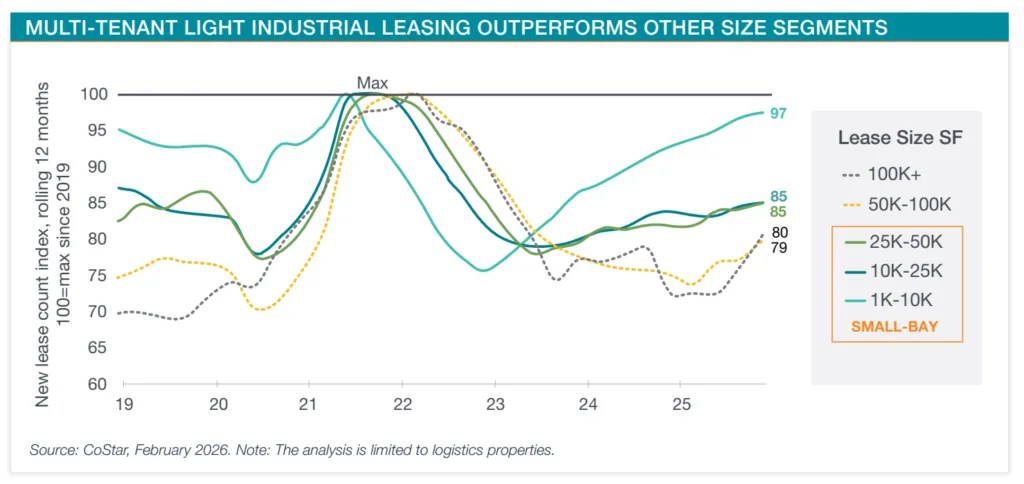
Small-bay vacancy averages 4%, which stands 47% below vacancy across other industrial segments. Transaction prices also reached $147 PSF for buildings below 50K SF. Larger formats traded at just $108 PSF. These fundamentals create value-add opportunities for investors capable of funding capex and repositioning aging properties for modern tenants.
Scarcity, Rents, and Resilient Investment Fuel Premium
Small-bay rents climbed 50% nationally over the past decade, according to CBRE and Green Street’s Q1 2023 report. Select markets recorded increases reaching 80% during the 2020–2022 COVID period. Meanwhile, 83% of existing small-bay inventory was built before 2000. Limited recent development further strengthens value-add strategies.
Industrial also maintains the lowest delinquency rate among CRE asset classes at 0.7%, according to Savills Q2 2026 data. Sector prices have climbed 39% since 2021. Stabilized industrial cap rates remain in the mid-5% range, reflecting disciplined pricing and healthy fundamentals. Oxford Economics and MSCI reported $64.7B in H1 2026 industrial transactions, the second-highest total on record. Deals below $100M represented 70% of activity, highlighting strong liquidity at smaller scales.
Why It Matters
Small-bay industrial outperformance is reshaping how investors and operators allocate capital across the US industrial market. Infill development faces power constraints and land scarcity, particularly across Tier I and II markets. Consequently, existing inventory increasingly benefits from its irreplaceable locations. CoStar reported just 36M SF of small-bay space under construction nationwide during Q2 2026. That represents less than 0.3% of inventory despite continued leasing strength.
Concentrated demand and limited supply allow operators to command rent premiums and improve occupancy. Those conditions support durable cash flows and NOI growth. However, growing investor competition has compressed margins, making disciplined underwriting increasingly important for small-bay strategies. Institutional allocators are also becoming more active in small-bay aggregation strategies. Fragmented ownership gives specialized managers opportunities to build portfolios at scale. Meanwhile, flexible operations increase tenant stickiness and strengthen core-plus and value-add strategies.
What’s Next
New small-bay supply will likely remain scarce for several more years. The construction pipeline has fallen 61% from its 2022 peak, according to Savills. Development shows few signs of substantial recovery, particularly across urban infill markets with significant barriers. Most existing inventory is also aging. Successful operators can create value by repositioning properties and increasing rents through targeted capex.
Technology and supply chain changes should continue pushing occupiers toward greater operational flexibility and control. Small-bay properties can meet those requirements while offering investors limited supply and resilient tenant demand. For capital allocators seeking inflation hedges and stable cash flow, these secular tailwinds remain attractive. Small-bay industrial could remain a preferred CRE segment despite broader economic reversals.