





- US CRE investment volume jumped 21% year-to-date, totaling $250.3B in Q2 2026.
- Private buyers led the market, while cross-border capital surged, and lenders focused on pricing over leverage.
- LTV ratios and loan spreads tightened, reflecting robust lender competition and disciplined underwriting.
Investor Demand Accelerates Across US Markets
Capital markets momentum persisted in the second quarter of 2026, as commercial real estate investment volumes continued to climb in major US cities. CBRE Research reports that year-to-date investment volume surged by 21% to $250.3B. This expansion was underpinned by heightened activity in both gateway and Sun Belt markets, including New York, Los Angeles, and San Francisco. Private investors accounted for the largest share of new investment, trailed by institutional buyers, as the sector remained attractive amid evolving macro conditions. According to CBRE, overall investment activity is expected to register a 16% annual increase for the full year.
This uptick reflects a reversal from previous quarters dominated by wait-and-see sentiment and interest rate pressures, signaling renewed confidence in core and high-growth markets. The consistency of inbound capital and diversity of buyer profiles strengthened deal pipelines, with notable momentum in retail, hotel, and office assets despite broader sector challenges.
Get Smarter about what matters in CRE
Stay ahead of trends in commercial real estate with CRE Daily – the free newsletter delivering everything you need to start your day in just 5-minutes
The Details
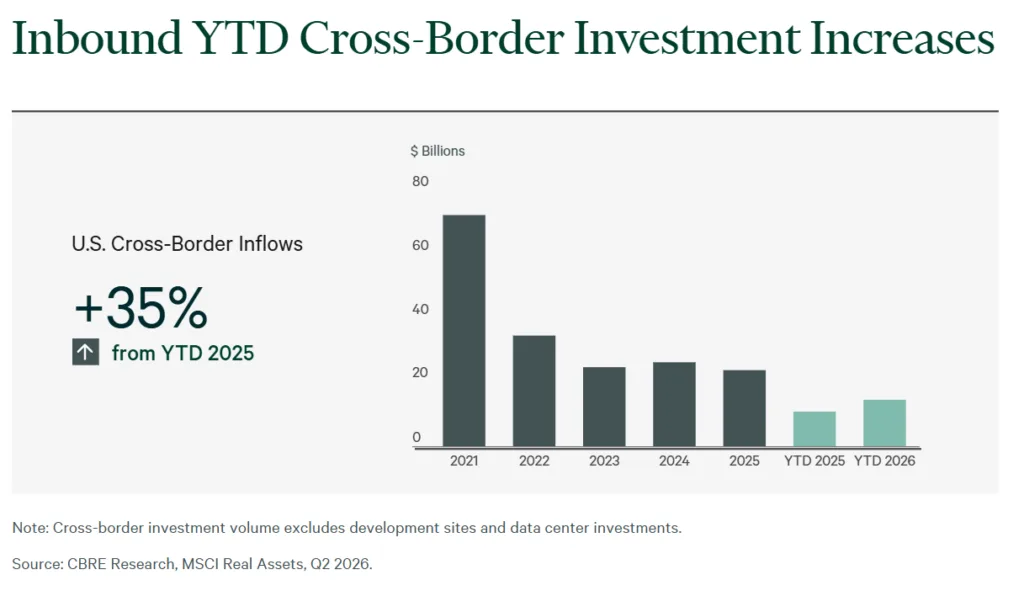
Year-to-date through Q2 2026, US commercial real estate saw $250.3B in total investment, a 21% year-over-year increase per CBRE. Private investors led all buyers with $70.9B in activity, far outpacing institutional capital at $22.4B. Inbound cross-border investment also ticked up sharply, with H1 2026 volumes hitting $14.4B, a 35% annual increase.
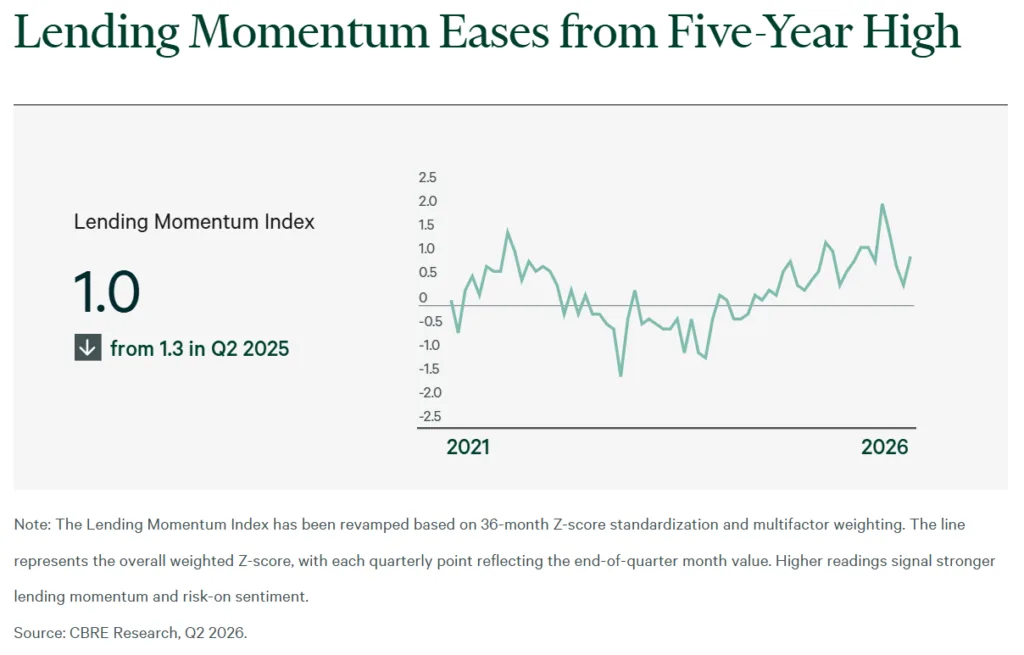
Notably, alternative lenders, such as debt funds and credit companies, participated in 38% of non-agency loan closings, up from 34% a year earlier. While the CBRE Lending Momentum Index slightly softened to 1.0 from 1.3 one year ago, both the number and average size of loans rose, and spreads tightened, reflecting healthy lender competition on price over leverage.
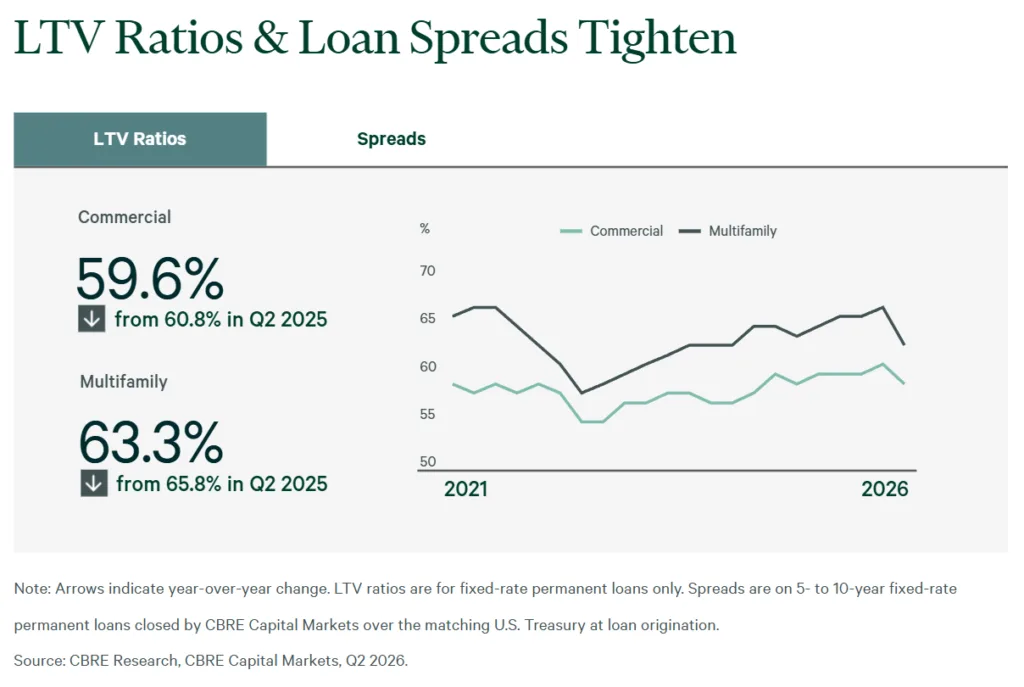
Loan-to-value (LTV) ratios for commercial deals averaged 59.6%, down from 60.8%, and multifamily LTVs dipped to 63.3% from 65.8%. Commercial mortgage spreads narrowed 21 basis points to 204 bps, while multifamily spreads fell 15 bps to 162 bps. This pricing trend mirrors a broader market shift, where tighter credit spreads have become a stronger driver of transaction activity than lower interest rates alone. Underwriting discipline held, with debt service coverage ratios and debt yields both improving, and mortgage rates, on average, settling at 5.7%.
Alternative Lenders Challenge Traditional Players
Competition among lenders continued to intensify in Q2. CBRE notes that alternative lenders expanded their market share, taking 38% of non-agency commercial and multifamily loan originations. Banks remained active but faced increased pressure from non-bank entities that prioritized competitive pricing over greater risk appetite.
The tightening of LTV ratios — now below historical averages — and declining spreads point to borrower and lender preference for lower leverage and cost, rather than stretching to win deals. This contrasts with prior years, when higher leverage often served as a differentiator.
Lending standards held firm, even as underwriting metrics like debt service coverage and debt yield improved. Cap rates, which edged up to 6.3% (from 6.0%), showed some recalibration in pricing, aligning with lower interest rates and slightly higher risk premiums, as reported by CBRE in its Q2 data.
Why It Matters
US capital markets rebounded faster than expected in 2026, as investors capitalized on compressed spreads and improved financing terms. According to the Q2 2026 CBRE report, the 21% jump in investment volume is notable after several years of uneven CRE deal activity amid economic uncertainty. The intensified focus on major markets signals a vote of confidence from both domestic and foreign investors, especially as cross-border volumes rose 35% in H1 — their sharpest gain in recent years.
The influx of both private and alternative lending capital is reshaping the market, gradually eroding the legacy dominance of traditional banks. Tighter LTV ratios (commercial at 59.6% and multifamily at 63.3%) and narrowing spreads underscore a highly competitive lending environment, with lenders favoring pricing strategies over risk-heavy loan structures. Discipline remains a hallmark of current underwriting, as debt service coverage rose to 1.43 and debt yields to 10.2%, suggesting lenders and investors are better protected against potential volatility. Marginally higher cap rates (now averaging 6.3%) hint at investor caution, even as mortgage rates drift downward to 5.7%.
For CRE professionals, these data points highlight an ongoing shift: a market that’s open for business, but unwilling to chase risk without solid fundamentals.
What’s Next
CBRE projects a 16% gain in total CRE investment for all of 2026. Lender competition is expected to hold spreads and LTV ratios near current levels, as alternative lenders continue to gain a larger foothold. Investors remain focused on gateway and growth markets, where liquidity and asset performance provide resilience against economic volatility. With solid debt service metrics and abundant capital availability, expect deal flow to accelerate into the second half, particularly in sectors like retail, hotels, and offices that drew outsized cross-border attention in H1. Analysts will be watching for any shifts in cap rates and underwriting standards if macro headwinds re-emerge late in the year.