






- Private real estate fundraising hit $92.6B in H1 2026, the slowest first-half pace since 2017, per Colliers Insight.
- Roughly 70% of funds met or beat target sizes as capital favored proven sponsors despite overall volume declines.
- Average fundraising periods shortened to 18.1 months, highlighting a disciplined, efficiency-focused market.
Investor Selectivity Defines 2026 Capital Flows
According to Colliers Insight, private real estate fundraising volume in the US slipped to $92.6B in H1 2026, a 38% year-over-year drop and the weakest first-half showing since 2017. Though headline numbers appear bleak, the story beneath the surface is less about widespread capital flight than about a disciplined recalibration.
While dealmakers faced persistent uncertainty around interest rates, asset values, and broader economic growth, most funds still managed to hit or surpass their capital targets. This selective approach shows capital isn’t gone but is primarily chasing top-tier sponsors who can deliver through volatility.
Get Smarter about what matters in CRE
Stay ahead of trends in commercial real estate with CRE Daily – the free newsletter delivering everything you need to start your day in just 5-minutes
The Details
Colliers data shows that 70% of funds raised in H1 2026 met or exceeded their target size. That marks a clear improvement from prior years. The average fundraising period also fell from 23.8 months in 2025 to 18.1 months in 2026.
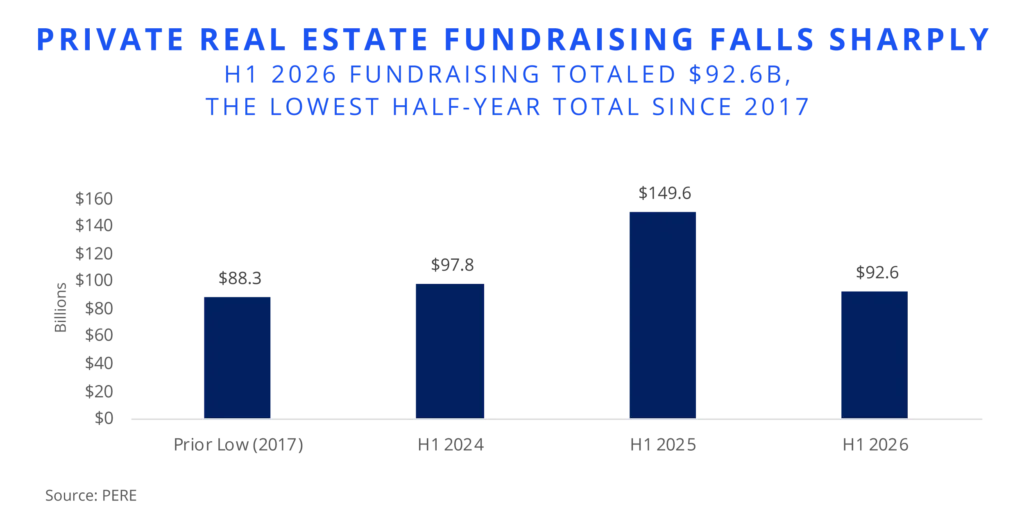
A handful of outsized fund closes helped 2025 set a high bar. However, the pool of available mega-funds has since shrunk. Fundraising volume increasingly flows toward name-brand managers. Investors remain cautious about an uncertain macro backdrop. As a result, they favor managers with proven experience navigating difficult markets.
Established Sponsors Dominate a Narrowing Pipeline
The market increasingly concentrates capital among a select group of experienced GPs. Colliers notes that several mega-funds closed during the early months of 2026. However, far fewer large vehicles are currently seeking capital.
Investors continue to favor established sponsors with strategic discipline and strong track records. Large, sophisticated managers continue to command confidence and reach successful closings more efficiently. Meanwhile, newer managers face greater pressure to demonstrate clear advantages before securing commitments.
Why It Matters
The current fundraising environment marks a sharp departure from the broad capital deployment of the previous market cycle. H1 2026 private real estate fundraising fell 38% from a year earlier. As a result, investors increasingly reserve capital for top-performing managers.
That selectivity also appears in data centers, where investors increasingly favor development strategies over costly acquisitions. This shift shows how capital allocation now depends heavily on sector-specific opportunities and pricing.
According to Colliers Insight, roughly 70% of funds raised still met or exceeded their targets. That suggests investors are not abandoning private real estate altogether. Instead, they demand greater manager quality, stronger strategies, and clearer conviction before committing capital.
Average fundraising cycles have shortened to just 18.1 months, signaling greater efficiency across the market. Meanwhile, the shrinking mega-fund pipeline reflects caution toward large, illiquid commitments during continued market uncertainty.
Investors now appear more deliberate and risk-aware when selecting managers. They increasingly favor platforms that can outperform through complex conditions rather than simply benefit from market growth. For sponsors, that selectivity creates fiercer competition and raises the standard for attracting capital.
What’s Next
The pipeline for new mega-funds remains thin as investors concentrate capital around established sponsors. Questions surrounding interest rates and property valuations also continue shaping allocation decisions. Capital remains available, but new entrants face an increasingly high bar.
Managers raising capital during the second half of 2026 must offer differentiated strategies and strong operational execution. They also need clear evidence of past outperformance to stand apart from competitors.
Fundraising efficiency and investor selectivity will likely continue through the remainder of 2026. Volume may remain subdued until macroeconomic confidence improves or more managers demonstrate consistent performance.