






- Credit card balances declined in May, even as retail sales grew and consumer sentiment stayed near record lows.
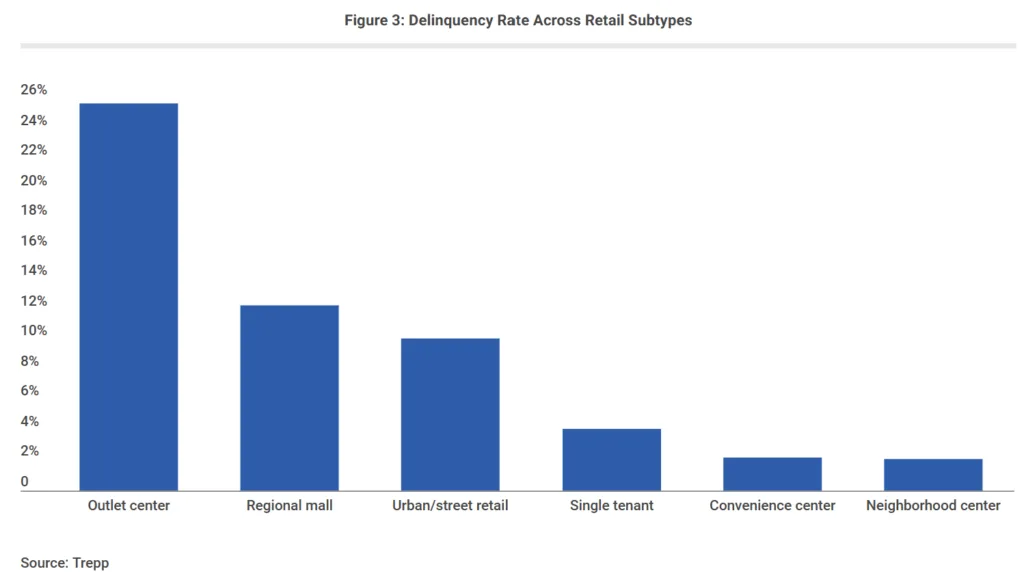
- Delinquency rates sharply diverge by retail property type, with discretionary-focused centers under more pressure than essential retail formats.
- A continued pullback in borrowing or spending could widen distress for retail CRE, especially for malls and outlet centers.
Credit Cycle Shapes Retail CRE Risk
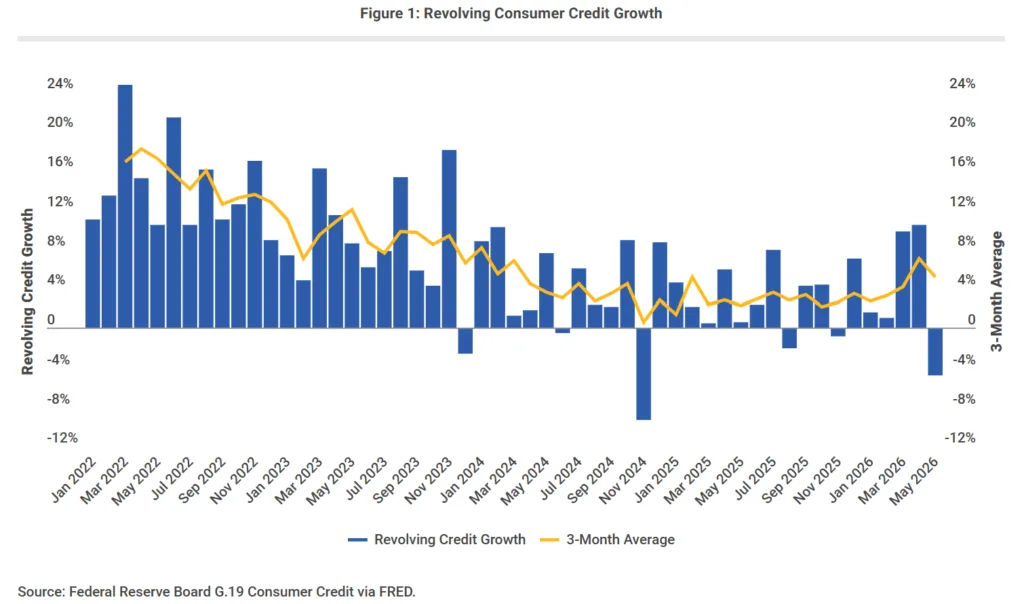
Retail property fundamentals are tracking two key consumer trends: resilient spending in the face of weakening sentiment, and the shifting role of credit card debt in financing that spending. According to the Federal Reserve’s latest consumer credit report, US households paid down card balances in May at a seasonally adjusted annualized rate of 4.7%, following a two-month surge not seen in three years. Trepp data highlights that, for CRE investors, the fate of retail property is more tightly linked to shifts in credit usage than ever. Discretionary retail—including regional, superregional malls, and outlet centers—remains far more vulnerable to a consumer retrenchment, acutely exposed if shoppers rein in discretionary purchases as access to credit tightens.
Get Smarter about what matters in CRE
Stay ahead of trends in commercial real estate with CRE Daily – the free newsletter delivering everything you need to start your day in just 5-minutes
The Details
Per the Federal Reserve’s May 2026 consumer credit release, revolving credit—overwhelmingly credit cards—fell, while nonrevolving credit (mainly auto and student loans) grew only marginally. Together, total consumer credit was flat for the month. Notably, May interrupted a run of strong growth: Average credit card balances posted their quickest back-to-back monthly rise in three years during March and April, but that growth stalled in May.
On the retail side, regional and superregional malls faced delinquency rates above 10%, with regional malls carrying over $2.2B in reported delinquent balances. In contrast, neighborhood and convenience centers, which serve essential daily needs, reported delinquencies near just 2%, per Trepp.
Borrowing and Sentiment Diverge
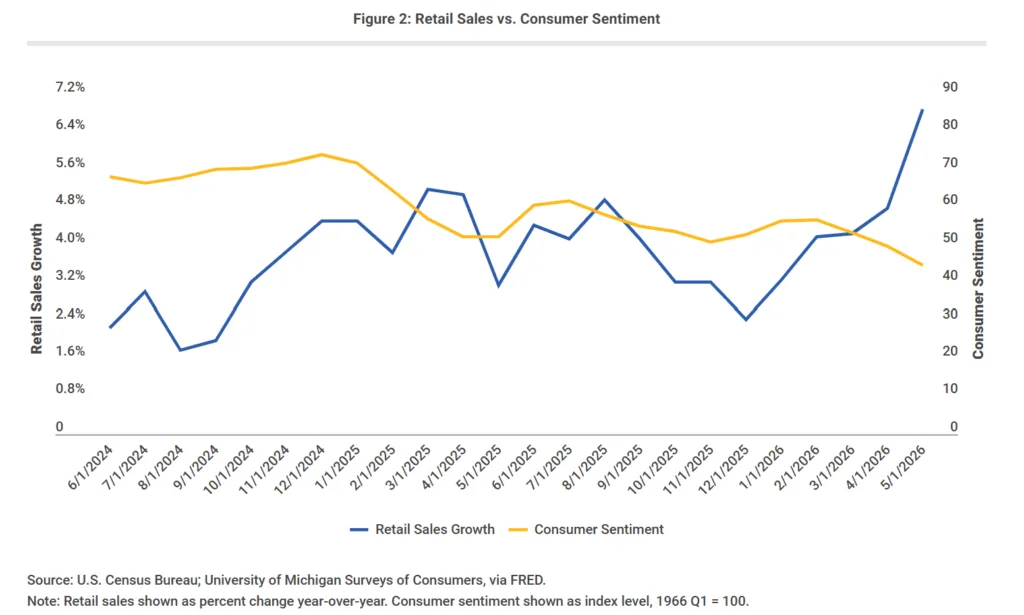
The gap between how consumers feel and how much they spend has rarely been wider. According to the University of Michigan, consumer sentiment in May hit one of its lowest historical readings, with most respondents citing persistent high prices as the primary drag on their outlook. Yet May also marked a fourth consecutive monthly bump in retail sales, per Commerce Department data. This resilience was previously fueled by increased reliance on credit card debt. However, in May, households paid down those balances at the same time as spending held up—a reversal from the earlier pattern, and one that raises questions about whether consumers will maintain outlays if credit access remains tight.
Why It Matters
The sharp split in retail property loan performance underscores how spending patterns are already sorting winners from losers within CRE. Discretionary formats, including regional malls and outlet centers, are reporting double-digit delinquency, reflecting heightened distress. Regional malls alone now account for more than $2.2B in delinquent loans, according to Trepp’s June dataset. By comparison, neighborhood and convenience centers, where tenants offer groceries, medical services, and other daily needs, have kept delinquencies at around 2%. Even so, higher-income households continue to account for a disproportionate share of retail spending, helping support stronger-performing retail formats despite broader consumer pressure.
This data-driven divide means retail CRE performance will be closely tied to how households continue to fund purchases. Should labor market conditions worsen or further interest rate hikes tighten household budgets, properties serving non-essential categories could see delinquencies spike further. The May credit report suggests that, for now, repayments simply reflect a temporary lull after heavy spring borrowing, especially with retail outlays buoyed by spring tax refunds. But if upcoming months show credit balances remain flat while the labor environment deteriorates, CRE professionals can expect credit woes to spill over most severely into retail properties focused on discretionary sectors.
What’s Next
Market watchers are eyeing the June consumer credit and spending releases for confirmation. If card borrowing returns alongside continued robust retail sales, it supports the repayment-blip theory and offers some relief to vulnerable retail CRE sectors. However, flat or falling balances—especially if mirrored by weaker labor market performance—could be an early warning for lenders and landlords in the discretionary retail segment. For now, the difference in performance between essential and discretionary retail properties will remain the main fault line in retail CRE, with the next few months of data likely to clarify just how deep the divide will get.