








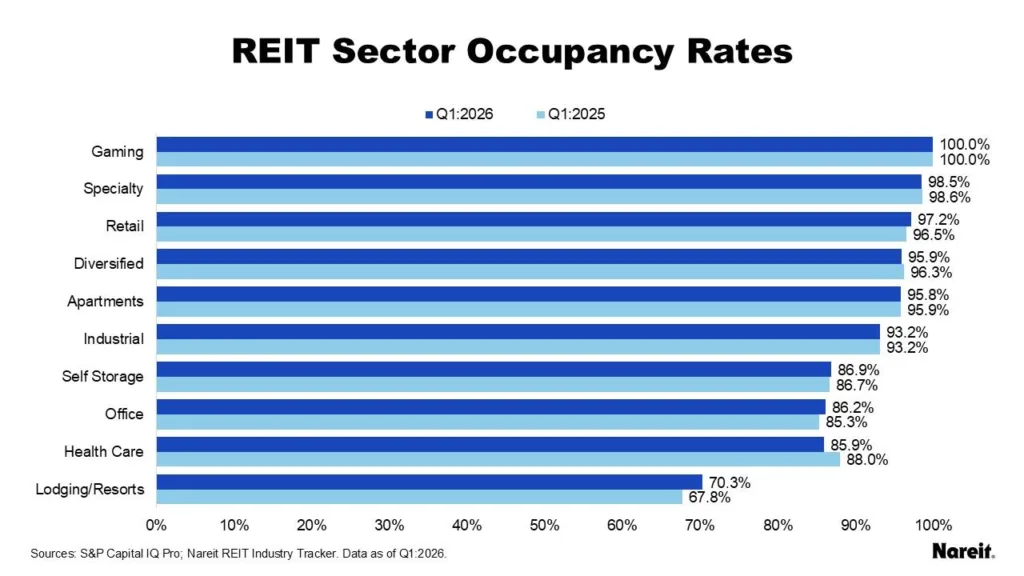
- REIT occupancy rates remained stable or improved across 10 property segments in Q1 2026, per Nareit’s Industry Tracker.
- Health care REITs saw the steepest drop in occupancy (-2.1%), while lodging/resorts led gains with a 2.5% uptick following stronger travel demand.
- Consistent occupancy rates highlight the sector’s operational discipline and underpin steady revenue in a challenging macro environment.
Expanded Sector Insights for REIT Occupancy
Nareit’s REIT Industry Tracker expanded coverage in Q1 2026, analyzing occupancy trends across 10 property sectors instead of the previous four. According to the Tracker, REITs broadly sustained strong occupancy performance throughout the first quarter despite an unpredictable economic backdrop. This wider lens now includes not only traditional sectors like apartments, office, industrial, and retail, but also diversified, gaming, health care, lodging/resorts, self-storage, and specialty (such as movie theaters, farmland, and signage). This expansion allows for a more holistic assessment of how REIT fundamentals are responding to shifts in supply, demand, and investor sentiment.
Get Smarter about what matters in CRE
Stay ahead of trends in commercial real estate with CRE Daily – the free newsletter delivering everything you need to start your day in just 5-minutes
The Details
The most notable occupancy movement occurred in health care and lodging/resorts. The health care sector posted a 2.1% year-over-year decline, which Nareit attributes to lease expirations and asset sales impacting major players. In contrast, lodging/resorts saw occupancy jump 2.5% thanks to robust leisure travel and the return of business trips. Other sectors, including apartments, industrial, and retail, reported steady or modest changes, demonstrating stability. Diversified REITs, which blend exposure across asset types, continued to draw interest from investors seeking broader risk mitigation and rental income sources. The specialty REIT segment, covering properties like farmland and billboards, also maintained relatively stable occupations over the period.
Sector Stability Amid Economic Headwinds
With recent economic uncertainty, keeping occupancy rates stable is no small feat. REITs have managed to avoid the kind of volatility seen earlier in the cycle, when rapid interest rate hikes and market jitters impacted lease renewals and acquisition strategies. The year-over-year trends reflected in Nareit’s Q1 2026 data stand in contrast to previous cycles that saw sharper swings in demand, particularly for office or hospitality assets. Health care’s dip—attributable to idiosyncratic events at a major operator—was offset by travel-driven strength in hospitality. Self-storage, office, and industrial all held steady, further supporting institutional investor confidence in the sector’s fundamentals despite shifting capital costs and leasing demand.
Why It Matters
REITs depend on occupancy to protect rental income, valuations, and investor confidence. Even small shifts can affect bottom lines. Now, Nareit tracks 10 sectors, giving investors a clearer view of strength and weakness. Its Q1 2026 analysis shows disciplined management, diversified portfolios, and operational adaptability still matter.
For instance, lodging/resorts posted a 2.5% occupancy increase as travel demand improved. That rebound could ease concerns about hotel performance under high rates. In contrast, health care occupancy fell 2.1%, showing the risks tied to tenant concentration and lease rollovers. A few large properties can still skew sector readings.
Across the board, steady occupancy signals that REITs remain a defensive CRE play. Management teams continue to navigate rent rollovers and asset sales without major revenue pressure. That operating strength also supports the case for renewed REIT momentum as valuation gaps tighten. That matters most for retail, industrial, and apartment REITs. Stable occupancy can support share prices and attract core capital. Longer term, the 10-sector view gives allocators sharper risk and return signals. As cycles shift, gaps between sectors will shape capital flows. Therefore, investors will need active oversight and stronger asset selection.
What’s Next
Investors and analysts will likely watch sector-level occupancy more closely in upcoming Nareit reports. Diversified and specialty REITs could gain more attention as uncertainty continues. These segments already appeal to investors seeking wider risk distribution. However, macro pressure may push allocators to review those strategies again.
Q1 2026 showed resilience, but market watchers will look for early weakness or new growth leaders. Q2 results should offer a clearer read. Portfolio managers will likely focus on balance sheet strength, tenant diversification, and proactive lease management. Those factors can help REITs sustain operational outperformance through continued uncertainty.