





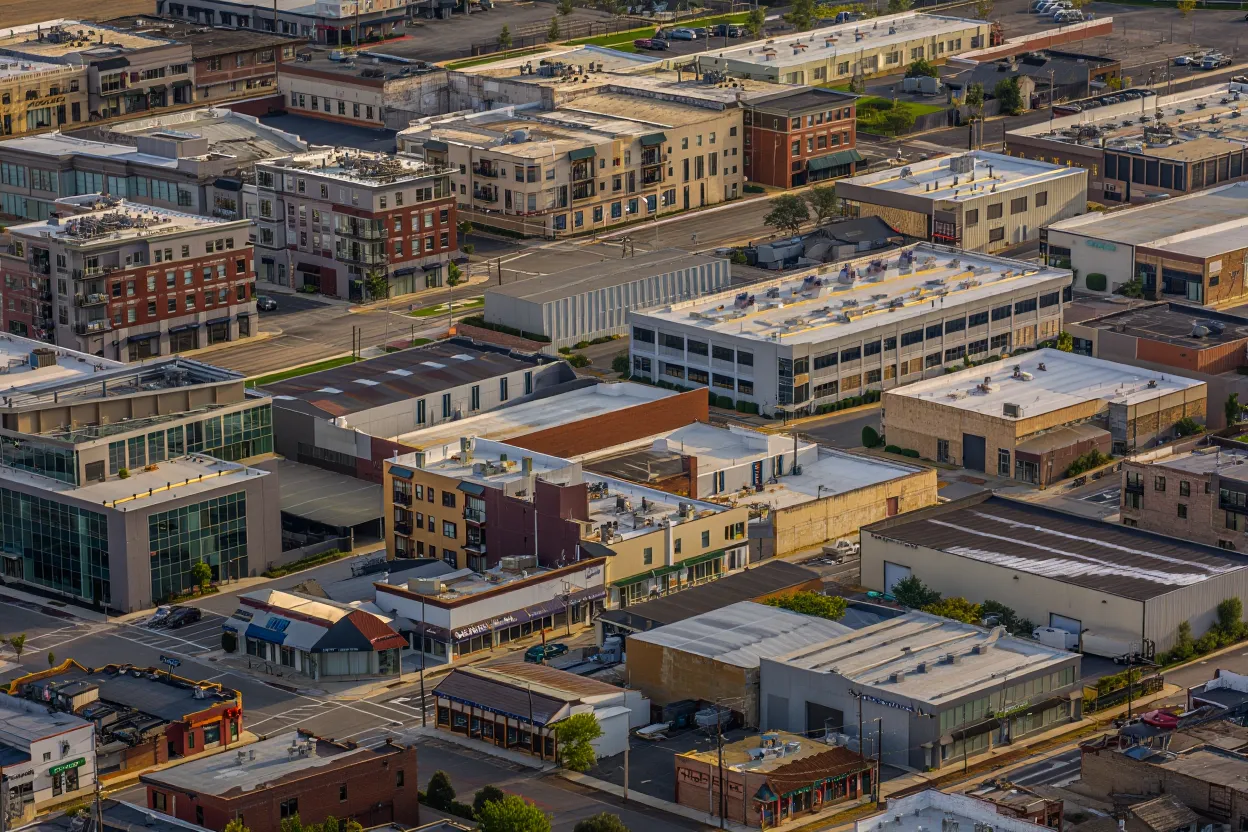
- US CRE set a record $129 PSF median transaction price in Q1 2026, marking twelve straight quarters of gains, per Altus Group.
- Deal sizes hit all-time highs across all sectors, but buyers targeted smaller and older buildings, signaling a shift in transaction patterns.
- Despite market turmoil—tech stock selloff, surging oil prices, and rate uncertainty—CRE pricing and activity remained resilient in Q1.
Macroeconomic Shocks Collide With CRE Resilience
According to Altus Group’s Q1 2026 US Commercial Real Estate Investment & Transactions Quarterly, the US commercial real estate (CRE) market saw record prices even as macro factors rattled broader markets. The quarter’s backdrop included a historic tech stock selloff—dubbed the “SaaSpocalypse”—with software equities plunging over 24%, plus an 85% YTD surge in oil prices stemming from renewed Middle East conflict. Despite these shocks, CRE transaction activity pressed forward, outpacing expectations amid a climate of sustained inflation fears and central bank inaction.
Contextually, the Federal Reserve held rates at 3.50%-3.75% throughout the quarter, and 10-year Treasury yields bumped to the mid-4% range. These headwinds would typically suppress real estate investment, particularly in a market with elevated borrowing costs and rattled capital markets. Instead, price and deal volume resilience points to underlying shifts in buyer preferences and sector fundamentals in early 2026.
Get Smarter about what matters in CRE
Stay ahead of trends in commercial real estate with CRE Daily – the free newsletter delivering everything you need to start your day in just 5-minutes
Record-Setting Prices Mask a Market in Transition
The expansion in transaction pricing remains undeniable. The median CRE price climbed to $129 PSF in Q1, up 8.7% YoY—though pace has cooled from 11.7% in Q3 2025. That marks a 2.3x increase since the 2009 cycle trough. Each major property type hit a rolling four-quarter high in pricing, but quarterly comparisons show some retreat in four out of six sectors, reflecting a market searching for equilibrium.
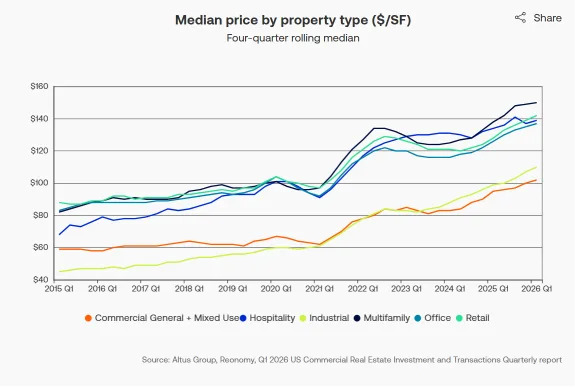
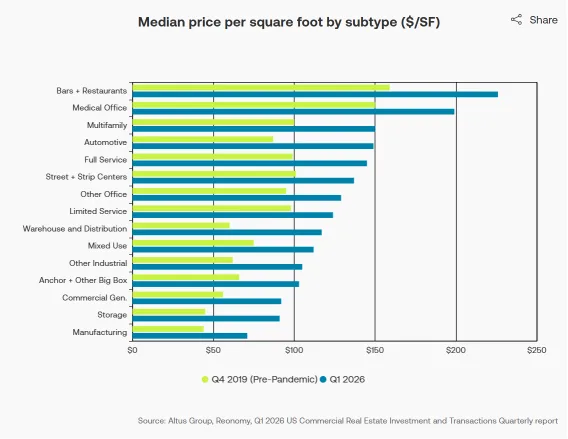
Price growth remains most pronounced in industrial assets, up 88.5% since pre-pandemic Q4 2019, while office assets lag at 36.6%. Multifamily now tops the price chart at nearly $150 PSF, while industrial is least expensive but fastest growing. At the granular level, certain subtypes—like storage (up 22.9% YoY)—are far outpacing their broader sectors. Bars and restaurants command the highest median price of any subtype at $226 PSF, likely buoyed by persistent consumer demand. The divergence across and within sectors marks an era of structural repricing, not just post-pandemic recovery.
Smaller, Older, Costlier—Profile of a 2026 CRE Deal
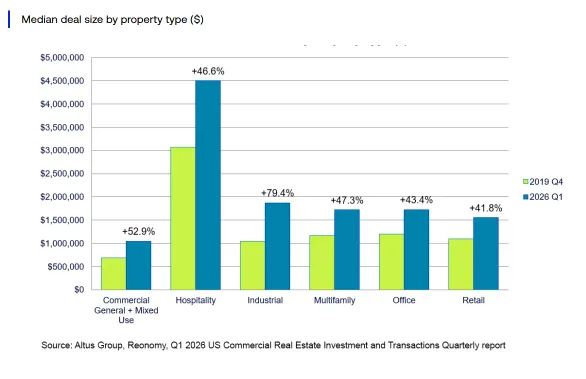
Q1 data shows CRE deal shrinkflation. Median deal values hit records across major sectors. Hospitality led at $4.5M, while commercial general topped $1M. Yet properties are getting smaller and older. Multifamily assets sold in Q1 were 23% smaller than in 2019. Still, median deal values rose 47.4%. The typical multifamily sale measured 9,713 SF and averaged 61 years old.
Other sectors showed similar trends. Median office and industrial properties shrank about 7% since Q4 2019. Retail and hospitality sizes stayed stable. Office buildings averaged 39 years old, while industrial reached 41 years. This reflects slower development and fewer sales of newer assets. Even so, buyers continue paying more for older, smaller buildings. New office, retail, and hospitality assets still command premiums. Multifamily pricing, however, has flipped that pattern.
Pricing Outruns Scale as CRE Repricing Deepens
Q1 brought two surprises. First, macro volatility had little effect on transactions. Tech stocks fell, energy costs climbed, and inflation persisted. Despite this, CRE maintained its recovery. This disconnect stands out. Past shocks quickly slowed deal activity. This time, capital behaved differently. Delayed effects may emerge in coming quarters.
The second surprise came from multifamily. Pre-1970 apartments traded 42% above newer properties on a PSF basis. Buyers also pursued smaller buildings while writing larger checks. Location premiums likely drove this shift. Limited new supply and changing priorities also played a role. Recent volatility in industrial pricing also suggests investors remain selective despite broader repricing pressures. For many investors, cash flow and location matter more than age or size.
Why It Matters
The data highlights growing selectivity in US CRE. Investors favor industrial and certain multifamily segments. They also pay premiums for assets that match their return targets. Altus Group found a widening gap between sectors. Industrial prices rose 88.5% since the pandemic. Office prices gained less than 40%. That spread signals changing risk perceptions and value drivers.
Headline PSF figures tell only part of the story. Smaller, well-located buildings often achieve higher values. Scarcity, amenities, and tenant demand support pricing. Repricing also complicates underwriting. Some assets earn premiums, while others face discounts. Lenders and equity providers should avoid relying on broad averages. Vintage, size, and location now matter more.
What’s Next
Altus Group expects two factors to shape future transactions. The first is the delayed impact of Q1’s macro shocks. The second is ongoing supply constraints, especially for newer assets. If rates and energy costs stay volatile, pricing could face pressure in Q2. Multifamily and industrial appear better positioned. Office may face sharper repricing if tech layoffs continue or AI reshapes demand.
For now, CRE remains active. Capital continues to move, but investors prefer unique assets over broad market exposure. Future transaction trends will depend heavily on vintage, quality, and location. Altus Group’s Q1 2026 report provides a deeper look at these shifts.