




- Location-based entertainment operators plan 721 new venues across the US and Canada, representing 16.5M SF of retail demand, according to a 2026 entertainment tenant study.
- Trampoline parks, challenge rooms, and immersive gaming concepts are taking over former big-box stores and theaters, especially in malls and power centers.
- Retail landlords increasingly view entertainment tenants as long-term traffic drivers capable of replacing struggling department stores and legacy anchors.
Location-based entertainment has become one of the most active growth categories in retail real estate as landlords search for tenants capable of driving repeat visits and longer dwell times, reports JLL. A 2026 entertainment tenant study tracking 207 concepts across the US and Canada found operators have 721 announced locations in the pipeline, totaling 16.5M SF of future demand.
The expansion reflects a broader shift in consumer spending. While destination vacations and premium experiences still attract affluent households, many consumers are choosing lower-cost local entertainment options instead. According to an April 2026 NerdWallet analysis, a three-day Disney World trip for a family of four now costs roughly $2,783 before airfare or rental cars, pushing more families toward local entertainment venues priced around $35 per person.
Get Smarter about what matters in CRE
Stay ahead of trends in commercial real estate with CRE Daily – the free newsletter delivering everything you need to start your day in just 5-minutes
A Bifurcated Consumer Base
Retail entertainment operators are increasingly targeting two distinct audiences. Premium “competitive socializing” brands like Puttshack, Flight Club, and The Cube are clustering in CBDs, Class A malls, and lifestyle centers, catering to higher-income consumers still spending heavily on dining and experiential outings.
At the same time, value-oriented concepts are expanding rapidly in suburban power centers and open-air retail. Foot traffic across 20 tracked entertainment concepts reached 217M visits in 2025, roughly 12% above 2019 levels, while average dwell time climbed to 140 minutes per visit, according to the study.
The Details
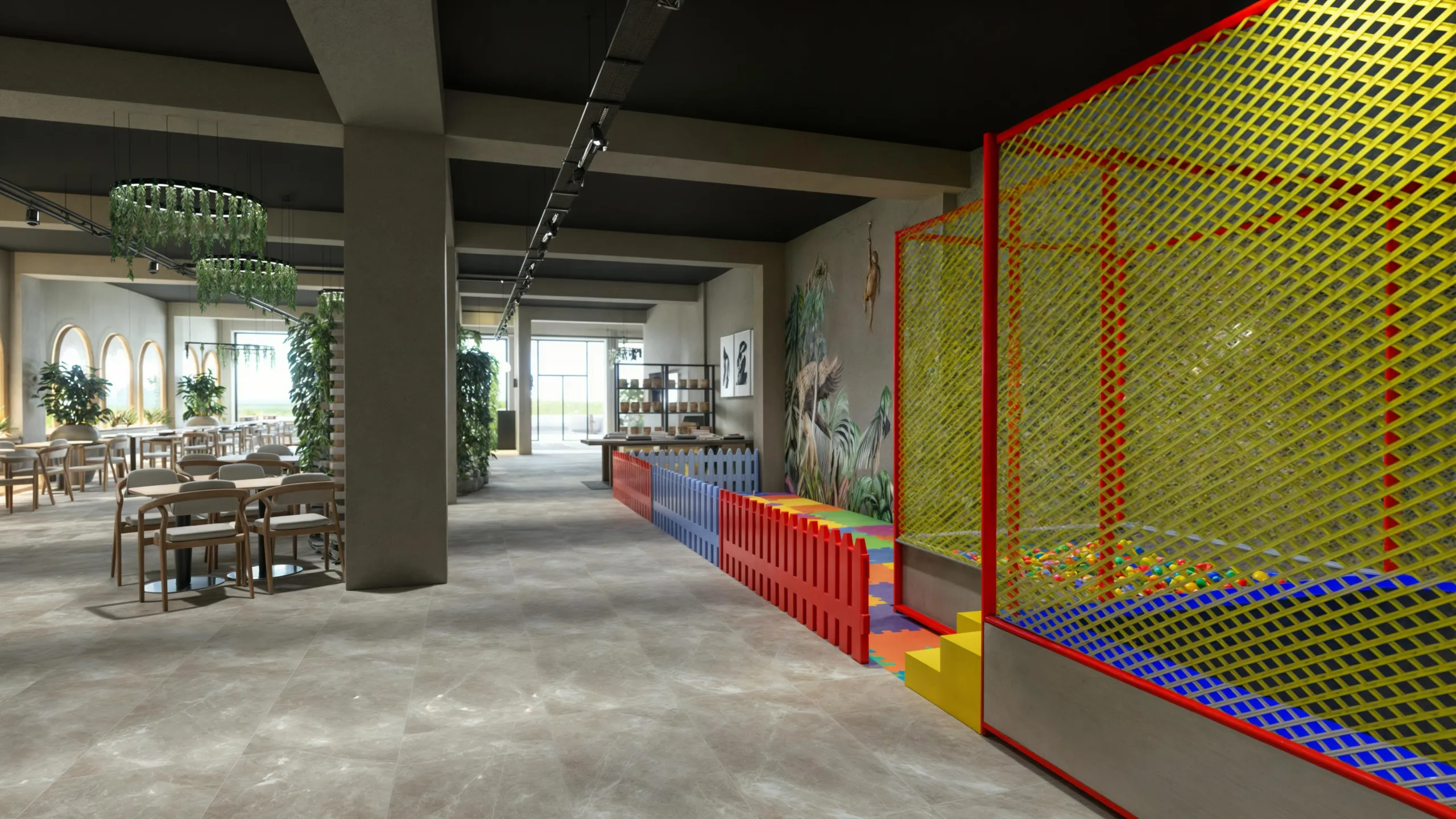
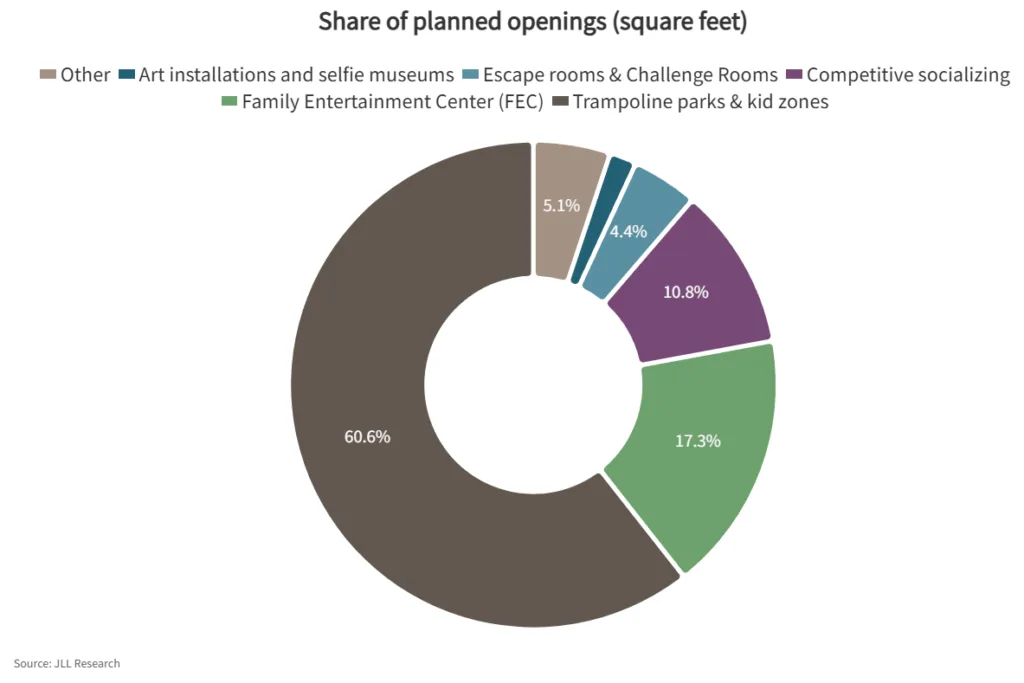
Kid-focused entertainment concepts dominate the current pipeline. Trampoline parks and “kid zone” operators account for 355 planned locations and roughly 10M SF of announced space, representing 61% of all planned entertainment square footage.
Urban Air Adventure Park operates 215 locations with another 31 planned, typically occupying 25K SF to 60K SF boxes that often backfill former Bed Bath & Beyond and other junior-anchor spaces. Sky Zone remains the largest operator with 258 locations and 32 more in development, averaging nearly 38.8K SF per venue.
Slick City Action Park has emerged as one of the fastest-growing operators, expanding to 34 open locations with 41 more planned. Kids Empire also more than doubled its footprint, growing from 43 to 111 locations.
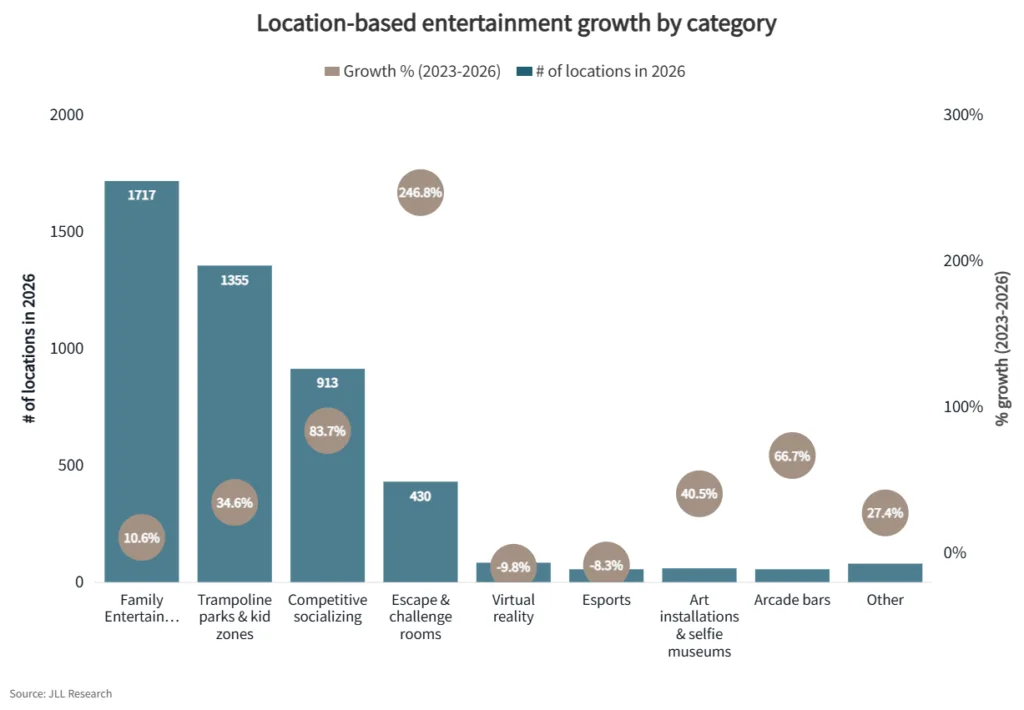
Traditional family entertainment centers still control the largest footprint overall. The category spans roughly 40M SF across 1,717 locations, led by Chuck E. Cheese, Bowlero, and Dave & Buster’s. But growth has slowed to 10.6% since 2023, signaling a more mature phase dominated by consolidations and remodels rather than aggressive expansion.
Challenge Rooms Replace Escape Rooms
Challenge-based entertainment has become one of retail’s fastest-growing experiential formats. Escape and challenge room concepts expanded 247% since 2023, reaching 430 locations across North America.
Unlike traditional escape rooms designed for one-time visits, challenge room operators focus on repeat play through RFID-scored games and competitive formats. Level99 has become one of the category’s most closely watched tenants, opening 40K SF to 45K SF venues that combine physical and mental challenges with full-service food and beverage offerings.
Backed by a $50M investment from Act III Holdings, Level99 has converted former Sears and JCPenney stores at malls including Natick Mall, Providence Place, and Westfield Garden State Plaza. The company plans to open a 45K SF flagship at Disney Springs in Orlando in 2026 inside the former NBA Experience space.
Game-show-themed concepts are also gaining traction. Operators including Game Show Battle Rooms, Great Big Game Show, and Game Show Studio continue expanding across malls and lifestyle centers. Meanwhile, The Cube — based on the British television game show — will debut its first US venue this summer in a 25K SF space on Chicago’s Michigan Avenue.
Malls Find a New Anchor Strategy
Entertainment leasing is reshaping the role of malls and large-format retail. While “mall decline” narratives persist, Class A malls remain a preferred destination for many high-profile entertainment brands.
Netflix House opened two flagship venues in late 2025, converting former department store boxes at King of Prussia Mall and Galleria Dallas into immersive entertainment destinations totaling more than 210K SF combined. Meow Wolf, Arte Museum, and other immersive art operators are similarly targeting former theaters and anchor spaces.
The leasing pattern has become increasingly consistent. Obsolete department stores and multiplex theaters are becoming entertainment-driven anchors. Developers are also pursuing large-format experiential venues beyond traditional malls, including next-generation entertainment destinations tied to concerts and immersive media. For landlords, these tenants offer a replacement strategy for vacant big-box spaces.
Why It Matters
Entertainment tenants are no longer viewed as supplemental mall attractions — they are becoming core retail anchors. Their ability to generate repeat traffic, extend customer dwell times, and support adjacent food-and-beverage sales makes them increasingly valuable in a challenging leasing environment.
The trend also reflects broader consumer behavior shifts. According to US Census Bureau data cited in the report, spending on performing arts rose 11.3% year over year from 2024 to 2025, while spending on spectator sports increased 3.5%.
What’s Next
The next phase of entertainment leasing will likely split along format and price-point lines. Affordable family-oriented concepts are expected to continue expanding into suburban power centers and vacant junior-anchor spaces, while premium experiential brands target urban corridors and top-performing malls.
Landlords with large vacant boxes — especially former department stores and theaters — remain well-positioned to benefit. As entertainment operators continue scaling nationally, experiential retail is increasingly shifting from an amenity to a primary demand driver in the retail leasing market.