





- BLS employment data revisions removed New York and Charlotte from recent top job gainer lists.
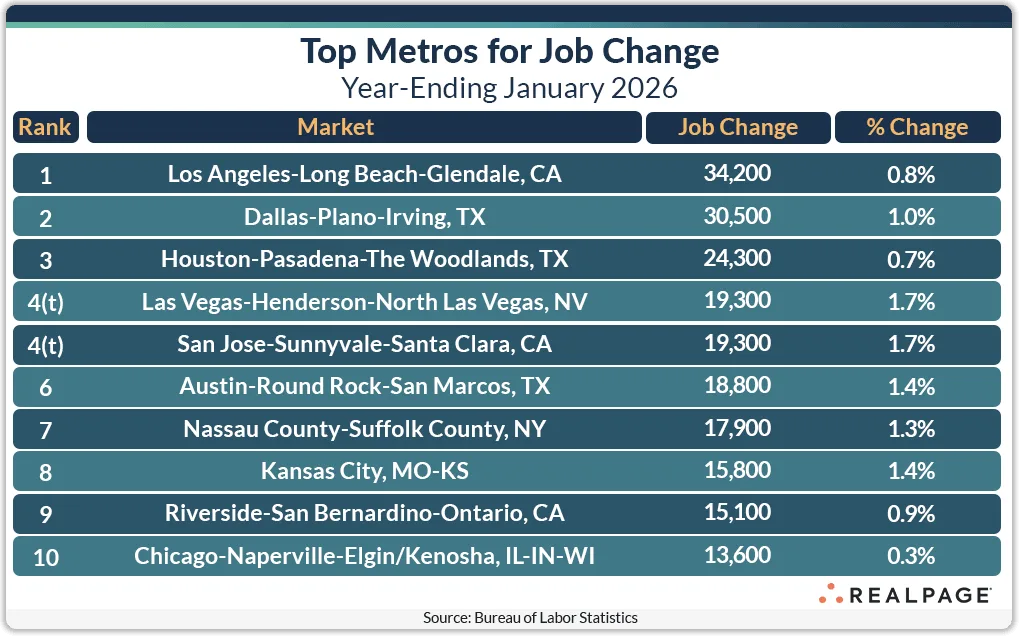
- Los Angeles, Dallas, Houston, and Austin led job gains among large metros in January 2026.
- Smaller tourism and college towns posted the fastest annual job growth rates.
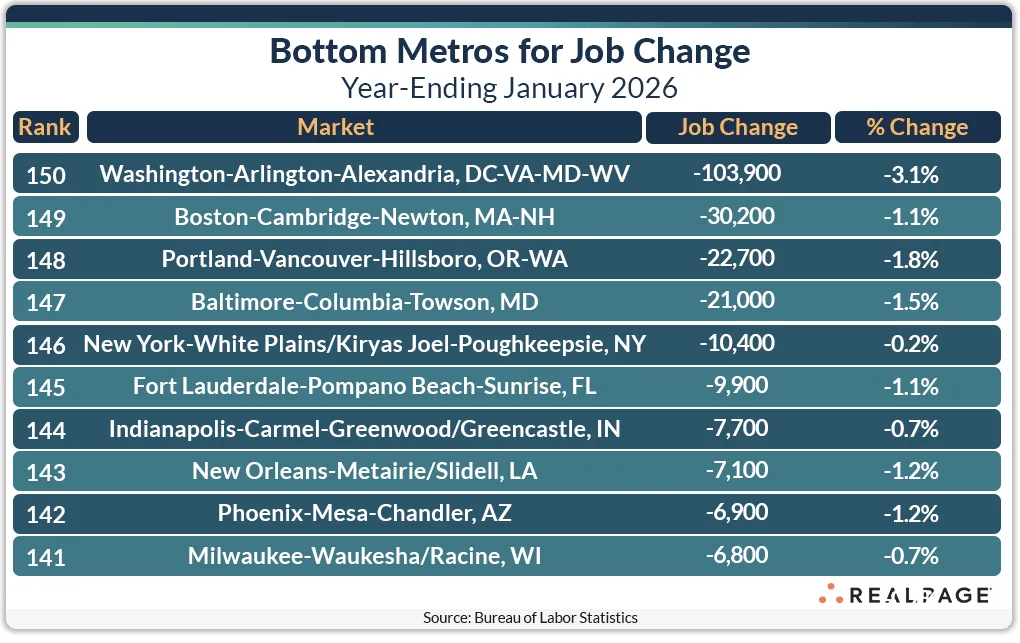
- 60 of the top 150 US markets reported annual job losses, including major hubs like Washington, DC and New York.
Major Markets Impacted by BLS Revisions
RealPage reports that annual benchmark revisions from the Bureau of Labor Statistics (BLS) have significantly altered the employment landscape for US metros. The recalculated figures changed the ranking of several top markets, with New York-White Plains no longer among the top job gainers and Charlotte dropping out of the top 10 by January 2026.
These revisions also show the overall employment environment was weaker than previously reported for much of 2025. For example, New York shifted from reporting average gains of 80,000 jobs to losses of 6,200 jobs over several months in the revised employment data.
Current Leaders in Job Gains
In January 2026, Los Angeles led US employment data with 34,000 new jobs added. Dallas, Houston, and Austin also ranked high for absolute job growth, along with Las Vegas, San Jose, Nassau County-Suffolk County (NY), and Kansas City. The combined top 10 metros registered 208,800 jobs added—just 11,700 more than last year’s top 10 aggregate.
Despite large metro gains, 60 out of RealPage’s top 150 markets posted job losses for the year ending January. Washington, DC led declines due to federal job cuts, followed by New York, Boston, and Phoenix among others in the negative column, reinforcing how recent benchmark revisions wiped out hundreds of thousands of previously reported jobs and reshaped the broader employment picture.
Percentage Growth: Smaller Markets Take the Lead
While larger metros dominated absolute job gains, smaller tourism and college markets posted the strongest percentage job growth. Atlantic City led with 4.5% growth, fueled by casino sector hiring. Wilmington (NC), Fayetteville-Springdale-Rogers (AR), Myrtle Beach (SC), and College Station (TX) were among the top, many seeing faster growth than last year’s rate.
California’s San Joaquin Valley—represented by Stockton-Lodi, Fresno, and Bakersfield—also made strong gains, and state capitals like Salem (OR) and college towns such as Springfield (MO) remained resilient. Including the top 10, 77 metros surpassed the national not seasonally adjusted growth rate of 0.2% in January.
Why It Matters
Employment data revisions from BLS affect both short and long-term decision-making for CRE investors, operators, and policymakers. The new numbers highlight shifts in market strength and reveal vulnerabilities in previously top-performing economies, while underscoring the resilience of tourism and college towns for job creation.
Get Smarter about what matters in CRE
Stay ahead of trends in commercial real estate with CRE Daily – the free newsletter delivering everything you need to start your day in just 5-minutes