



CRED iQ Overview
Founded in 2020, CRED iQ began with a focus on securitized commercial real estate debt. Its coverage now includes CMBS, single-asset single-borrower loans, CRE CLOs, agency loans, and property and mortgage information drawn from county public records.
That expansion matters for users researching loans outside the securitized market. County recorder data can surface mortgages held by banks, life insurers, debt funds, and other lenders. The depth of those records varies by county, however, so users should check coverage in the markets most relevant to their work.
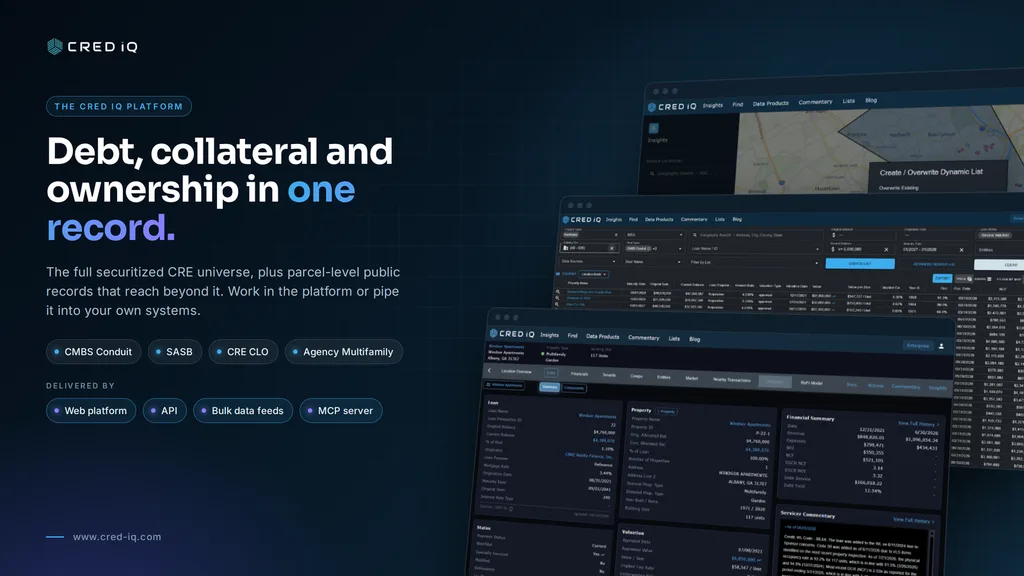
CRED iQ is available in three main forms: a web platform, bulk data feeds, and an API with an MCP server for supported AI workflows. Its users include lenders, brokers, investors, servicers, underwriters, and research teams.
Our Take On CRED IQ
Best for CRE teams that need to connect debt, property, ownership, and valuation information in one workflow.
CRED iQ brings loan, property, ownership, and valuation data together so CRE teams can research assets and assess opportunities in one place. Its search, analytics, and monitoring tools help users identify maturing loans, signs of distress, and potential lending or acquisition opportunities.
 Pros
Pros- Intuitive interface that makes it easy to search and filter a large amount of CRE data.
- Borrower and owner contact information helps users identify the people behind a property.
- Built-in DCF software lets users value properties, adjust assumptions, and compare scenarios.
- Access to data across geographies and property types without purchasing separate market subscriptions.
- Coverage extends beyond securitized loans through county public records.
- Portfolio uploads, analytics, and alerts help teams monitor multiple assets or loans.
- API, MCP, and bulk-data options let teams use CRED iQ data in their own systems.
 Cons
Cons- Non-securitized loan coverage and record detail vary by county.
- Newer analytics modules may have less historical depth than the securitized loan data.
- Teams needing extensive leasing or brokerage comparables may need another data source.
Pros Explained
Easy-to-use interface: CRED iQ organizes a large amount of property and loan data in a platform that is relatively easy to navigate. Users can narrow a search by location, property type, loan balance, maturity date, loan status, and other criteria, then save relevant properties to a list or monitor them through alerts.
Borrower and owner contact information: CRED iQ connects property records with ownership and borrower information, helping users identify the people behind an asset rather than stopping at an LLC name. That can be valuable for brokers and lenders building outreach lists, as well as investors researching a potential acquisition.
Built-in valuation tools: CRED iQ’s DCF software lets users underwrite a property, adjust income and expense assumptions, and compare scenarios within the platform. Having property data alongside the model can reduce the work of gathering inputs, though users should still review the assumptions behind any valuation.
Access across geographies and property types: Users can search across CRE markets and asset classes without buying a separate subscription for each geography or property type. That is useful for teams whose opportunities or portfolios span multiple markets. The depth of available information still depends on the data source and location.
Coverage beyond securitized debt: In addition to CMBS, SASB, CRE CLO, and agency loans, CRED iQ draws on county public records to identify properties and mortgages outside the securitized market. This gives users a broader view of potential lending and acquisition opportunities, although non-securitized loan detail varies by county.
Portfolio monitoring and alerts: Teams can upload their own portfolio or watchlist data and analyze it alongside CRED iQ’s information. Portfolio Analytics supports analysis across a group of assets or loans, while lists and alerts help users track maturities, distress signals, and other changes without researching every property individually.
Flexible data access: CRED iQ offers a documented API, an MCP server for compatible AI workflows, and bulk-data delivery in addition to its web platform. These options allow technical teams to incorporate CRED iQ data into internal models, research processes, and risk systems rather than working exclusively in the platform.
Cons Explained
Public-record coverage is still expanding: County recorder data broadens CRED iQ’s reach, but non-securitized loan detail is not uniform nationwide. Teams focused on a particular market should confirm which counties and fields are available before relying on the data for a workflow.
New modules have a shorter history: Features such as multifamily rent analytics and Portfolio Analytics were added after the core loan dataset. Buyers whose work depends on long historical comparisons should ask how far back the specific data they need will go.
Some research needs remain outside its focus: CRED iQ is centered on debt, collateral, ownership, and related analytics. A brokerage team that depends heavily on lease listings or detailed leasing comps may still need a complementary platform.
CRED iQ Key Features
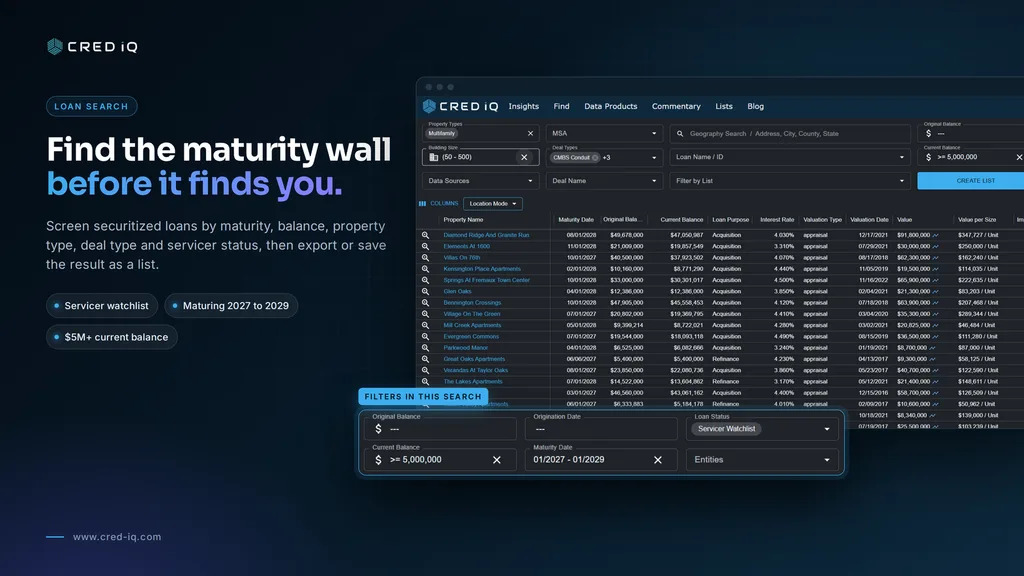
Property and Loan Search
CRED iQ lets users search and filter properties and loans by geography, asset class, loan status, maturity date, and other criteria. Users can build targeted lists for prospecting, research, or portfolio monitoring and set alerts for properties they want to follow.
Loan and Ownership Data
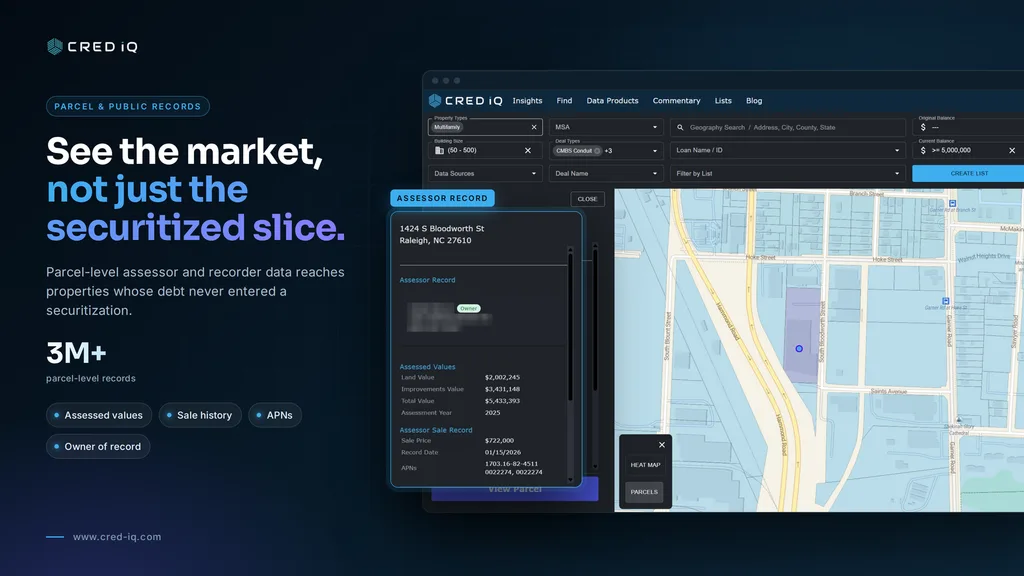
The platform connects loan details, property records, and borrower and owner information in one place. Its coverage includes CMBS, SASB, CRE CLO, and agency loans, while county public records extend its reach to mortgages outside the securitized market. The amount of detail available for those loans varies by county.
Income and Expense Data
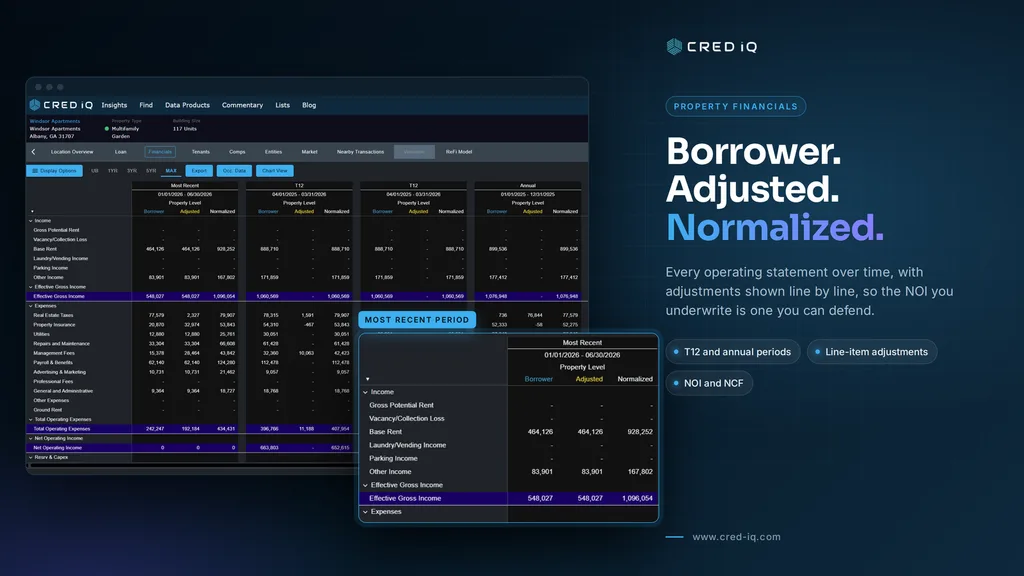
CRED iQ tracks property-level operating statements over time, including T12 and annual periods, with every line item shown three ways: as reported by the borrower, as adjusted, and normalized. Users can see exactly where expenses such as taxes, insurance, payroll and repairs were revised, and how those changes carry through to NOI, NCF, DSCR and debt yield. The same reported financials power CRED iQ’s Income and Expense Comps API, so underwriters can compare an asset against similar properties in the platform or pull the data into their own models.
Multifamily Rent Analytics
PRISM brings asking-rent data into the same workspace as a property’s loan and ownership information. Users evaluating a multifamily asset can compare its financial profile with current rent data as part of their underwriting.
Portfolio Analytics
Clients can upload portfolio, rent-roll, or watchlist data and analyze it alongside CRED iQ’s information. Portfolio Analytics lets credit and investment teams examine a group of assets or loans, rather than researching each property separately, with tools for stratification, stress testing, and dashboards.
Insights and Alerts
CRED iQ helps users track upcoming maturities, distressed loans, and other changes that could signal an opportunity or risk. The company also publishes research on delinquency, distress, and broader CRE market trends.
API and Developer Tools
Alongside the web platform, CRED iQ offers a documented API, command-line interface, and MCP server for compatible AI workflows. Its Income and Expense Comps API provides property-level comparables drawn from reported financials, while its Maturity Wave API tracks upcoming loan maturities.
Bulk Data Delivery
Organizations can license data feeds for use in their own systems and models. This gives research, credit, and risk teams a way to combine CRED iQ’s data with internal datasets and workflows outside the platform.
User Experience
CRED iQ’s data platform is intuitive and easy to navigate. The layout is clean and simple, making it easy to learn.
CRED iQ’s search tools make it relatively straightforward to narrow a large set of properties or loans by location, asset type, financing characteristics, and other criteria. Lists, maps, and alerts give users several ways to organize their work.
The learning curve rises as a team moves into DCF modeling, portfolio uploads, or programmatic access. Those tools offer more flexibility, but getting the most from them will depend on the team’s workflow and onboarding.
Customer Support
CRED iQ lists email support for its Solo plan, email and chat support for Starter, and priority support with onboarding for Professional. Enterprise plans include a dedicated customer success manager and service-level terms. Support arrangements should be confirmed against the plan and agreement a buyer selects.
Pricing
CRED iQ publishes the following platform prices. The monthly figures are billed annually:
| Plan | Published price | Seats | Selected features |
| Solo | 625/month(7,500/year) | 1 | Securitized coverage, property and loan search, lists, alerts, and standard CSV/XLSX exports |
| Starter | 1,250/month(15,000/year) | Up to 5 | Solo features plus shared lists, portfolio uploads, distress alerts, and advanced exports |
| Professional | 3,850/month(46,200/year) | Up to 25 | Starter features plus multifamily analytics, Portfolio Analytics, DCF access for five seats, and API access |
| Enterprise | Custom quote | Custom | Additional modules, MCP access, bulk delivery, and enterprise support |
CRED iQ also lists its DCF Valuation Software at $200 per month per seat, available as a standalone product or add-on. Buyers should confirm which tools, feeds, and usage limits are included in a quote.
The company offers a one-seat, view-only demo account for qualified users with a business email. Solo’s published features include standard CSV and XLSX exports, while Starter includes advanced exports. Buyers who need a particular valuation-model or report format should confirm that workflow during a demo.
Competitors
CRED iQ’s main competitors are Trepp, CoStar, and Reonomy.
Trepp, founded in 1979, provides data, technology solutions, and insights to the structured finance, commercial real estate, and banking markets. Trepp offers a suite of products for monitoring and analyzing both securitized and non-securitized commercial mortgages and properties, whole loan portfolios, and nationwide commercial mortgage financial statistics.
Trepp is CRED iQ’s #1 competitor. Compared to Trepp, CRED iQ is materially less expensive. CRED iQ is also much easier to learn and use. Trepp’s user interface is not intuitive and can take much longer to learn and be productive, while CRED iQ is intuitive from the start. Trepp also doesn’t pierce through LLC ownership to provide names and contact information for the real people behind property ownership, a key business development feature many other platforms provide, including CRED iQ.
CoStar is a widely recognized and utilized commercial real estate information company. It provides a comprehensive database of commercial properties and market intelligence to a broad spectrum of users, including investors, brokers, landlords, and tenants. The platform offers various services and tools that enable users to access detailed information about available properties, market trends, property analytics, comparables, lease and sale listings, and research reports.
CRED iQ is materially less expensive than CoStar. While CoStar is one of CRE’s most widely used platforms, it does not offer as much data on property loans as CRED iQ. Much of CoStar’s analytics come from its affiliate brands, including LoopNet, Showcase, Ten-X, Apartments.com, Apartment Finder, and Homesnap, making it the largest and most well-known commercial real estate database.
Reonomy is a commercial real estate data platform that provides comprehensive property information and insights to real estate professionals, investors, brokers, lenders, and other industry stakeholders. The platform aggregates vast data from various sources, including public records, tax assessments, transaction histories, and more, to offer detailed information about properties across the United States.
Compared to Reonomy, CRED iQ covers much more property data. CRED iQ covers 100% of all securitized and agency markets and will soon cover around 93% of all properties, including land and residential. Reonomy’s coverage is much more limited.
FAQs
CRED iQ is a CRE data and analytics provider offering a web platform, bulk data feeds, and API access for property, loan, ownership, valuation, and market research.
Yes. It covers agency and other securitized loans, and county public records extend its reach to mortgages outside securitized debt. The depth of non-securitized loan information varies by county.
Yes. Depending on the product and agreement, CRED iQ offers API access, an MCP server, and bulk-data delivery. Clients can also upload certain internal datasets for analysis in the platform.
Yes. Free trials, which are good for 48 hours, can be requested by emailing [email protected]. Additionally, anyone can create a free account to access basic features such as every property type, basic property data, and basic loan data.
Published platform plans begin at $625 per month for Solo, billed annually. Starter is $1,250 per month, Professional is $3,850 per month, and Enterprise pricing is customized. DCF software is listed at $200 per month per seat.
It is a strong fit for lenders, investors, brokers, underwriters, and risk teams whose work centers on CRE debt, property research, valuations, and portfolio monitoring.
How We Evaluated CRED iQ
When evaluating CRED iQ, we looked at several factors, including:
- Product offerings: We looked into the depth and breadth of data provided on CRED iQ, including what offerings set it apart from competitors.
- Pros and Cons: We weighed what potential customers should watch out for against the features they would find stand out amongst competitors.
- Ease of Use/Functionality: We tested how user-friendly and intuitive the CRED iQ platform is and how quickly a new user could understand its functionality.
- Customer Support: We evaluated CRED iQ’s support network for response time, training materials, and accessibility to customer service reps.
- Pricing and transparency: We examined how CRED iQ’s products are priced and how readily available pricing information can be found.
Summary of CRED iQ Review
CRED iQ is a strong option for CRE professionals who need to move from finding an opportunity to evaluating it. The platform brings loan performance, property details, ownership information, financial data, and valuation tools into one place. Lenders can monitor maturities and distress across a portfolio, brokers can identify potential refinancing or acquisition opportunities, and investors can use the data to support underwriting and market research.
Its coverage of securitized debt is a core strength, while county public records extend its reach to loans held outside that market. DCF modeling, multifamily rent analytics, portfolio monitoring, and alerts add depth to the web platform. Teams with more technical needs can also access data through APIs or bulk feeds and incorporate it into their own systems.
The main consideration is whether CRED iQ has the depth of data a team needs in its target markets and for its particular workflow. Public-record detail varies by county, and teams that rely heavily on leasing comps may still need another source. For buyers focused on CRE debt, ownership, valuation, and portfolio risk, CRED iQ offers a useful combination of data and tools in a single platform.
Disclaimer
This page may contain affiliate links. If you make a purchase or investment through these links, CRE Daily LLC may receive a commission at no extra cost to you. These recommendations are based on our direct experience with these companies and are suggested for their usefulness and effectiveness. We advise only purchasing products that you believe will assist in reaching your business objectives and investment goals. Nothing in this message should be regarded as investment advice, either on behalf of a particular security or regarding an overall investment strategy, a recommendation, an offer to sell, or a solicitation of or an offer to buy any security. Advice from a securities professional is strongly advised, and we recommend that you consult with a financial advisor, attorney, accountant, and any other professional that can help you to understand and assess the risks associated with any real estate investment. For any questions or assistance with these resources, feel free to contact [email protected]. We’re here to help!