



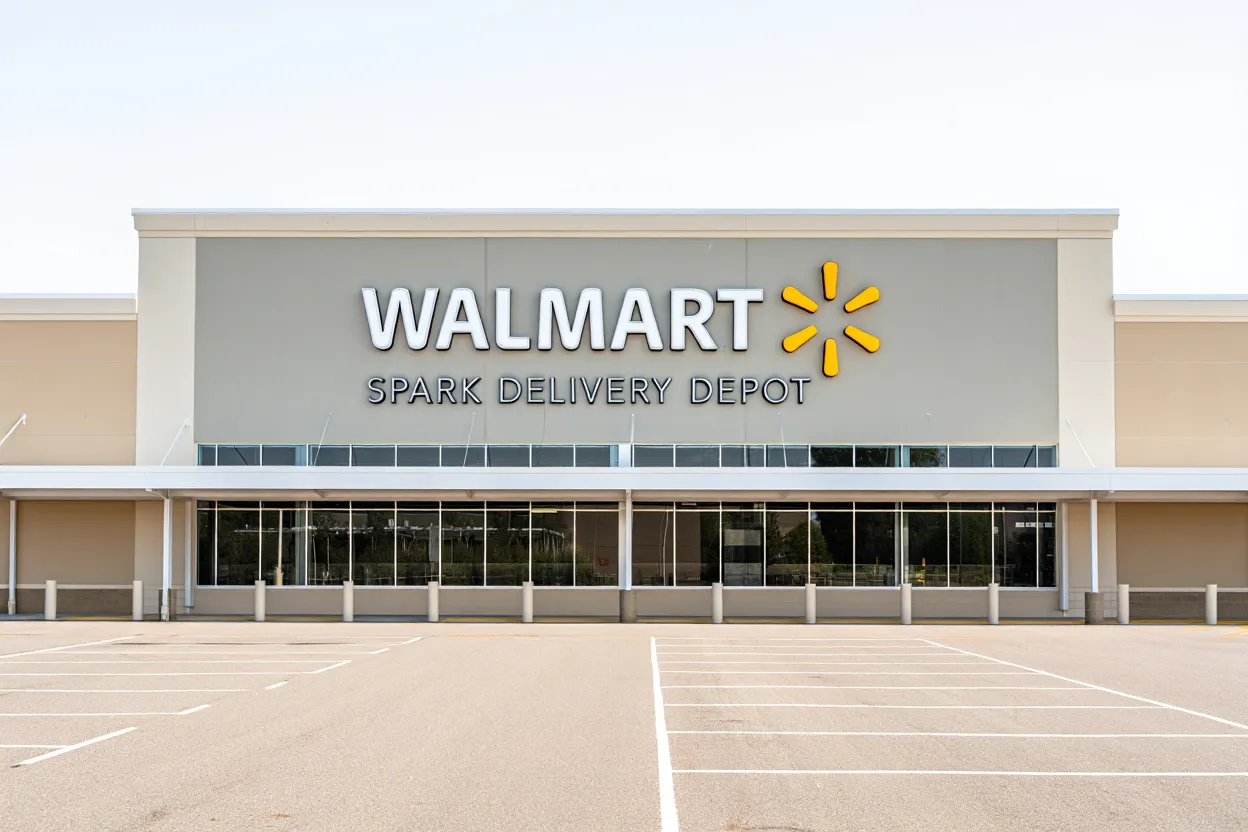
- Walmart has launched Spark Delivery Depots—small, closed-to-public fulfillment hubs—starting in Fayetteville, Arkansas.
- Repurposing 20,000 SF former drugstores, these dark stores focus on stocking high-demand items for rapid local delivery at a premium fee.
- This model leverages Walmart’s store footprint to challenge Amazon’s last-mile advantage and accelerate e-commerce growth in the US.
Walmart Tests Localized Fulfillment Model
Walmart is doubling down on last-mile delivery speed by testing so-called “Spark Delivery Depots” in vacant retail locations, according to Talk Business & Politics. The latest dark store was set up in a shuttered Walgreens at 2964 W. Martin Luther King Blvd. in Fayetteville, Arkansas, joining earlier efforts in Dallas and with more planned in Poughkeepsie, NY, and Carlstadt, NJ. These dark stores are closed to walk-in customers and serve as rapid fulfillment points for online orders, targeting delivery speeds as fast as 30 minutes in select markets for a $10 express fee.
This move signals Walmart’s intent to reconfigure its omnichannel platform at the hyper-local level. The company reported US e-commerce sales just shy of $100B for 2025, up 25% year-over-year, with last-mile innovations like these depots poised to drive further gains.
Get Smarter about what matters in CRE
Stay ahead of trends in commercial real estate with CRE Daily – the free newsletter delivering everything you need to start your day in just 5-minutes
Repurposed Retail Power Play
Walmart launched this pilot as it repurposes underused retail space for faster delivery. The company targets former drugstores averaging 20,000 SF. These include closed Walgreens and Rite Aid locations.
Each depot typically links to a nearby supercenter. Spark drivers pick and deliver popular items from these sites. This setup avoids crowded aisles and in-store shoppers. In Fayetteville, Walmart placed inventory near residential neighborhoods. As a result, deliveries cost less and arrive faster than those from distant distribution centers.
Delivery Depots Shift Last-Mile Equations
Walmart’s micro-fulfillment strategy reflects a wider push to shorten delivery routes. Retail consultant David Happe says Walmart’s 4,600 US stores give it a major edge over Amazon.
He notes that 80% of Walmart’s sales come from 20% of supercenter inventory. That makes it practical to stock only high-demand items in depots. Nearby supercenters can replenish inventory when needed. Walmart’s CFO said 36% of US e-commerce orders arrived within three hours in Q1 2026. Therefore, focusing on fast-moving products could strengthen Walmart’s position.
Why It Matters
Walmart’s Spark Delivery Depots show how retailers can convert vacant stores into logistics hubs. These sites support faster distribution in urban and suburban markets. Walmart’s US e-commerce sales grew 25% year over year. The company has also expanded dark store concepts as online demand and delivery expectations continue to rise. That growth increases pressure to meet same-day and next-hour delivery demands.
By leasing or buying vacant 20,000 SF stores, Walmart lowers real estate costs. At the same time, it speeds up local fulfillment. Other omnichannel retailers use similar strategies as drugstore closures rise.
Traditional big-box stores often struggle with labor-intensive order picking. Depots give delivery drivers dedicated fulfillment space. They also reduce congestion inside stores and keep popular items closer to customers. Happe says 90% of Americans live within 10 miles of a Walmart. Combined with express delivery, that reach has boosted customer engagement and satisfaction. Walmart’s flexible network could set new standards for profitability, speed, and retail reuse.
What’s Next
Walmart still tests the dark store model, but observers expect quick expansion. David Happe expects Walmart to open 20 to 40 depots before sharing detailed results.
Meanwhile, delivery speed and customer satisfaction will remain priorities. Each new depot will reveal the best locations, product mixes, and operating challenges. If the model works, more retailers may redevelop dark stores to improve last-mile efficiency.