








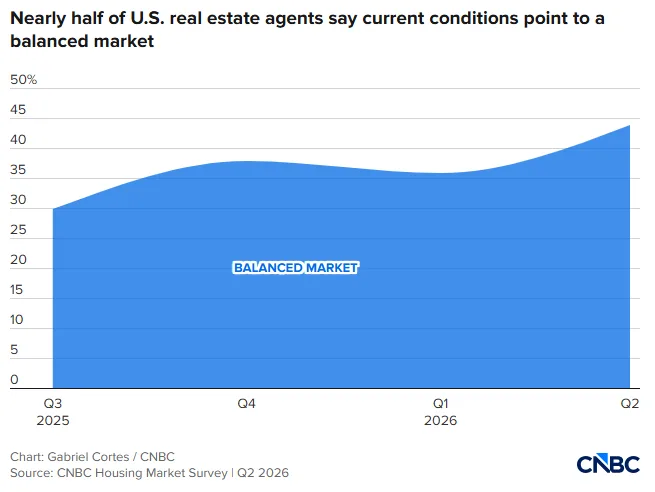
- CNBC’s Q2 Housing Market Survey shows 44% of agents now report market balance, up from 30% in Q3 2025.
- Price cuts and contract cancellations are down, with sellers pricing homes closer to current demand.
- Stubborn mortgage rates keep buyer optimism in check, even as supply conditions ease from pandemic lows.
Agents See a Market Tipping Toward Balance
After several years of highly constrained supply and fast-paced price growth, US real estate agents are increasingly reporting a shift toward a more balanced housing market. According to CNBC’s latest Housing Market Survey, 44% of agents in Q2 2026 described conditions as balanced, up from just 30% in Q3 2025. Responses, gathered from 53 agents across the country in late June, signal that neither buyers nor sellers have a definitive upper hand. This marks a notable change for a residential sector defined by pandemic-era scarcity and extreme competition. The rising share of agents reporting balanced conditions is supported by other indicators, including a decline in price cuts and stabilization in home values.
The National Association of Realtors reported that US home sales in May climbed 3% year-over-year, reflecting slightly higher supply and cooling price expectations. The S&P Cotality Case-Shiller national index shows prices remain about 1% higher than the prior year, while more measured seller pricing is leading to fewer markdowns. According to Realtor.com, June’s asking prices dropped 2.5% year-over-year—the largest annual decline since tracking began in 2017. This normalization may signal a new phase for the US housing market, with buyer leverage returning in some regions and product types after years of frothy conditions.
Get Smarter about what matters in CRE
Stay ahead of trends in commercial real estate with CRE Daily – the free newsletter delivering everything you need to start your day in just 5-minutes
Plateau After Pandemic Surges
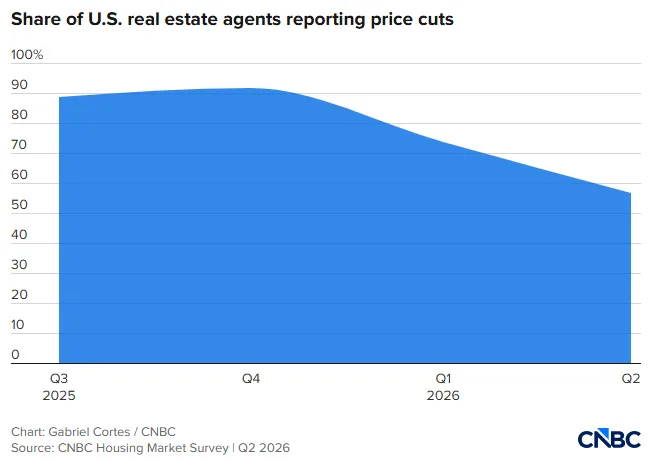
The push toward market balance follows a period of extraordinary volatility, with the pandemic unleashing sharp swings in both supply and demand. Home values and asking prices soared in 2021 and 2022 as buyers competed for limited inventory, while sellers often commanded swift sales and multiple offers. In CNBC’s Q3 2025 survey, a substantial 89% of agents reported at least one price cut among their listings. That share has now fallen to 57% in Q2, reflecting more realistic pricing and muted seller expectations. Industry voices point out that sellers are no longer expecting pandemic-era appreciation, and correctly priced properties are still selling efficiently. The rise in inventory is also noteworthy: Realtor.com calculates 1.1M active homes on the market in June, up sharply from approximately 614,000 in June 2023.
The Details
According to CNBC’s survey, sellers are adjusting to market realities. At least one price cut was reported by 57% of agents in the second quarter—down from 89% in Q3 2025. Contract fall-throughs are also less frequent: only 40% of agents experienced a canceled contract in Q2, compared to 51% in Q1 2026. Asking prices moved in line with supply, dropping 2.5% year-over-year in June per Realtor.com. Meanwhile, home sales notched a 3% annual gain in May, according to NAR, and supply climbed modestly by just under 2%. Despite softening, the market remains far from flooded, with inventory still historically lean but better than the pandemic squeeze. Sellers and agents say aggressive overpricing has waned, resulting in fewer protracted listings and more stabilization overall.
Buyer Sensitivity Persists Despite More Choice
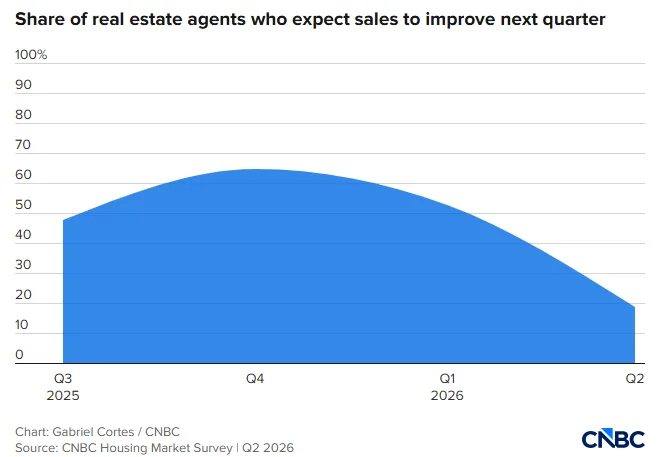
Mortgage rates and affordability remain the biggest hurdles for buyers, even as supply conditions improve. The average 30-year fixed rate hovered around 6.6% in late June, according to Mortgage News Daily, and 37% of agents surveyed by CNBC cited rates as buyers’ top concern, up from 26% at the end of 2025. Reflecting that caution, only 19% of agents expect sales activity to improve in the near term, while 67% anticipate flat conditions.
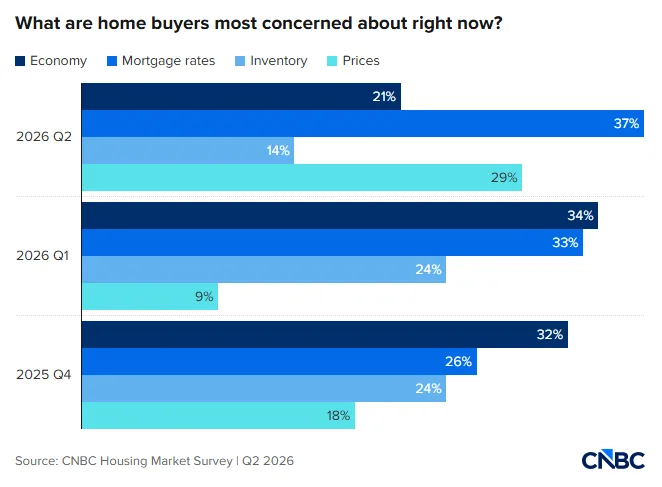
Inventory pressures have eased, with active listings and new listings both rising year over year, according to Realtor.com. But despite more options and less competition, many buyers remain sidelined until borrowing costs or affordability improve.
Why It Matters
The national housing market is moving toward normalization, with pricing volatility easing and buyer and seller expectations becoming more aligned. The 14-point increase since late 2025 in agents describing a balanced market suggests less volatility for investors, brokers, and developers. Sellers are increasingly pricing homes to current demand rather than pandemic-era expectations, while buyers face less competition.
Rising inventory is helping shift leverage back toward buyers. Realtor.com data shows active listings have nearly doubled over the past three years, creating more negotiating room even as high mortgage rates continue to weigh on affordability. For CRE professionals, the takeaway is clear: future gains may depend more on market selection and strategy than broad-based appreciation.
What’s Next
The housing market appears poised for a relatively balanced second half of 2026 unless lower rates or stronger demand shift the equation. CNBC’s survey found that just 19% of agents expect sales activity to improve, with most anticipating little change in the months ahead.
CRE professionals should watch for growing divergence across markets. Some Sun Belt and Midwest metros are becoming more buyer-friendly as inventory rises, while high-cost coastal markets may remain constrained until affordability improves.