




- Cotality reports that 2.5M properties across ten states face moderate wildfire risk, with a $1.4T reconstruction cost.
- The new analytics approach accounts for fire spread between structures, sharply raising exposure and refining insurance models.
- Growing wildfire risk challenges CRE underwriting, driving demand for more granular risk assessments and mitigation strategies.
Wildfire Risk Rises on New Analytic Methods
A new Cotality report recalibrates US wildfire risk by focusing on the 10 states with the greatest property exposure. Bisnow reports that Cotality now considers over 2.5M properties in these states at least moderately at risk. Those properties carry $1.4T in reconstruction value based on the latest estimates.
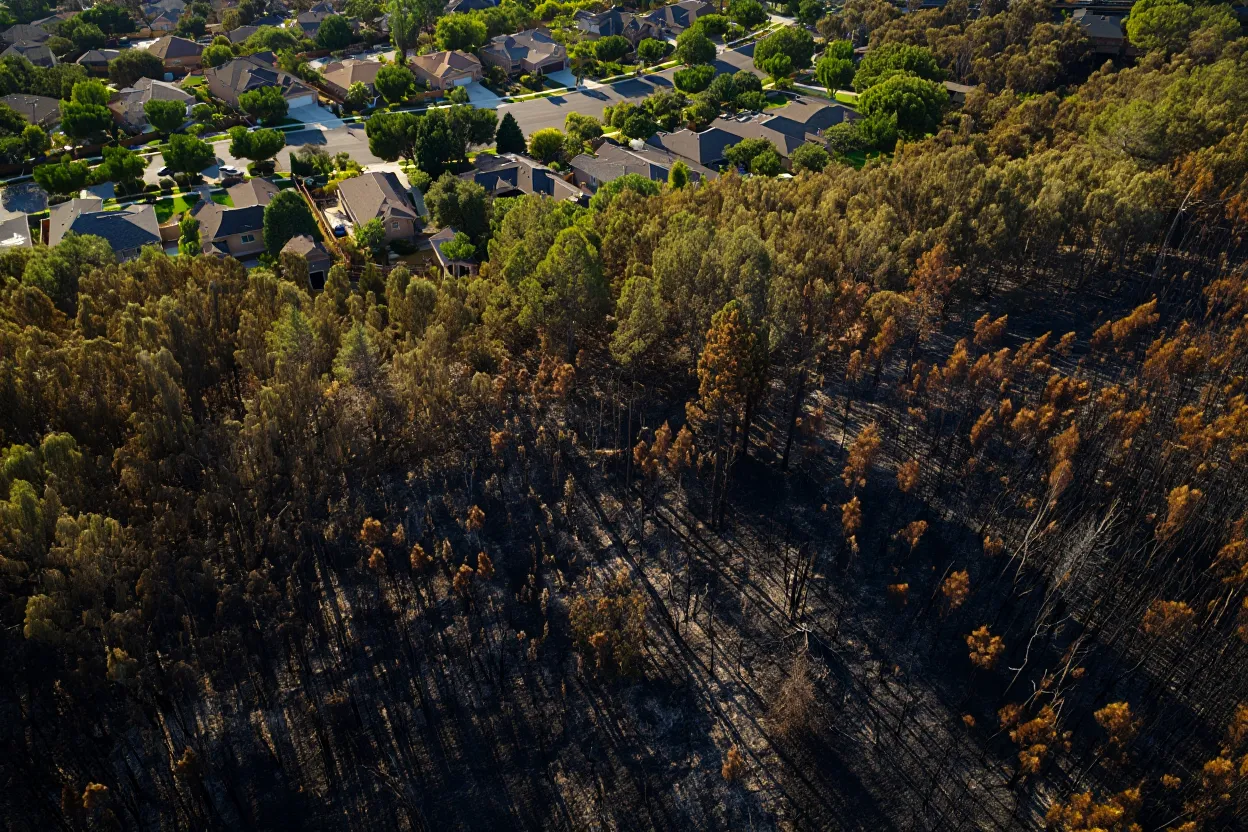
That figure exceeds earlier models that overlooked how flames can spread rapidly between structures. The research shows growing vulnerability across high-density CRE, residential neighborhoods, and expanding suburban areas. Fire behavior has also shifted as development pushes deeper into exposed regions. Cotality now evaluates structure-to-structure spread alongside traditional wildfire exposure.
Get Smarter about what matters in CRE
Stay ahead of trends in commercial real estate with CRE Daily – the free newsletter delivering everything you need to start your day in just 5-minutes
The Details
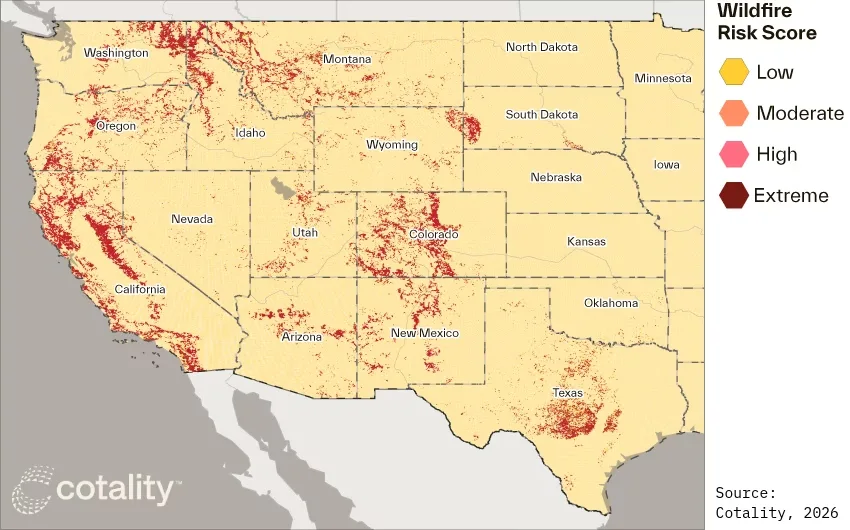
Cotality identifies California as the center of US wildfire risk, with 1.28M properties exposed. Those properties represent more than half of the top 10 states’ total exposure. They also carry $850B in potential reconstruction costs. However, nearly half of the 2.5M at-risk properties sit outside California.
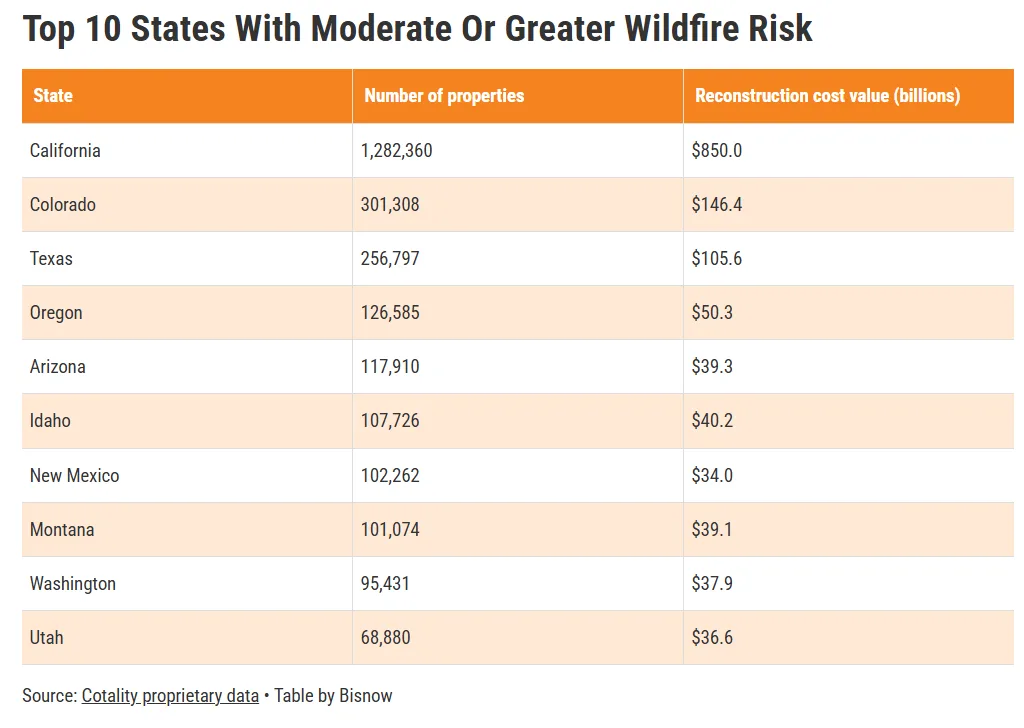
Colorado and Texas combine for 560,000 at-risk properties, representing $252B in reconstruction costs. Oregon, Arizona, Idaho, New Mexico, Montana, Washington, and Utah complete the list. Los Angeles leads US metros with 250,000 properties at risk. Austin leads non-California cities with $49B exposed, followed by San Antonio, Denver, and Spokane.
Cotality combines traditional terrain and vegetation metrics with more dynamic property-level factors. These include structure density, wind patterns, and building material composition. Legacy underwriting and risk-scoring models often overlooked these factors.
Changing Underwriting in the Face of Conflagration
Wildfire exposure increasingly intersects with CRE migration and development trends. Pandemic-era migration moved more Americans into fire-prone corridors, bringing additional construction and investment. Cotality executive John Rogers said climate risks accelerated during this period. He spoke at the 2026 National Association of Real Estate Editors conference.
Rogers also said 41% of occupied US rental units now face extreme weather risks. For property owners and CRE lenders, these conditions create tougher insurance markets and new due diligence requirements. Insurers continue adjusting premiums and coverage across fire-prone regions. Rising insurance costs are already reshaping migration patterns as households reconsider moves toward increasingly expensive high-risk markets. These pressures could slow migration and reduce investment activity in exposed markets.
Meanwhile, underwriters increasingly favor granular, property-level analytics over broad risk models. These tools can better match policies with actual property threats, including structure-to-structure transmission.
Climate Change, Migration, and Insurance Pressure
Wildfire exposure increasingly intersects with CRE migration and development trends. Pandemic-era migration moved more Americans into fire-prone corridors, bringing additional construction and investment. Cotality executive John Rogers said climate risks accelerated during this period. He spoke at the 2026 National Association of Real Estate Editors conference.
Rogers also said 41% of occupied US rental units now face extreme weather risks. For property owners and CRE lenders, these conditions create tougher insurance markets and new due diligence requirements. Insurers continue adjusting premiums and coverage across fire-prone regions. These pressures could slow migration and reduce investment activity in exposed markets.
Meanwhile, underwriters increasingly favor granular, property-level analytics over broad risk models. These tools can better match policies with actual property threats, including structure-to-structure transmission. CRE professionals should expect new underwriting workflows, risk pricing, and potential regulations covering building materials and density. Structural hardening, defensible space, and stronger fire response could also become bankable CRE investment strategies.
What’s Next
Underwriters and investors increasingly use granular wildfire analytics to refine portfolio exposure and pricing strategies. More nuanced insurance products and risk-rated loan terms could follow. Institutional investors may also demand greater transparency around wildfire and broader climate exposure.
Longer and more severe fire seasons could encourage regulators to strengthen building codes in high-risk areas. Governments may also expand incentives for property hardening or relocation. Wildfire analytics are moving beyond back-office compliance and becoming central to CRE investment decisions.