



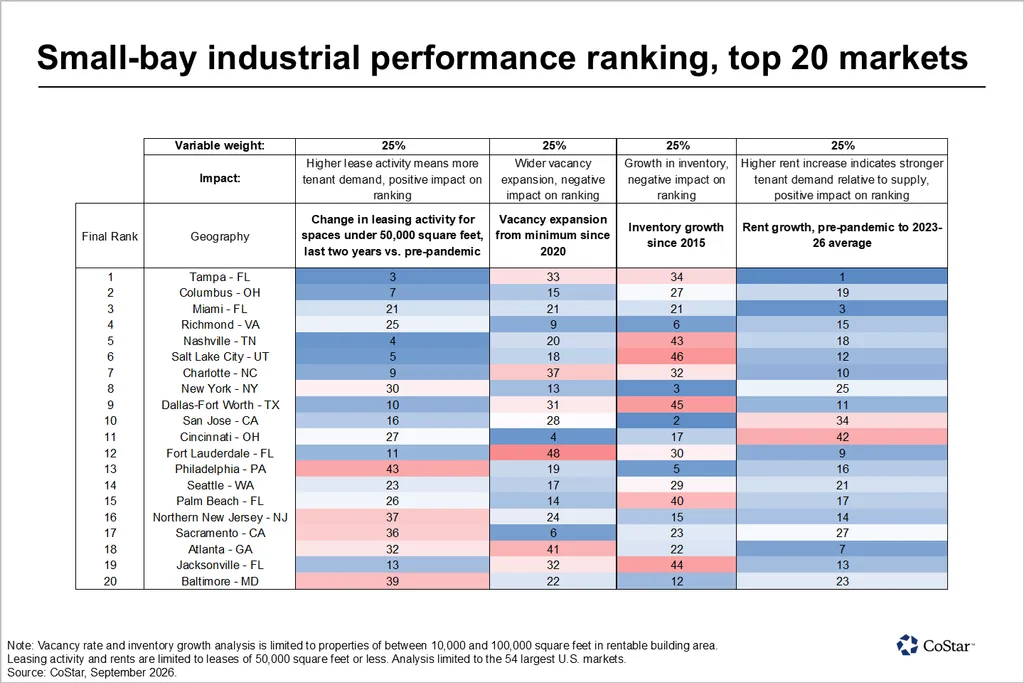
- Tampa ranked first among 54 large US small-bay industrial markets, supported by the strongest rent growth and third-best leasing growth.
- Columbus ranked second, with strong demand concentrated in the Airport and Hilliard infill submarkets.
- CoStar says small-bay performance remains tied to population growth, local business formation, and limited infill supply.
CoStar Group reports in its updated small-bay industrial ranking that Tampa and Columbus lead the sector among the 54 largest US markets. The analysis compares leasing growth, vacancy expansion, inventory growth, and rent gains. Tampa ranked first, while Columbus took second place. The results show strong small-bay demand even as broader industrial fundamentals weaken.
Get Smarter about what matters in CRE
Stay ahead of trends in commercial real estate with CRE Daily – the free newsletter delivering everything you need to start your day in just 5-minutes
Small-Bay Industrial Details
Tampa ranked third for leasing activity growth and first for rent growth in CoStar’s latest analysis. National Industrial Analytics Director Juan Arias said small-bay leasing remains substantially above pre-pandemic levels. He tied demand to construction, manufacturing, logistics, and service-oriented businesses. Supply has stayed relatively constrained compared with other Sun Belt markets. That has helped smaller and newer industrial buildings capture the strongest tenant interest. Arias also said developers are shifting toward smaller projects as demand for large speculative facilities cools.
Columbus Holds Balanced Conditions
Columbus placed second because of strong leasing activity and elevated rent increases. The market ranked seventh for leasing growth and 15th for vacancy expansion. CoStar said the Airport and Hilliard submarkets captured much of the local small-bay demand. Both are infill locations benefiting from population growth and last-mile distribution needs. Limited construction has kept availability relatively low. That has preserved landlord pricing power despite broader economic uncertainty and several years of industrial development.
How CoStar Measured the Sector
The ranking compared four variables. CoStar measured leasing for spaces under 50K SF over the last two years. It compared that activity with the pre-pandemic average since 2015. The analysis also tracked vacancy expansion for 10K to 100K SF properties. Inventory growth since 2015 covered buildings 100K SF or smaller. The final variable compared recent small-bay rent growth with pre-pandemic averages. Small-bay industrial has continued to outperform larger formats in several markets.
Why It Matters
The updated ranking shows that weaker national industrial fundamentals are not affecting every building type equally. Small-bay demand remains closely linked to local business formation, population growth, and hard-to-replicate infill locations. Tampa benefits from limited new supply as larger speculative facilities cool. Columbus shows a similar advantage in select infill nodes. For owners, tenant depth and constrained construction can support occupancy and pricing. Those advantages can remain meaningful even when the broader industrial market loses momentum.