






- With the 10-year Treasury above 5%, REIT buyers and sellers cannot agree on price, and a gap of about 10% to NAV is too narrow to make REITs takeover targets or acquirers, per Hoya Capital.
- Large deals still closed, including AvalonBay and Equity Residential’s all-stock merger creating a 180,000-unit REIT valued at $69B, and Public Storage’s $10.5B purchase of National Storage Affiliates.
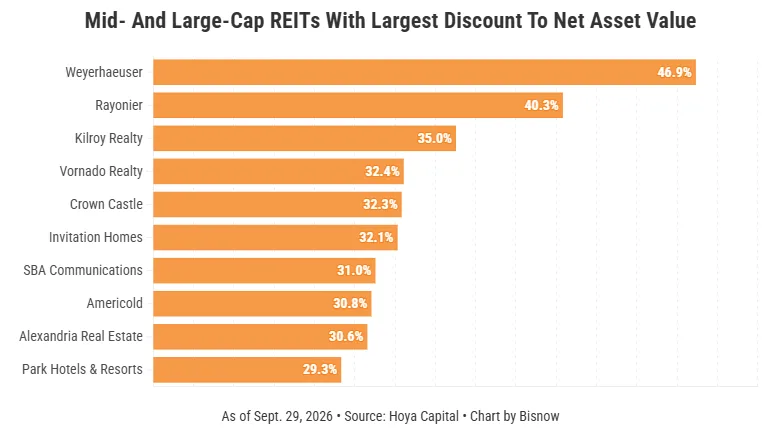
- Nine REITs above $3B in market cap trade at NAV discounts of 30% or more while Welltower trades near a 97% premium, so deals hinge on whether discounts widen or premiums persist.
REIT dealmaking is slowing as Treasury yields climb past 5%, leaving buyers and sellers unable to agree on price, Bisnow reports in its look at REIT M&A.
The 10-year is at a level last seen in 2002. REIT shares are also trading closer to their asset values than in years, which makes them neither cheap enough to be taken over nor rich enough to be buyers.
Get Smarter about what matters in CRE
Stay ahead of trends in commercial real estate with CRE Daily – the free newsletter delivering everything you need to start your day in just 5-minutes
Pricing Gap Freezes Deals
Haendel St. Juste, a REIT analyst at Mizuho Americas, told Bisnow after Mizuho’s annual digital REIT conference that management teams there described acquisitions as paused. Purchasers are demanding wider cap rates after their cost of capital jumped, while sellers still expect the prices available when debt was cheaper.
Hoya Capital data put the average REIT at roughly a 10% discount to net asset value. That compares with the 15%-to-30% gaps typical of recent years.
Stuck in the Middle
Alex Pettee of Hoya Capital told Bisnow by email that the smaller gap between public and private values should keep M&A in a holding pattern until REITs rise enough to buy or fall enough to be bought.
Cohen & Steers’ Seth Laughlin told Bisnow that rates need to steady before activity speeds up, especially take-privates. He said public pricing is too uniform within each asset class, so public-to-public deals lack appeal without more divergence.
Big Deals Still Got Done
A few large transactions have padded the totals even as deal counts stay low. AvalonBay and Equity Residential completed an all-stock combination in August, forming a 180,000-unit apartment REIT with a $69B enterprise value, now the largest apartment REIT in the U.S.
Public Storage agreed to buy National Storage Affiliates in a $10.5B all-stock deal. Independence Realty Trust plans an all-stock combination with Centerspace to create a 44,000-apartment company valued at $8.1B, though a minority shareholder wants IRT to explore a sale instead.
Bisnow’s own count shows a dozen or more additional REITs merging or going private over the past year. Laughlin said this year’s takeouts are about adding scale rather than value-add buying.
Who Trades Cheap, Who Trades Rich
Hoya says 30 or more REITs trade at NAV discounts of 20% or deeper. Nine with market caps above $3B trade at discounts of 30% or deeper, among them office REITs Kilroy Realty and Vornado Realty Trust, and Park Hotels & Resorts sits just under that line. UDR, Vivmark and Mid-America Apartment Communities trade at discounts of at least 22%.
At the other end, 2nd Market Capital shows Welltower near a 97% premium to NAV, American Healthcare REIT at 56% and Ventas at 35%. Janus Living trades roughly 35% above NAV. Laughlin said senior housing offers higher yields, so those REITs keep deploying capital while private competition retreats.
Why It Matters
Pettee argues a large enough NAV discount can overcome higher borrowing costs, as it did repeatedly when REITs traded 20% to 30% below NAV. If public REITs hold their valuations, their balance sheets and capital access beat most private owners. If they slide, they become targets for private buyers, whose pricing has been slower to reset.
Market volatility is part of the picture, as REITs fell 5.7% in September.
What’s Next
Laughlin cautioned that M&A is hard to predict. Pettee’s framework is that rates set the backdrop while the NAV discount decides where capital and assets flow, so watch both the 10-year and how far REIT discounts move.