





- Retail property income has remained steady, even as the Michigan sentiment index hit a record low in May.
- Adjusted sentiment data suggest consumer spending will cool, but not collapse, with the weakest retail CRE assets most at risk.
- Ongoing monitoring of loan-level performance is key—headline sentiment misses early signs of distress within retail’s bottom quartile.
Sentiment-Spending Dislocation Since 2020
Retail properties continue to perform even as consumer sentiment data suggest a dire outlook. According to Trepp, there is a striking divergence. The University of Michigan’s sentiment index hit a record low in May. That same month, US retail sales reached a trailing-year high.
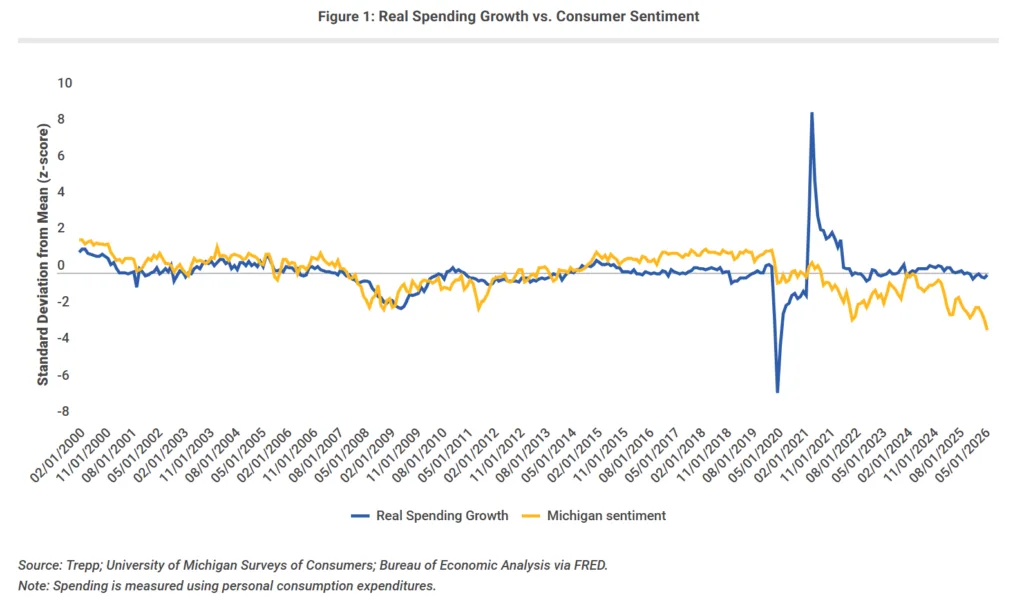
This divergence leaves CRE investors weighing which signal to trust. Previous cycles saw retail spending and sentiment move together. Sentiment downturns typically foreshadowed weaker consumer spending. However, that correlation has broken down since 2020. Consumer sentiment remains near recessionary levels without matching declines in retail spending or property income.
Retail property net operating income (NOI) usually tracks consumer demand closely. Retail sales remain firm, weakening the case for lower CRE rent or income assumptions. Still, investors should watch early distress signals as performance differences across assets widen.
Get Smarter about what matters in CRE
Stay ahead of trends in commercial real estate with CRE Daily – the free newsletter delivering everything you need to start your day in just 5-minutes
The End of One-to-One Signaling
For two decades, sentiment and spending moved as reliable partners. Before the pandemic, weaker sentiment often accompanied cautious spending and lower property income. Now, shoppers have largely kept their wallets open despite persistent pessimism in surveys.
According to the source, this decoupling accelerated when the Michigan survey moved online in April 2024. The change contributed to record-low headline sentiment readings. Meanwhile, the Chicago Fed’s alternate Consumer Sentiment Index showed only routine weakness. Measurement quirks may therefore drive much of the divergence.
CRE participants relying on these headlines for recession signals could misread current consumer behavior. Owners should prioritize occupancy, DSCR, and tenant performance over sentiment headlines alone. Investors also need sharper monitoring of bottom-quartile assets for emerging risks.
The Details
The Michigan sentiment index registered 49.5 in June. Meanwhile, the Chicago Fed’s adjusted reading stood much higher at 72.3. This discrepancy largely traces back to the Michigan survey’s shift toward online interviews. The Chicago Fed’s recalibrated signal suggests 2022-like conditions rather than a crisis.
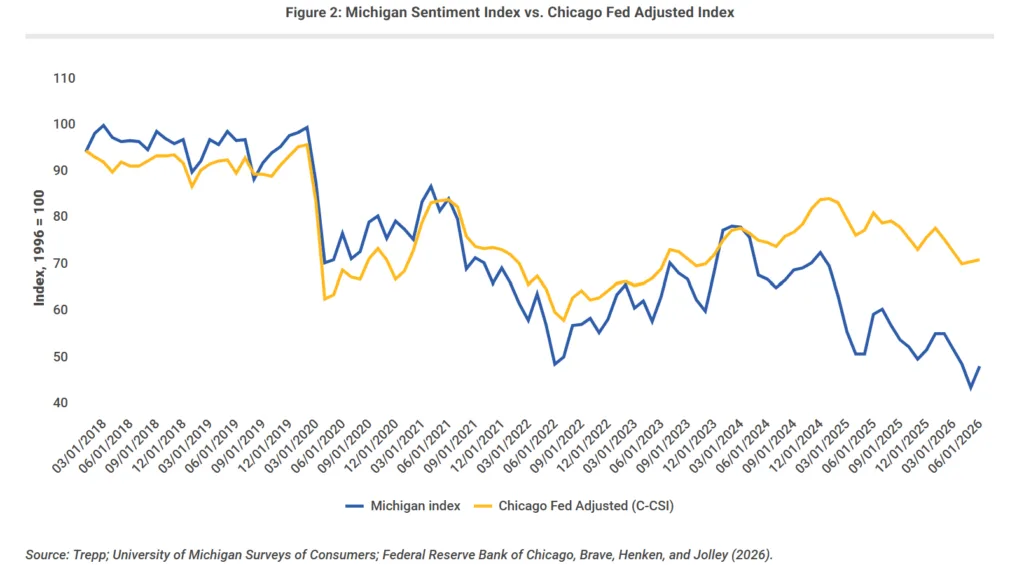
The adjusted reading puts near-term Personal Consumption Expenditure growth near 2%. That sits barely below the current 2.1% run rate. It also exceeds the 1.3% implied by Michigan’s unadjusted reading. Trepp tracks 3,664 CMBS retail properties on watchlists. Only 84 have DSCRs below 1.0x or show early income distress.
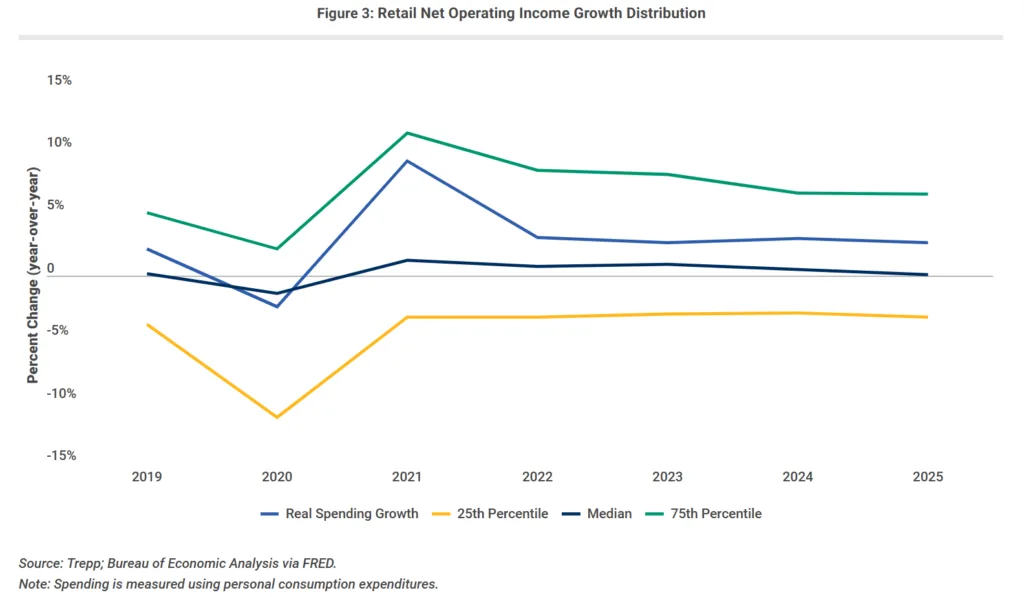
Median retail NOI has remained steady at roughly 1% year-over-year growth. New Braunfels Market Place maintains 95% occupancy and a DSCR above 5x. Pavilions North Shopping Center tells a different story. Large tenant losses and falling occupancy eventually foreshadowed cash management triggers.
Distress Concentrates at the Bottom
The divide between median performers and distressed properties echoes the 2020 retail stress test. Most properties recorded flat or modest NOI growth. However, bottom-quartile properties suffered much steeper income declines.
Broader CMBS strength can also mask stress concentrated in weaker properties and loans. Owners should focus on discretionary tenants and persistent watchlist placement. Retail losses rarely spread evenly across the sector. Weaker properties often show trouble before headline retail sales reveal slowing demand.
Granular data provide better early warnings than aggregate indicators. Pavilions North Shopping Center offers one example. Occupancy plunged from the low-40% range into the low-20% range. The property only partially recovered before lender intervention. Similar failures could emerge first among older or poorly tenanted strip centers.
Why It Matters
Retail investors and landlords should avoid overreacting to the latest sentiment headlines. The record-low Michigan index in May may overstate consumer weakness. The Chicago Fed’s recalibrated measure paints a less severe picture. Spending also remains near long-term averages.
Meanwhile, NOI growth and DSCR show few signs of widespread retail distress. Owners have little reason to broadly revise income projections based solely on negative sentiment surveys. However, Trepp’s loan-level data highlight watchlist placement and DSCR deterioration as earlier warning signals.
The sector’s median remains healthy, but performance differences continue widening. Grocery-anchored, high-occupancy centers with national tenants remain resilient. Older properties and discretionary-focused centers face greater vulnerability. Investors should prioritize tenant rosters, cash flow coverage, and servicing flags when assessing future risks.
What’s Next
The next meaningful retail CRE signals will likely come from watchlist and DSCR trends. Aggregate sentiment metrics may provide less reliable guidance. CRE professionals should closely track property-level loan performance and tenant disruptions. Centers exposed to vulnerable discretionary retailers deserve particular attention.
Conditions could change if adjusted sentiment declines alongside actual retail income and spending. That combination would strengthen the case for lower rent assumptions. It could also force investors to revise acquisition models.
Until then, investors should separate headline noise from operational reality. Tenant-level performance will likely carry more weight than survey mood swings.