




- Zillow found that Buffalo, Chicago and Houston posted the largest annual increases in out-of-town rental search activity.
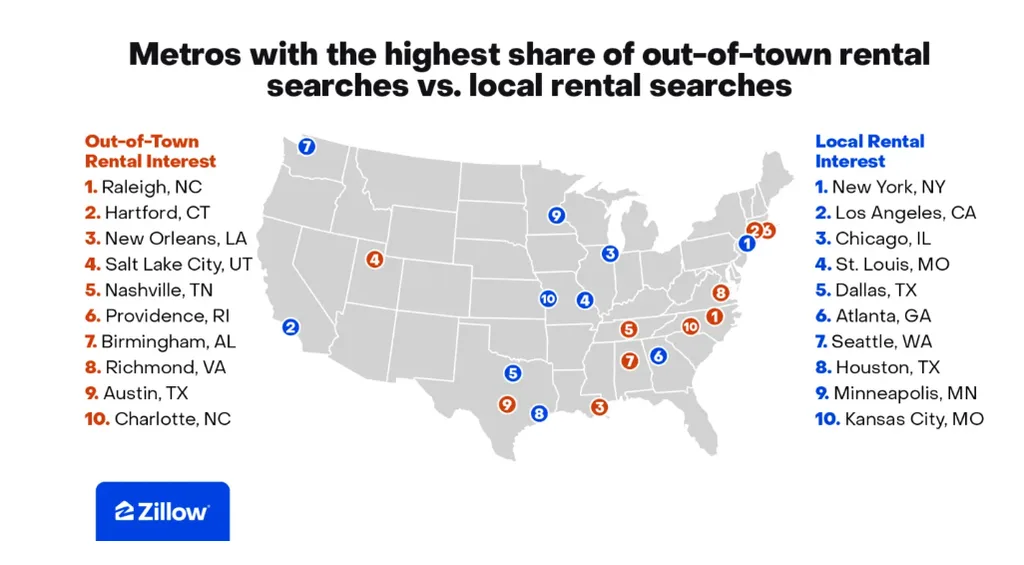
- Raleigh led major markets with 59% of rental listing views coming from outside the metro, while New York was far more locally driven at 23.7%.
- Cross-market searches remain concentrated among neighboring metros, but New Yorkers continue to show strong interest in Florida and other Sun Belt markets.
Zillow’s rental search trends point to shifting relocation demand across US housing markets, with out-of-town renters showing the strongest gains in Buffalo, Chicago and Houston. The findings, published by Zillow Research on September 2, are based on rental listing page views and offer a look at where prospective renters are shopping before they potentially move.
That makes search behavior an early indicator for rental demand. Buffalo’s share of out-of-town rental views rose 4.2 percentage points year over year, followed by Chicago at 3.7 points and Houston at 3.4 points. Zillow’s data suggests those markets are attracting more attention from renters outside their existing metros, even before that interest appears in completed moves or leasing activity.
Get Smarter about what matters in CRE
Stay ahead of trends in commercial real estate with CRE Daily – the free newsletter delivering everything you need to start your day in just 5-minutes
Rental Search Trends Reveal New Demand Patterns
Rental search behavior can provide a useful lead indicator because prospective movers often research housing before committing to a new market. Zillow’s analysis shows that the strongest increases are not limited to one region or a single type of market.
Buffalo recorded the largest increase in outside rental interest, with its share of out-of-town page views climbing 4.2 percentage points year over year. Chicago followed at 3.7 points, Houston at 3.4 points, New Orleans at 3.2 points and Dallas at 3 points.
The pattern contrasts with markets where local interest is strengthening. Cincinnati’s share of local rental views increased 8.1 percentage points, while Jacksonville rose 4.6 points and Columbus gained 3.2 points. That split suggests some markets are increasingly dependent on incoming renters, while others are seeing more demand from residents already in the area.
The Details
Raleigh had the highest share of out-of-town rental searches among the markets analyzed, with 59% of rental listing page views coming from outside the metro. Hartford followed at 55.1%, while New Orleans, Salt Lake City and Nashville posted shares of 53.7%, 51.9% and 51.7%, respectively, according to Zillow.
Providence also crossed the 50% threshold at 51.5%. Zillow previously named Providence its hottest rental market for 2026, adding context to the strength of interest in the Rhode Island market.
At the other end, New York recorded 23.7% of rental views from out-of-town shoppers, while Los Angeles stood at 27.1% and Chicago at 30.9%. Larger populations help explain the high local shares in these major metros, where a deeper pool of potential renters is already searching within the market.
Neighboring Markets Still Drive Most Searches
The strongest rental search flows generally connect nearby metros, underscoring the importance of regional migration rather than purely long-distance relocation. Washington, DC renters accounted for 23.9% of Baltimore’s rental listing views, while Los Angeles shoppers represented 21.3% of views in Riverside.
Other major flows include San Francisco to San Jose at 17.6% and Boston to Providence at 16.1%. Those patterns can reflect renters moving for jobs, affordability or lifestyle reasons while remaining within the same broader economic region.
Long-distance searches tell a somewhat different story. Among searches between markets in different states and at least 100 miles apart, New York renters generated 6% of Hartford’s rental listing views. Los Angeles renters accounted for 5.5% of Las Vegas views, while Houston renters represented 5.2% of Oklahoma City views.
Why It Matters
For multifamily owners, developers and investors, search activity offers a potential early read on where renter demand is developing. It does not guarantee a corresponding increase in leases, but a sustained rise in out-of-market interest can identify markets attracting attention before migration data fully captures the shift.
The geographic patterns also reinforce the importance of relative affordability and proximity. Many of the largest search flows connect neighboring markets, suggesting renters may be expanding their housing search radius rather than making entirely new geographic bets. That can matter for operators competing for tenants across a regional portfolio.
The New York-to-Sun Belt flows stand out as a longer-distance exception. Zillow found that New York-area renters accounted for 4.8% of Miami rental views, 2.7% of Orlando views and 2.4% of Tampa views. They also represented 2.8% of Raleigh’s rental views, despite the roughly 425-mile distance.
For investors, those flows can help distinguish markets benefiting from local demand from those increasingly drawing renters from elsewhere.
What’s Next
The next question is whether rising search activity translates into stronger leasing demand. Zillow’s September 2026 analysis cannot establish that connection by itself, but the direction of travel provides a useful signal for markets where incoming renter interest is accelerating.
Buffalo, Chicago and Houston warrant particular attention because they recorded the largest year-over-year increases in out-of-town search share. Minneapolis, Miami, Pittsburgh and Las Vegas also posted gains of at least 1.8 percentage points.
Meanwhile, markets with declining outside interest, including Cincinnati, Jacksonville and Columbus, may be seeing a greater share of demand generated internally. Tracking whether those search patterns persist could give multifamily owners and developers a clearer read on where relocation demand is translating into actual housing needs.