








- Coworking prices vary widely across US metros, with monthly memberships ranging from $129 to $340.
- Day passes have a $31 national median, while meeting rooms sit at $45 and virtual offices at $179.
- Hybrid workspace strategies can reduce costs, with modeled savings of about $188 per person annually in 65 of 66 metros.
Coworking operators are pricing four distinct products across US metros, and the gaps can materially change how companies structure flexible workspace budgets. According to CoworkingCafe’s Coworking Price Report, monthly memberships have a $190 national median, while day passes, meeting rooms and virtual offices show very different pricing patterns.
The study covers 119 metros for memberships, 92 for virtual offices, 83 for meeting rooms and 82 for day passes, using markets with at least five listings in each category. The results show that location matters, but so does usage: for many teams, the cheapest headline rate is not necessarily the lowest total occupancy cost.
Get Smarter about what matters in CRE
Stay ahead of trends in commercial real estate with CRE Daily – the free newsletter delivering everything you need to start your day in just 5-minutes
Small Markets Drive Membership Extremes
Memberships remain the largest recurring expense in the study, with a $190 monthly median across the 119 metros analyzed by CoworkingCafe. Anchorage topped the list at $340, nearly 80% above the national benchmark. Albany, NY, and Bend, OR, followed at $285 and $282.
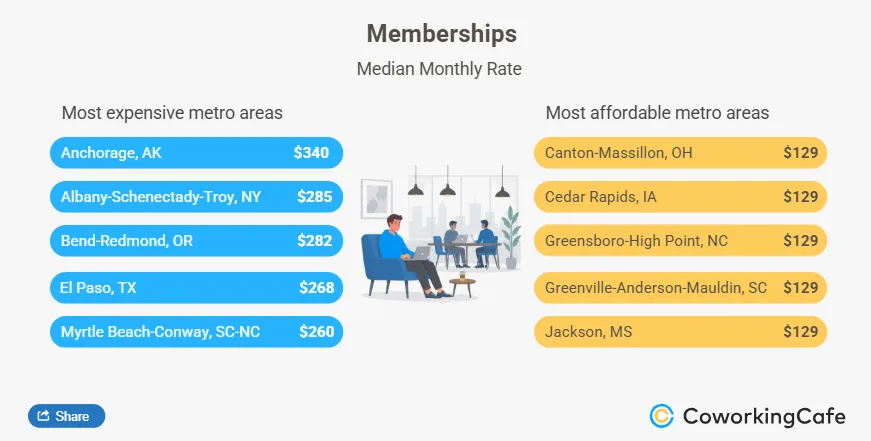
At the affordable end, Canton-Massillon, OH; Cedar Rapids, IA; Greensboro-High Point, NC; Greenville-Anderson-Mauldin, SC; and Jackson, MS, all posted a $129 median. The spread suggests local competition and market depth can matter as much as metro size. New York City, for example, had a $250 median across 288 priced properties, while several smaller metros with fewer listings ranked above it.
The Details
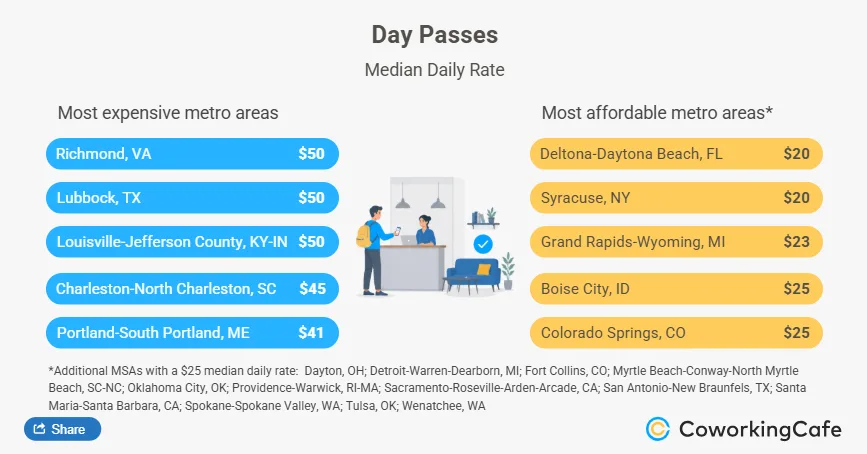
Day passes carried a $31 national median, according to CoworkingCafe, with Louisville, KY-IN; Lubbock, TX; and Richmond, VA, tied at $50. Deltona-Daytona Beach, FL, and Syracuse, NY, had the lowest median at $20. The category had the narrowest pricing range of the four, with the top rate 2.5 times the bottom.
Meeting rooms showed a $45 national median. Santa Maria-Santa Barbara, CA, was highest at $80 per hour, while Deltona-Daytona Beach, Lancaster, PA, and Wichita, KS, tied at $25. Pittsburgh fell to $62.50 from $75 in the prior edition, making it the clearest comparable decline cited in the report.
Virtual offices, included for the first time in this edition, had a $179 national median across 92 metros. Naples, FL, and Knoxville, TN, led at $225, while College Station-Bryan, TX, was lowest at $50. The 4.5-times spread was the widest among the four products.
Usage Changes the Break-Even
The relationship between coworking memberships and day passes is more useful than either price alone. CoworkingCafe found that, across 66 metros with data for both products, a monthly membership costs about the same as 6.5 day passes. That puts the rough financial break-even point at about 1.5 office days per week.
The local spread is meaningful. Albany’s $285 membership and $30 day pass produce a ratio of roughly 9.5 passes, while Charleston, SC, sits at 3.9 with a $175 membership and $45 day pass. In Charleston, a worker using coworking about once a week can already reach the membership break-even point.
For operators and occupiers, that means flexible workspace decisions cannot be reduced to a national median. Teams need to weigh local rates against expected attendance, while also considering practical benefits such as dedicated storage and a consistent workstation.
Why It Matters
The report points to a broader shift in how companies can manage flexible workspace. A hybrid setup does not automatically mean abandoning memberships. Instead, the mix of memberships, drop-ins and meeting-room usage can be tuned to actual attendance patterns.
CoworkingCafe’s modeled scenarios reinforce that point. In 65 of 66 metros, replacing memberships for 20% of employees with four day passes per month lowered annual costs, producing an average saving of about $188 per person. At national benchmark prices, the report modeled a five-person team at $3,055 per person annually with full memberships versus $2,866 under the hybrid approach.
Meeting rooms can be an even larger budget driver. CoworkingCafe found that they account for roughly 40% of the bill for 10- and 25-person teams under its scenarios. A 10-person team using 30 meeting-room hours per month would spend about $15,837 annually on those rooms at the report’s benchmark assumptions. That makes meeting-room utilization a potentially bigger lever than the membership-versus-day-pass decision.
What’s Next
The data suggests occupiers will have more reason to evaluate coworking costs at the metro and usage level rather than rely on a single national benchmark. Virtual offices add another variable for companies that need a market presence without regular desk usage, but their 4.5-times price spread indicates substantial local variation.
For operators, the pricing differences also highlight the importance of product mix. Day passes can attract light users, memberships serve recurring demand, meeting rooms monetize episodic collaboration, and virtual offices capture customers who need an address more than workspace. As companies continue balancing office attendance with flexible work, those products may increasingly be evaluated as parts of one workspace budget rather than separate purchases.