




- Pittsburgh ranked first among midsized US cities for Gen Z, narrowly beating Madison, Wis., and Lincoln, Neb.
- The ranking weighs affordability, graduate-friendly jobs, unemployment, education, transit, internet costs, recreation and parks.
- The results show how midsized markets can compete for young professionals by pairing career access with a lower cost of living.
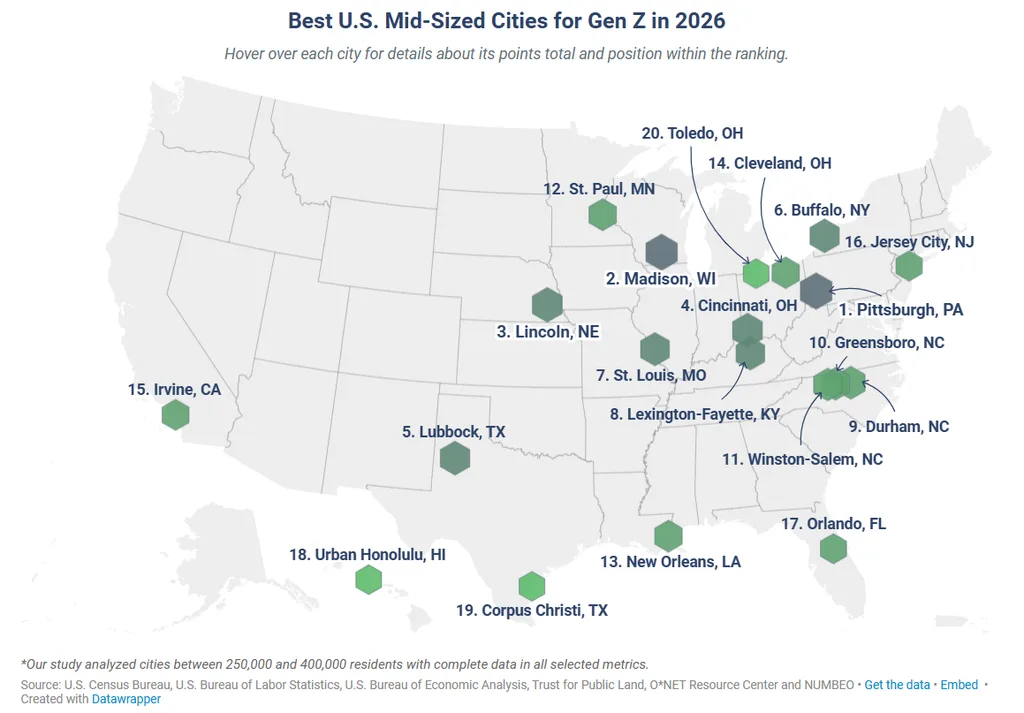
Pittsburgh leads the 2026 list of the best midsized cities for Gen Z, according to CommercialCafe’s annual analysis of US markets with 250,000 to 400,000 residents. The city scored 69.4 points, just ahead of Madison, Wis., at 68.4.
The ranking evaluates nine measures tied to affordability, career opportunity and quality of life. Data comes from the US Census Bureau, Bureau of Labor Statistics, Bureau of Economic Analysis, Trust for Public Land, O*NET Resource Center and Numbeo.
Get Smarter about what matters in CRE
Stay ahead of trends in commercial real estate with CRE Daily – the free newsletter delivering everything you need to start your day in just 5-minutes
A Broader Talent Competition
Young workers face a tougher entry into the labor market, while AI adds another layer of uncertainty around early-career jobs. That makes location more important for cities trying to attract and retain emerging talent.
CommercialCafe’s methodology focuses on adults ages 20 to 24, using 2024 Census data for Gen Z population share, educational enrollment and unemployment. It also incorporates 2025 Bureau of Labor Statistics data on jobs suited to recent graduates.
The affordability component uses 2024 Bureau of Economic Analysis data and accounts for regional price differences across goods, housing, utilities and other services. The approach favors cities that can offer a credible path from school to employment without forcing young workers into the highest-cost markets.
The Details
Pittsburgh’s advantage came from consistency rather than a single dominant metric. CommercialCafe found that the city posted four top-five finishes and ranked in the top half across all nine measures. Its 69.4-point score put it only one point ahead of Madison, while Lincoln trailed the leader by 6.9 points.
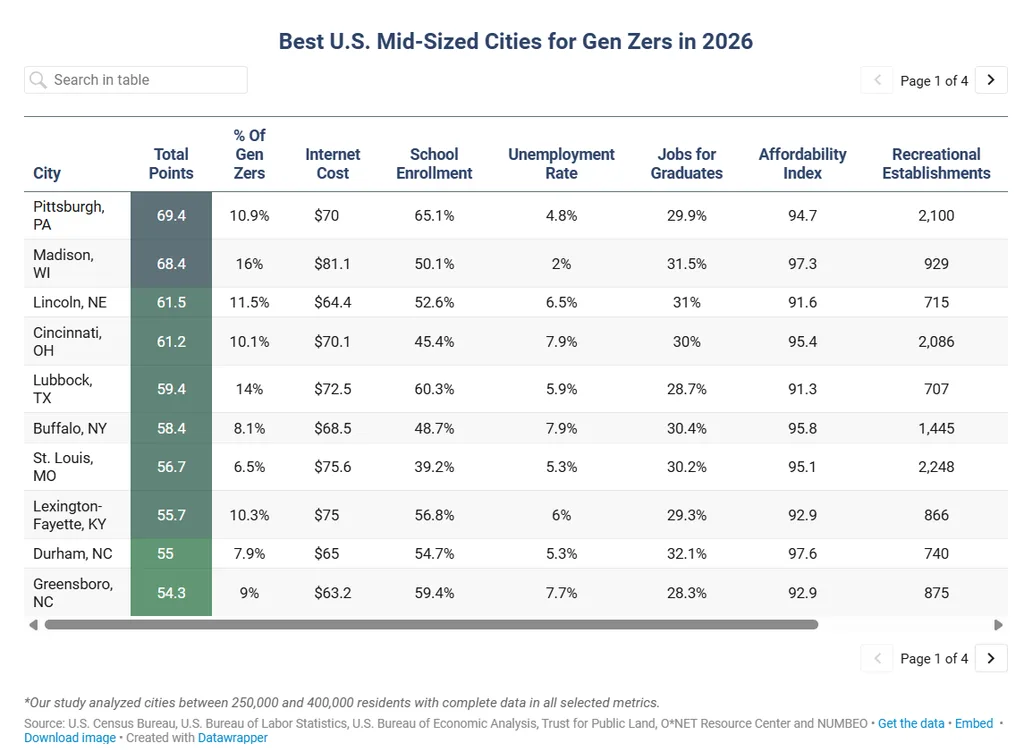
Pittsburgh also benefits from a deep education ecosystem. The city has 10 colleges and universities, and about 65% of its 20-to-24-year-old population is enrolled in school, according to the study. That age group represents nearly 11% of the city’s population.
The city also recorded 4.8% youth unemployment and roughly 2,100 recreation and entertainment establishments. About 24% of working residents commute without a car, giving Pittsburgh one of the stronger non-car commuting rates in the ranking.
Midwest Markets Punch Above Their Weight
Pittsburgh was one of four Midwestern cities to finish in the national top 10. Madison ranked second, followed by Lincoln and Cincinnati, while St. Louis landed seventh. Three additional Midwestern markets, St. Paul, Cleveland and Toledo, finished inside the top 20.
Madison stood out for its concentration of young residents and low unemployment. Gen Z accounts for 16% of the city’s population, the highest share in the study, while unemployment among young adults sits at 2%. The city also has 31.5% of local jobs classified as suitable for recent graduates.
Lincoln offers a different combination. About 31% of jobs fit the study’s graduate-friendly definition, while living costs sit 8.4% below the national average. Gen Z also represents 11.5% of the population.
Cincinnati adds another piece to the equation with a large entertainment base, extensive parks and living costs 4.6% below the US average. Its free streetcar also helps young residents move through downtown and nearby neighborhoods without relying entirely on cars.
Why It Matters
The ranking highlights a competitive advantage for midsized markets that can combine employment access with manageable living costs. For CRE, that matters because population growth and talent retention influence demand across apartments, retail, restaurants, coworking and other urban amenities.
Pittsburgh’s result is especially notable because it did not win any individual metric. Its first-place finish instead came from broad-based performance. That suggests cities do not necessarily need to dominate one category to compete for young workers. A balanced mix of jobs, education, mobility and amenities can be just as important.
Other markets show the same pattern. Lubbock ranked fifth while offering living costs 8.7% below the national average. Durham ranked ninth and led the study for graduate-friendly employment, with 32.1% of jobs meeting that measure. Greensboro, ranked 10th, combined 59.4% educational enrollment among its Gen Z population with relatively low internet and living costs.
The regional results also show that affordability is not the only path. Jersey City ranked 16th and had the nation’s highest share of non-car commuters at 51.8%, but its living costs were about 12.6% above the national average. The tradeoff illustrates how transit access can offset some housing and living-cost pressures, but not eliminate them.
What’s Next
The data points to a continued competition among midsized cities for younger residents entering the workforce. Markets that can connect education to entry-level employment while keeping daily costs manageable have a stronger case for retaining that population.
CommercialCafe’s methodology also captures factors beyond employment. Its index assigns weight to affordability, graduate-friendly jobs, youth unemployment, Gen Z population share, educational enrollment, internet costs, amenities, non-car commuting and parks. The approach reflects how young professionals increasingly evaluate cities as complete environments rather than simply places to find a job.
For CRE stakeholders, the broader takeaway is straightforward: the cities competing most effectively for Gen Z are not defined by one asset or industry. They are building ecosystems that make it easier for young adults to study, work, live and stay.