







- Only 2 of the 13 Chicago projects that won tax credits in 2023 have closed and started construction, and both are rehabilitations of existing buildings, per city records Bisnow obtained.
- Five more are expected to close by year-end, four in 2027 or later, one has no date and one is withdrawn or inactive, against a city window that runs to March 2027.
- Delays are lifting costs, with Hub 32 rising from about $732K to nearly $796K per unit, and Chicago projects can run more than 50% above peers such as Houston.
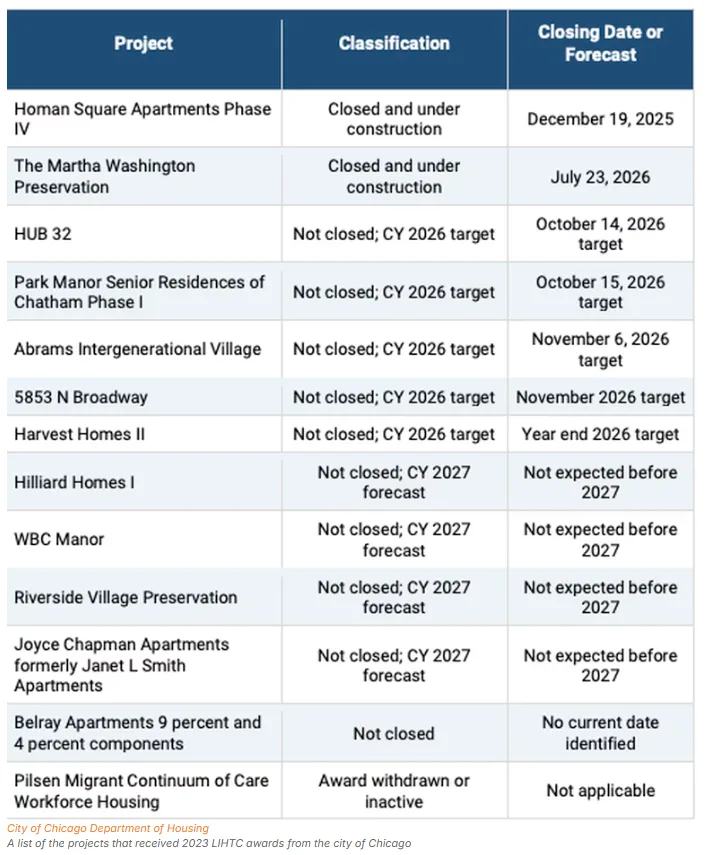
Just two of the 13 developments the city picked for credits in its 2023 LIHTC round have closed financing and started construction, according to Bisnow.
City Department of Housing records obtained by Bisnow show that count as of mid-September, 30 months after the awards were announced in March 2024.
Get Smarter about what matters in CRE
Stay ahead of trends in commercial real estate with CRE Daily – the free newsletter delivering everything you need to start your day in just 5-minutes
Where the 13 Projects Stand
Both projects now under construction are rehabilitations that preserve existing units. Those cost far less per unit than ground-up buildings in Chicago’s program, per A City That Works.
Of the other 11, five are expected to close by the end of 2026. Another four are not slated to close until 2027 at the earliest, one lacks a closing date and one has been withdrawn or gone inactive.
When the awards came out, the city expected closings to take between a year and a half and three years, which puts the end of that window at March 2027.
Delays Push Costs Up
The city’s March 2024 estimate for the 13 projects was $562M in combined public and private funding. Construction costs have climbed since, so the real figure is probably higher.
Hub 32, a Garfield Park development with 51 units, shows the effect. A City That Works puts its per-unit cost at roughly $732K in 2023 and nearly $796K as of February.
Costs were already steep. Between 2019 and 2023, state-allocated projects in Chicago averaged about $454K per unit, versus $519K for city-allocated ones, around 15% less. Even so, projects from either source can run more than 50% above peers such as Houston.
Too Many Layers
Rachel Rhodes, a senior vice president overseeing tax credit production for the National Equity Fund, told Bisnow that Chicago has far more approval steps than other places. Its soft financing comes from several City Hall departments, which slows closings.
Chicago also runs its own federal allocation, a status only it and New York City hold. The Illinois Housing Development Authority allocates credits to projects in the city as well, under separate rules.
How the Credits Work
Congress created the credit in 1986, and it has supported more than 3.9 million homes through 2024. Developers sell credits to banks and corporations that want to trim their tax bills, and the proceeds become equity in the project.
With affordable housing spending split across city and state programs, Bisnow notes, it is hard to tell which part of it is truly headed for construction.
Why It Matters
Chicago’s apartment construction pipeline sits at historic lows while rents rise quickly, so tax credit deals are a main source of new affordable housing. Every delayed closing keeps those homes on paper.
Housing Action Illinois reported earlier this year that close to 440,000 households of low-income renters statewide compete for a little over 150,000 affordable rentals. In metro Chicago, extremely low-income renters have 31 affordable, available homes per 100 households.
What’s Next
The city’s closing window ends in March 2027. The Johnson administration has pushed its Cut the Tape initiative to speed approvals, though some CRE professionals say it has not gone far enough.
The Department of Housing has also revised parts of its building codes and how it awards credits to shorten the gap between award and closing. Results will take time to show.