








- CBRE says office occupancy on the busiest days now exceeds pre-pandemic levels, even as Friday attendance has fallen sharply.
- Large companies are choosing fewer, higher-quality and more sustainable square meters, while SMEs are expanding floor space and managing costs.
- About three-quarters of surveyed organizations expect AI to change office use, but most do not expect it to reduce space needs.
Office occupancy is not following a simple shrinkage story. CBRE’s 2026 occupier benchmark found offices are fuller on the busiest days. Peak occupancy now exceeds pre-pandemic levels on certain weekdays.
The study covered 160 organizations across Dutch regions. It examined real estate strategy, workplace policy, occupancy, sustainability, and AI use. Both corporates and SMEs participated. Organizations came from the Randstad and other Dutch regions.
Get Smarter about what matters in CRE
Stay ahead of trends in commercial real estate with CRE Daily – the free newsletter delivering everything you need to start your day in just 5-minutes
Office Occupancy Peaks Drive Space Planning
Organizations are again taking greater control over which days employees use the office. Tuesdays and Thursdays now exceed pre-pandemic occupancy levels. Friday attendance, meanwhile, has fallen by half. That creates a much wider difference between high-demand and low-demand office days.
That uneven pattern is influencing how occupiers size their offices. Companies must maintain enough space for peak days, despite lower attendance at other times. As a result, strong peak demand limits how much office space occupiers can release.
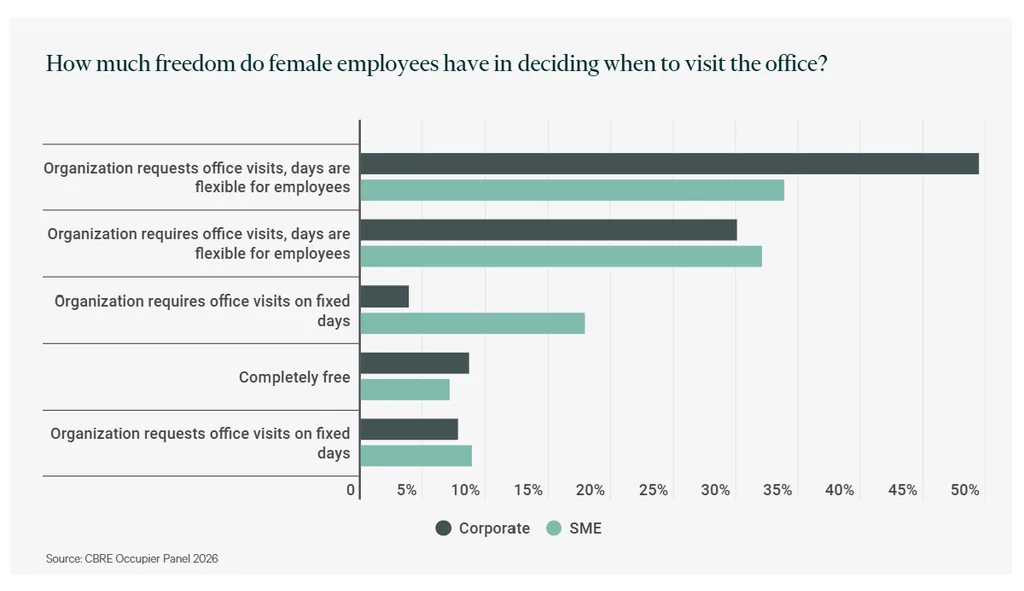
Peak attendance is also becoming central to hybrid workplace strategy. Organizations increasingly control office-day decisions instead of leaving schedules entirely to employees or teams. However, policies still differ between corporates and SMEs.
Corporates and SMEs Split
Large organizations and smaller businesses are taking different approaches to their office portfolios. Corporates are choosing fewer, better, and more sustainable square meters. SMEs are expanding their floor space while remaining focused on cost.
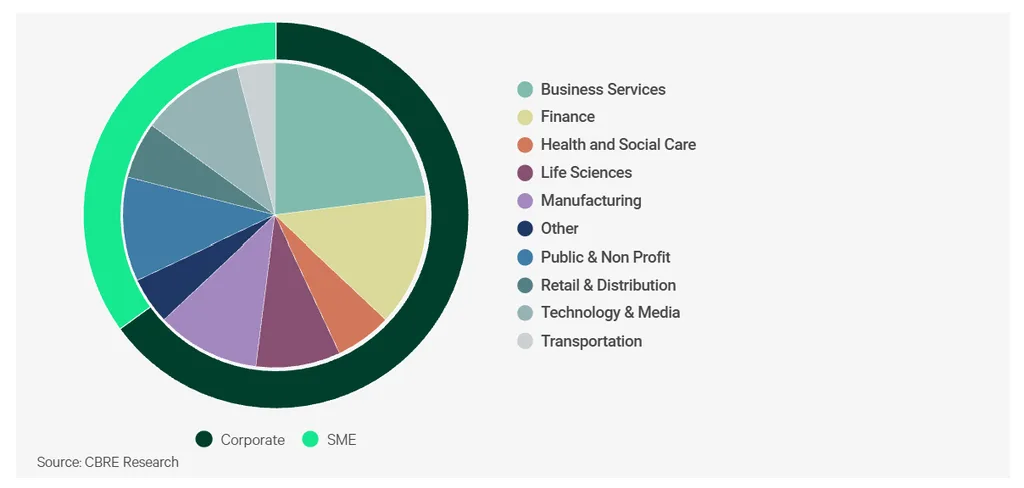
Those differences also extend to hybrid workplace strategy. Collaboration remains the office’s most important function across the market. Large companies also use real estate strategically to support talent attraction and retention.
Accessibility remains another important location factor. The report primarily frames offices as places for collaboration and connection. That keeps space quality and accessibility important, even when occupiers reduce their overall footprints. Smaller footprints therefore do not necessarily mean lower expectations for the space itself.
Sustainability and AI Shift Priorities
Sustainability is becoming more important when organizations make location decisions. However, implementation continues to lag behind the sustainability ambitions companies have stated. That creates a gap between stated priorities and actual workplace decisions.
The report also measured expectations around AI for the first time. About three-quarters of participating organizations expect AI to noticeably change office use. The finding shows that many occupiers already expect technology to affect workplace patterns.
However, those expectations rarely translate into plans for less floor space, according to CBRE. Organizations expect workplace use to change without automatically assuming they will need smaller offices.
Why It Matters
The benchmark suggests office strategy increasingly centers on quality, peak utilization, and workplace function. That differs from a broad strategy of simply reducing square footage. Occupiers are balancing efficiency with the practical demands of their busiest office days.
Companies that reduce their footprints often use those reductions to upgrade their space. Quality therefore remains important alongside portfolio efficiency. Collaboration, accessibility, and sustainability also continue shaping office decisions.
At the same time, strong peak-day attendance constrains larger space reductions. Occupiers still need enough capacity for their busiest office days. Uneven weekly attendance therefore does not automatically translate into proportionally smaller offices.