








- Global listed real estate fell 2.8% in August but remained up 8.8% year to date.
- North America leads developed regions with a 16.3% 2026 total return, compared with 0.5% in Europe and -3.1% in Asia.
- Data centers are the top global property sector this year, returning 31.6% through August.
Global REIT performance weakened in August as the FTSE EPRA Nareit Developed Plus Index fell 2.8%. Nareit reported in its September market commentary that the index still held an 8.8% year-to-date total return. North America remains the strongest developed region, while Europe is barely positive and Asia remains negative for 2026.
The pullback came during another volatile period for global markets. Investors weighed shifting Middle East tensions, while benchmark yields continued rising across major developed economies. Nareit linked higher yields to sticky inflation and ongoing geopolitical uncertainty.
Get Smarter about what matters in CRE
Stay ahead of trends in commercial real estate with CRE Daily – the free newsletter delivering everything you need to start your day in just 5-minutes
North America Sets the Pace
North America has generated a 16.3% total return so far this year. That far exceeds Developed Europe’s 0.5% gain and Developed Asia’s -3.1% return. However, global equities have performed better overall, with the FTSE Global All Cap returning 14.6%.
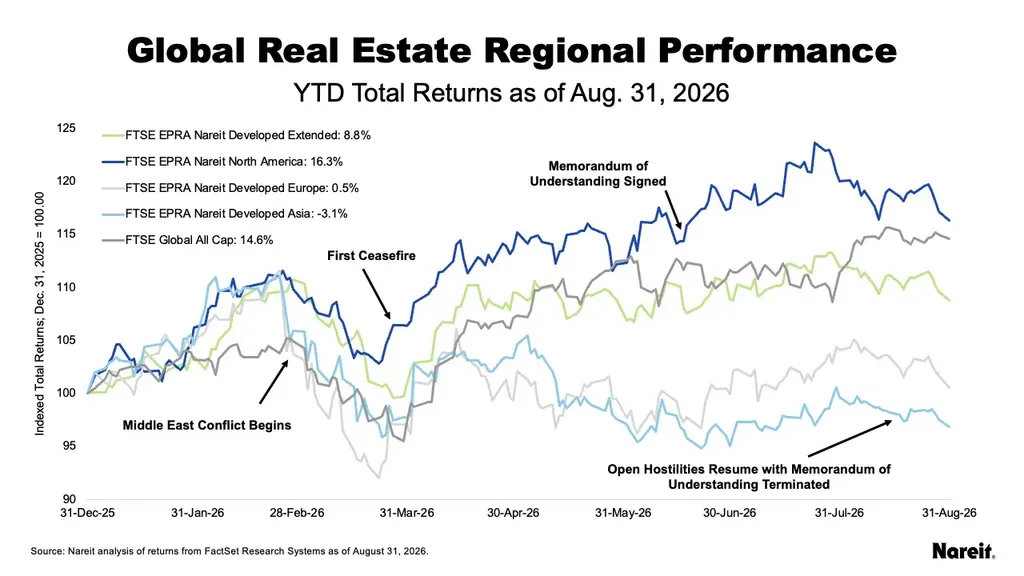
North America’s lead survived a difficult August for listed real estate. Nareit said real estate faced headwinds across every region, while global equities rebounded. Market volatility also remained elevated as investors tracked geopolitical developments in the Middle East.
Higher benchmark yields have added another challenge for real estate investors. Nareit attributed the increase partly to sticky inflation and continuing geopolitical uncertainty. Those pressures have persisted despite significant differences in regional performance.
Global REIT Performance by Sector
Data centers remain the strongest global listed real estate sector in 2026. The sector has generated a 31.6% year-to-date total return. Lodging and resorts follow at 25.4%, while health care has returned 21.6%.
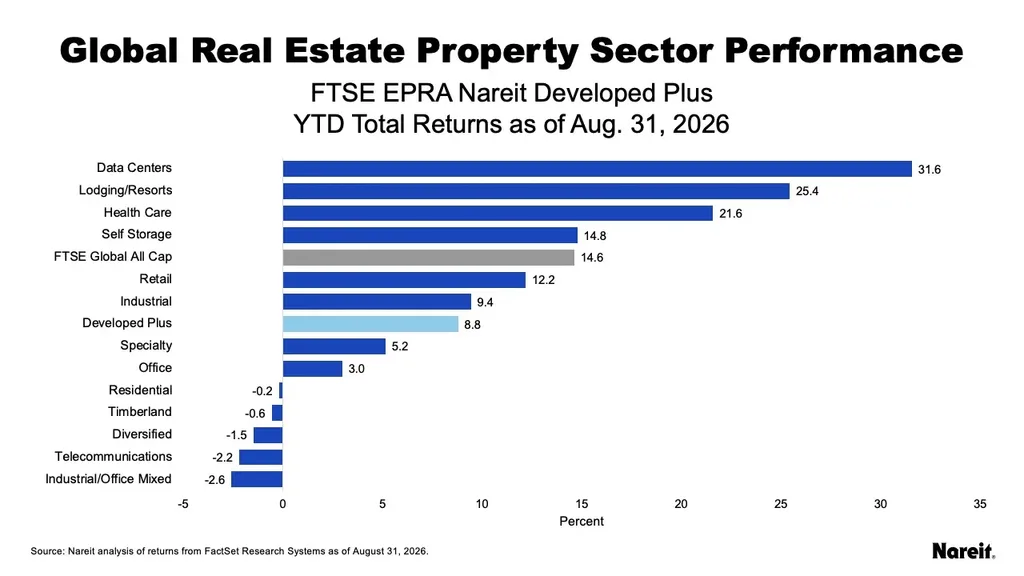
Several sectors remain negative despite the broader index’s 8.8% gain. Industrial and office mixed assets have returned -2.6%. Telecommunications has declined 2.2%, while diversified real estate has fallen 1.5%.
North America’s strongest sectors have delivered even larger gains. Lodging and resorts lead at 36.5%, followed by data centers at 33.0%. Health care has gained 22.6%, while telecommunications is the region’s only negative sector at -2.2%. The results extend the gap in REIT performance during volatile markets.
Europe and Asia Diverge
Developed Europe remains narrowly positive with a 0.5% year-to-date return. However, several individual sectors have performed considerably better. Industrial leads at 15.2%, followed by retail at 10.0% and health care at 5.5%.
Developed Asia has generated a -3.1% total return through August. Data centers have gained 12.5%, while health care has returned 1.8%. Those are the region’s only positive listed property sectors.
Every other listed sector in Developed Asia remains negative. Specialty has fallen 22.3%, self-storage has declined 11.4%, and residential is down 9.9%. These losses have outweighed gains from the region’s strongest sectors.
Higher Yields Add Pressure
The regional divide is developing against a challenging macroeconomic backdrop. Benchmark yields have increased across major developed economies during 2026. Nareit linked the increase to sticky inflation and geopolitical uncertainty surrounding the Middle East.
August demonstrated that pressure across listed real estate markets. Every region encountered headwinds, even as global equities rebounded. The contrast highlights the difficult environment facing public real estate markets.
Sector results also show how differently property categories are responding. Data centers remain strongly positive, while several categories remain negative despite the broader index’s year-to-date gain.
Why It Matters
The August pullback did not erase the large regional and sector gaps formed during 2026. North American listed real estate still leads developed regions by a wide margin. Data centers also remain the strongest global property sector with a 31.6% return.
However, higher benchmark yields and geopolitical uncertainty continue pressuring public real estate markets. August showed those headwinds can affect every region simultaneously.
The result is an increasingly uneven global REIT market. Geography and property sector remain major drivers of listed real estate performance in 2026.