



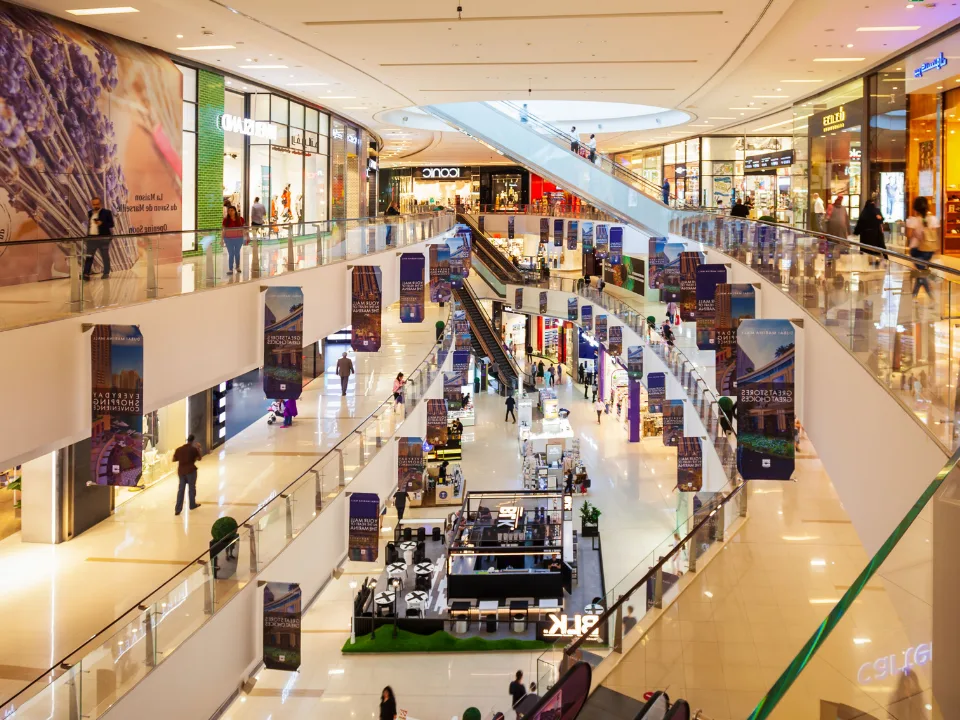
- Green Street says U.S. mall values rose 13% year over year, the best of any commercial property type, yet Morningstar counts $8.7B of mall CMBS loans in special servicing.
- About 250 Class A malls hold roughly 90% of sector value, per Green Street, while some 300 Class C malls remain in decline.
- Morningstar sees hidden distress in malls whose loans perform but cannot be refinanced, such as Wolfchase Galleria, whose cash flow trails underwriting by 35%.
Mall values are up 13% from a year ago, the strongest gain of any commercial property type, according to Green Street, yet distress in malls persists below the top tier, Bisnow reports.
Morningstar counts $8.7B of mall CMBS loans in special servicing, a sign that the recovery is concentrated in a small group of properties.
Get Smarter about what matters in CRE
Stay ahead of trends in commercial real estate with CRE Daily – the free newsletter delivering everything you need to start your day in just 5-minutes
Two Tiers
Of roughly 900 U.S. malls, about 250 are Class A, and they hold around 90% of the sector’s value, per Green Street’s Vince Tibone. Around 300 more are Class C, where decline continues.
Tibone told Bisnow that most mall square footage may still be shrinking in value.
The Numbers Behind the Distress
Morningstar follows 182 malls backed by 423 CMBS loans with nearly $42B in balances. Ninety-two of those loans, totaling $8.7B, are with special servicers, and another 42 loans worth $3.4B are delinquent.
Managing director David Putro told Bisnow he expects mall loans to keep moving steadily to special servicers through roughly the next two years, even as the better malls gain value.
Hidden Distress
Putro points to Simon’s Wolfchase Galleria. Its loan went to special servicing last month despite never going delinquent over a 10-year term.
A year ago the property’s coverage ratio, which measures income against debt payments, was 1.65, yet its cash flow today trails underwriting by 35%. Putro calls that hidden distress: loans that perform but cannot be refinanced, in a market where capital is available only for the best mall in each area.
Winners Reinvest
The big mall REITs are shedding weak assets and buying strength. Santa Monica Place went back to the lender in 2024 after Macerich defaulted on a $300M loan, and the REIT has since bought malls in markets such as Annapolis and Raleigh. Its occupancy was 94% last quarter.
CEO Jackson Hsieh told investors during second-quarter earnings that roughly 90% of Macerich’s forward NOI comes from Class A assets. Simon walked away from Southridge Mall and Town Center at Cobb, and has spent hundreds of millions upgrading centers like The Mall at Green Hills and Cherry Creek Shopping Center. Its occupancy was 96%.
Colliers’ Anjee Solanki told Bisnow that leading malls are becoming destinations, adding Main Street-style retail, dining and entertainment.
A Mall That Fell Behind
Valley West Mall near Des Moines shows the other side. Built for 138 retailers, it has 17 occupants. It sold last month for $11M, about a tenth of its 2005 value, and Threshold Capital plans a mixed-use redevelopment that will take at least a decade.
A decades-old lease with the lone anchor, JCPenney, runs through 2032 and gives it broad say over redevelopment, so Threshold has asked a Polk County court to rule on those rights. West Des Moines development director Ryan Moffatt blamed the mall’s slide partly on the 2004 opening of Jordan Creek Town Center.
Why It Matters
Averages mislead. A 13% rise reflects top-tier centers, while loans on weaker malls keep migrating to special servicers. At Natick Mall, a 92%-leased turnaround lifted cash flow from $35.3M to $45.5M, per Fitch, and a $400M loan is slated to close Oct. 22, but Putro says deals like that are rare.
The divide is visible regionally too, as CRE Daily reported when DFW malls thrive at the top centers.
What’s Next
Putro expects many struggling malls to become something other than malls. Watch special servicing volumes over the next two years and whether more mixed-use conversions clear legal and financing hurdles.