



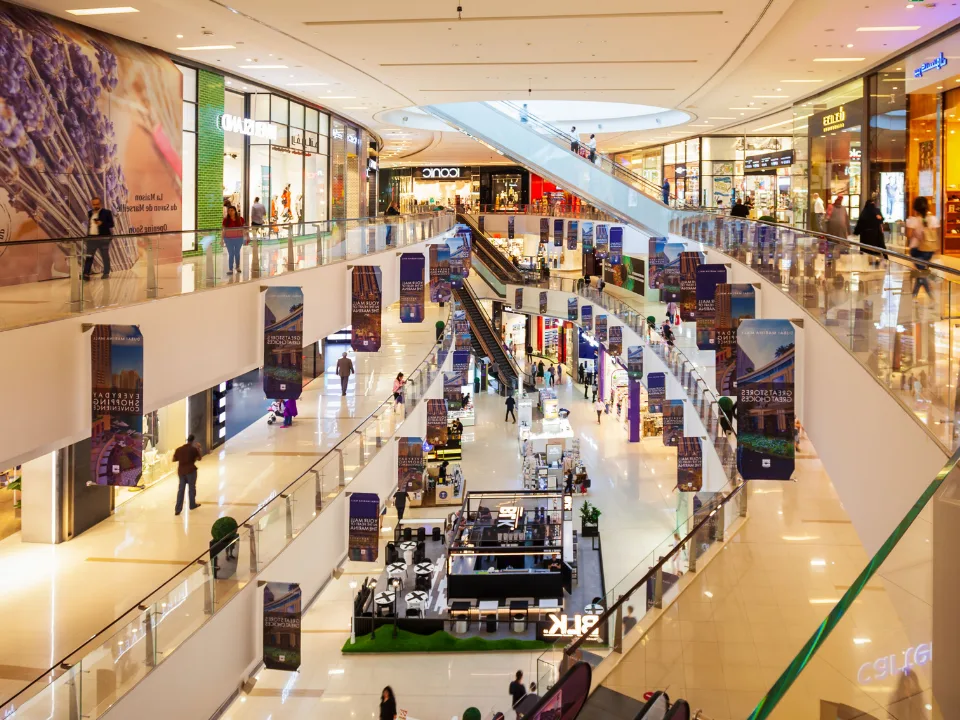
- Mall values rose 13% year over year, Green Street says, but 90% of the sector’s value sits in about 250 Class-A properties out of roughly 900 malls.
- Morningstar tracks 182 malls backed by 423 CMBS loans totaling nearly $42B, with 92 loans worth $8.7B in special servicing and 42 loans worth $3.4B delinquent.
- Top landlords Macerich and Simon report 94% and 96% occupancy while hidden distress builds in loans that perform today but cannot be refinanced, Morningstar’s David Putro says.
The success of top-tier malls is hiding enduring distress in the rest of the sector, according to Bisnow. Green Street reported last month that mall values rose 13% year over year, outpacing every other asset class.
But of roughly 900 U.S. malls, about 90% of the value sits in about 250 properties Green Street rates Class-A. Roughly 300 Class-C malls remain under strain.
Get Smarter about what matters in CRE
Stay ahead of trends in commercial real estate with CRE Daily – the free newsletter delivering everything you need to start your day in just 5-minutes
A Mall That Fell Behind
Outside Des Moines, the 50-year-old Valley West Mall was built for 138 retailers and now has 17 occupants. It sold last month for $11M, roughly 10% of its 2005 valuation, after four years in receivership.
West Des Moines Community and Economic Development Director Ryan Moffatt pinned much of the decline on a rival enclosed center, Jordan Creek Town Center, which opened across town in 2004. In an e-commerce era, many markets that once supported two or more malls now have room for one.
New owner Threshold Capital plans a mixed-use project with 300 to 400 apartments, a hotel, offices and an outdoor venue. The redevelopment will take at least a decade, and a JCPenney lease valid through 2032 gives the anchor extensive control, which Threshold has asked a Polk County court to address.
The Numbers Behind the Distress
Morningstar tracks 182 malls backed by 423 CMBS loans totaling nearly $42B. Of those, 92 loans worth $8.7B are in special servicing and 42 loans worth $3.4B are delinquent.
“There’s still a lot of mall distress out there to be seen,” Morningstar’s David Putro said. He expects a steady transfer of mall loans to special servicing over the next couple of years.
Hidden Distress
Putro points to Simon’s Wolfchase Galleria, which entered special servicing last month without ever going delinquent. It reported a 1.65 debt service coverage ratio last year, but current cash flow is 35% below underwriting.
Many such loans perform today but cannot be refinanced, he said, calling that the hidden distress. There are few active capital markets for anything but the best mall in each market.
Winners Reinvest
Macerich and Simon have given up on weak malls to reinvest in top properties. Macerich relinquished Santa Monica Place to its lender in 2024 after defaulting on a $300M loan, and the mall remains under a receiver. It has since bought malls in affluent markets such as Annapolis and Raleigh and reports 94% portfolio occupancy.
“The scarcity of space in our best centers is by design,” Macerich CEO Jackson Hsieh said on the second-quarter call, adding that about 90% of go-forward NOI comes from Class-A assets. Simon handed back struggling malls such as Southridge Mall in Wisconsin and Town Center at Cobb near Atlanta, then invested hundreds of millions in The Mall at Green Hills and Cherry Creek Shopping Center. It reported 96% occupancy in Q2.
Natick Mall shows the upside. Occupancy fell to 82% in 2022, then new tenants, including a 97K SF pickleball facility, lifted it to 92% and cash flow from $35.3M to $45.5M, per Fitch. GGP has lined up a $400M loan scheduled to close Oct. 22.
Why It Matters
Putro expects better malls to keep benefiting from value increases while weaker ones keep moving into special servicing. Headline mall performance can mislead. Strong values at the top coexist with a long tail of centers that cannot refinance, a split also visible in the DFW mall recovery.
Colliers’ Anjee Solanki said leading malls are evolving into destinations with Main Street-style retail, restaurants and entertainment.
What’s Next
Putro expects many malls to stop being malls as we know them. Mixed-use redevelopment is attractive given the housing shortage and cheap pricing, but it is a hard, slow process.
Watch the flow of mall loans into special servicing and the outcome of the Valley West court motion.