




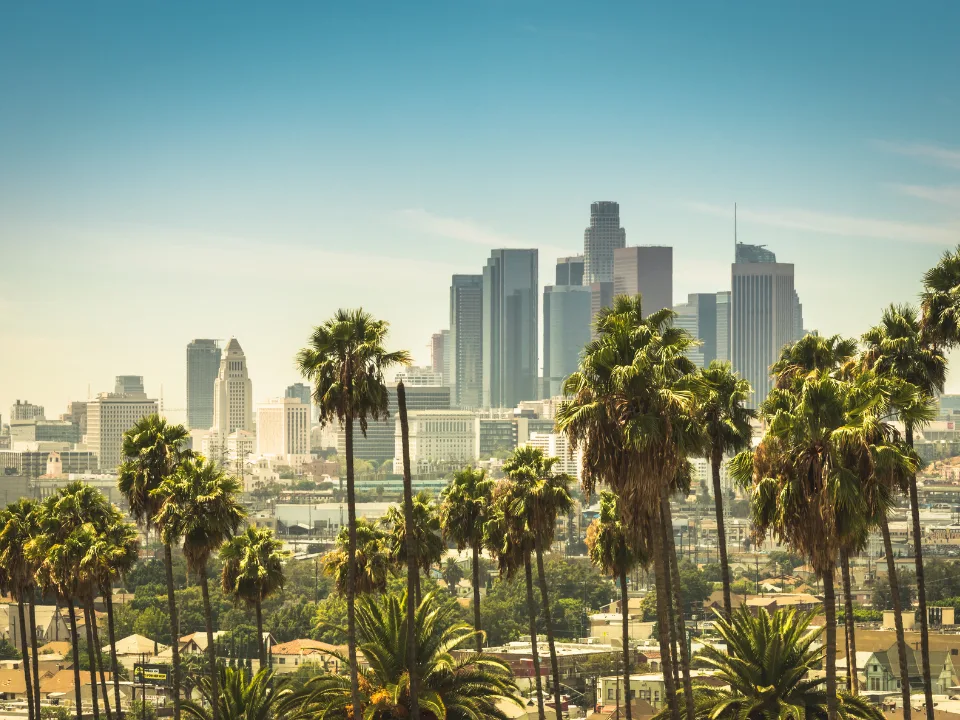



- Downtown L.A. office towers sold at roughly $130 to $150 per square foot versus a pre-pandemic average near $450, and half of recent metro office sales closed at a loss.
- Family offices, private lenders and owner-users are buying or financing selectively, while Q3 office leasing reached 4 million square feet, up 15% year over year.
- Loan maturities peak in 2027 at $6.2 billion, but expensive financing and Measure ULA keep new development largely sidelined.
Los Angeles is starting to attract investors hunting deep discounts on office assets and steady housing demand, according to Commercial Observer.
Sentiment remains cautious after six rough years, but capital from outside the region is returning, particularly in Downtown L.A.
Get Smarter about what matters in CRE
Stay ahead of trends in commercial real estate with CRE Daily – the free newsletter delivering everything you need to start your day in just 5-minutes
Why Investors Stayed Away
In mid-September, the Urban Land Institute convened its Advisory Services Program to evaluate Downtown L.A. and propose ways to revive the urban core. The panel opened with three challenges: homelessness, crime and a deteriorating public realm; high costs and difficulty doing business compared with other U.S. cities; and decades of housing and affordability problems.
Greater Los Angeles would rank among the world’s 20 largest economies if it were a country. Citiventure Associates’ Marilee Utter said the panel’s overwhelming impression was that downtown has many assets and was thriving until the pandemic, with no reason it cannot return.
Optimists include Bill Witte, the retired developer who co-founded Related California nearly 40 years ago. In late 2025 he argued that the city is better than people think and remains the cultural core of the region. San Francisco’s recent surge, driven by AI-related demand for office and residential space, shows how quickly sentiment can turn.
Prices Reset Hard
Capital Group bought Bank of America Plaza, its corporate headquarters, for $210 million in March at close to $150 per square foot. The Aon Center sold for roughly $130 per square foot, against a pre-pandemic neighborhood average near $450.
Uncommon Developers paid $210 million for the Figueroa at Wilshire tower in summer 2025, a 40% discount. Newmark data shows half of metro L.A. office sales in the second half of 2025 and first half of 2026 closed at a loss.
Northwind Group’s Ran Eliasaf said the repricing of Downtown L.A. office assets created an attractive entry point that changes the competitive position of new ownership, after his firm bought the office complex at 333 South Grand Avenue in June at a steep discount.
Long-Term Capital Moves In
Fortress Investment Group provided $96 million for Cityview’s Jasper multifamily project downtown. G4 Capital Partners opened an L.A. office in April to provide private lending for residential projects.
G4’s Larry Grantham said the capital reset across L.A. has set the stage for more deal volume. With enormous amounts of capital on the sidelines, he wants to be ready when the pendulum swings back.
D2 Asset Management sees affordability pressure and middle-income workforce housing as an opening for debt, and 3650 Capital’s Jonathan Roth said family offices with a generational horizon see L.A. as cheap.
Leasing Shows Signs of Life
Savills counted 4 million square feet of third-quarter Los Angeles office leasing, a 15% jump from a year earlier. Renewals made up most of the volume, though Universal Music Group signed a new deal and Banc of California opened a 40,000-square-foot downtown office.
Ad agency Innocean also moved from Orange County to a 100,000-square-foot space in El Segundo, closer to L.A., a reversal of the more traditional move out of Los Angeles County.
Downtown office vacancy still runs above 20%. The 730,000-square-foot 1950 Avenue of the Stars in supply-constrained Century City comes online early next year.
Why It Matters
Small or nonexistent development pipelines in most major submarkets should keep supply tight over time, which helps a recovery. Cushman & Wakefield analysts expect more value-add, owner-user and public-sector buying as pricing adjusts.
Financing is the bottleneck. Multifamily developers are mostly sidelined by rising costs, tough lending and Measure ULA, the three-year-old tax on pricier real estate trades.
What’s Next
Savills’ Dalton Brusseau expects L.A. office loan maturities to peak in 2027 at $6.2 billion, which he says could spur new ownership and leasing. The Urban Land Institute also recommended a downtown development corporation and a tax-increment finance district.
The $2 billion Fourth and Grand project and a possible Oceanwide Towers cleanup still need funding, and the 2028 Olympics offer a deadline for downtown to start rather than finish.