






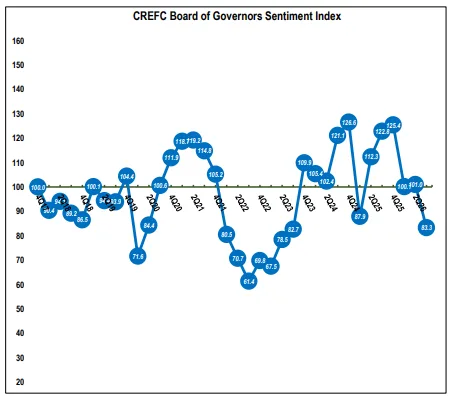
- The index fell to 83.3 from 101.0 in Q2 2026, the lowest since Q3 2023 and 34% below its Q4 2024 record of 126.6, with all nine core questions weakening.
- Ninety-two percent expect mortgage and cap rates to hurt CRE finance businesses, up from 53%, while 62% expect a weaker U.S. economy and 35% expect less borrower demand.
- Respondents see credit tightening and rising distress ahead: 38% expect tighter loan terms, 61% expect CMBS delinquency at 8.00% or higher by year-end, and 46% see prices falling.
The CRE Finance Council’s Board of Governors sentiment index fell 17.5% in the third quarter of 2026 to 83.3, its lowest reading since Q3 2023, according to CREFC’s latest survey.
The index stood at 101.0 in Q2 and now sits 34% below its Q4 2024 record of 126.6. All nine core questions weakened.
Get Smarter about what matters in CRE
Stay ahead of trends in commercial real estate with CRE Daily – the free newsletter delivering everything you need to start your day in just 5-minutes
Rates Lead the Retreat
Rates drove the drop. Ninety-two percent of respondents expect mortgage and cap rates to weigh on CRE finance businesses over the next 12 months, up from 53% in Q2 and the most negative reading since Q3 2022. Just 3% expect a positive impact.
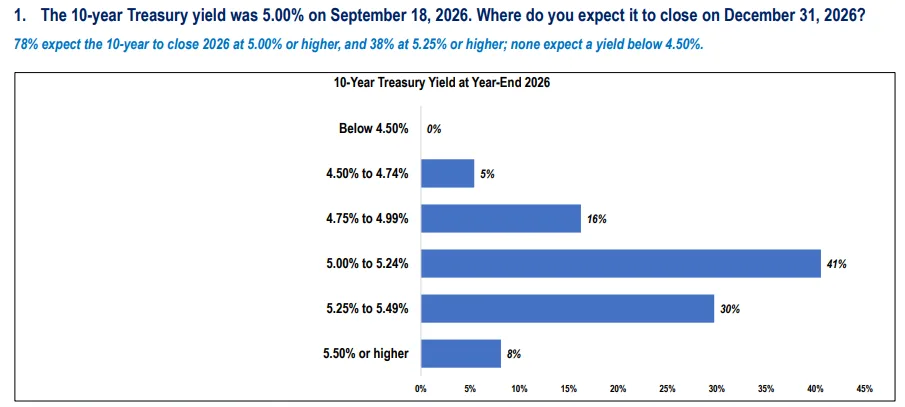
The survey ran Sept. 21-28, when the 10-year Treasury yield stood at 5.00%. Seventy-eight percent of respondents expect it to close 2026 at 5.00% or higher, 38% expect 5.25% or higher, and none expect a yield below 4.50%.
Caution Spreads Beyond Rates
Neutral remained the most common answer on seven of the nine questions, but negative responses rose on eight. Sixty-two percent now expect the U.S. economy to perform worse over the next 12 months, up from 24% in Q2, and just 3% expect improvement.
Borrower demand turned net negative for the first time since Q4 2022. Only 24% expect more demand for CRE and multifamily loans, versus 45% in Q2, while 35% expect less.
Expectations for CRE fundamentals such as occupancy, rents and NOI also turned net negative for the first time since Q1 2025. Thirty percent expect them to worsen, up from 11%, while 22% expect improvement, down from 37%.
Investor demand split evenly, with 30% expecting more demand for CRE and multifamily assets and 30% expecting less. Overall industry sentiment tilted negative as well. Thirty-eight percent are negative on CRE finance businesses, up from 8%, and only 11% are positive.
Credit, Liquidity and CMBS Turn Cautious
Twenty-four percent of respondents expect liquidity in CRE debt markets to contract, up from 5% in Q2. Thirty-two percent see CMBS and CRE CLO trends weighing on performance, versus 13% last quarter.
Thirty-eight percent expect credit terms on new loans, including leverage, interest-only periods and lender protections, to tighten. That is twice the 19% expecting looser terms. Policy optimism also faded, with the positive share falling to 11% from 26%.
Delinquency and Pricing Worries
CMBS delinquency rates stood at 7.85% in August, according to Trepp. Sixty-one percent of respondents expect the rate to reach 8.00% or higher by Dec. 31, and 19% expect 8.50% or higher.
On pricing, MSCI shows U.S. CRE prices up 0.2% year over year through July. Forty-six percent of respondents expect prices to fall at least 1% over the next 12 months, versus 24% expecting a rise.
AAA-rated data center SASB CMBS paid about 165 basis points over benchmark in mid-September, compared with 85 to 120 basis points for other property types, per BofA Global Research. Forty-one percent expect those spreads to widen.
Why It Matters
The survey drew responses from 37 of 40 Board of Governors members, so it captures how the industry’s leadership expects to originate, securitize and price debt over the next year. The shift in a single quarter is sharp.
“This is the most negative our board has been in three years,” said Raj Aidasani, managing director at CREFC.
One respondent put the problem in terms of capital costs: “The industry’s refinancing challenges are increasingly tied less to property performance and more to the cost of capital.” Others flagged fiscal deficits, record Treasury issuance and inflation as the drivers of higher-for-longer rates.
Respondents also pointed to rising diesel prices, one expected multifamily to keep driving CLO and CMBS delinquencies, and another warned that office and multifamily could see pricing pressure as owners are forced to sell.
What’s Next
Several respondents still see opportunity, citing strong refinancing demand as 2021 and 2022 five-year loans and 2017 ten-year loans mature, along with continued CRE CLO growth. Others expect new CMBS issuance to slow in the fourth quarter.
Watch whether the 10-year holds above 5% and whether delinquency lands at the 8.00% level most respondents expect by year-end.