




- Delinquency rates for commercial and multifamily mortgages declined in Q2 2026, per the Mortgage Bankers Association.
- Improvements were broad but varied, with commercial mortgage-backed securities (CMBS) and office assets still showing heightened risk.
- Up to $875B in loans mature in 2026, raising the stakes for refinancing as borrowers face higher rates and lower valuations.
The End of First-Quarter Weakness
According to Globe St, CRE lenders gained some breathing room in Q2 2026 as delinquency rates declined after a weaker first quarter. The Mortgage Bankers Association reported lower shares of non-current commercial and multifamily mortgage balances across most property types and capital sources by June 30. That marked a clear reversal from Q1, when short-term delinquencies increased across nearly every major property sector except industrial.
The shift suggests market distress has not accelerated. However, improvements varied by sector and lender.
The MBA survey covers about 59% of the $5T US commercial and multifamily mortgage market. It offers a broad snapshot of lending conditions. Q1 data showed steady delinquency increases across multifamily, office, and healthcare loans. Q2 results point to stabilization, although some categories still face pressure.
Get Smarter about what matters in CRE
Stay ahead of trends in commercial real estate with CRE Daily – the free newsletter delivering everything you need to start your day in just 5-minutes
The Details
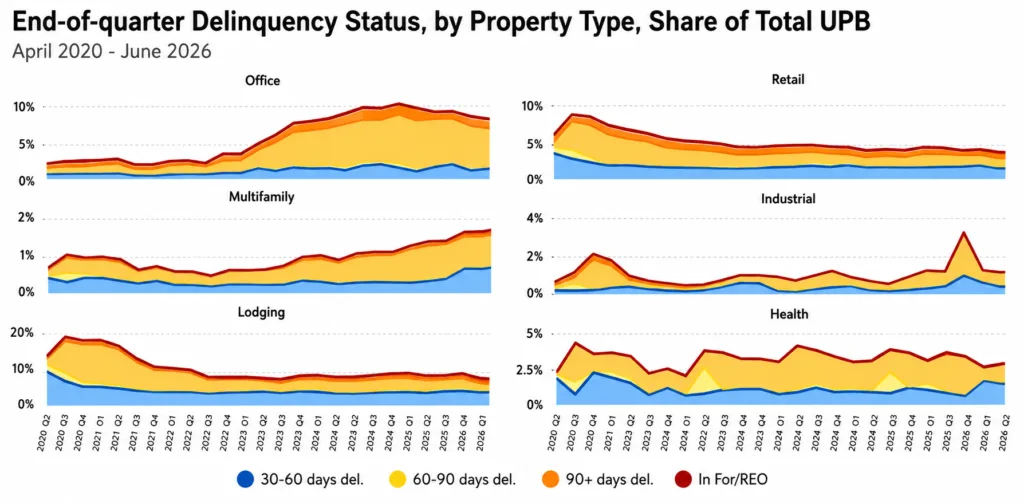
Delinquency rates declined across nearly every major property category during Q2. Office and lodging still posted the highest delinquency rates but both improved. Healthcare stood out as the only sector with a slight increase.
CMBS portfolios remained the weakest capital source despite quarterly improvement. Their delinquency rate fell to 4.82% from 5.21% in Q1. Life insurance company portfolios also improved, with delinquencies dropping to 1.19% from 1.47%.
Government-backed multifamily lenders moved in the opposite direction. Fannie Mae and Freddie Mac delinquency rates increased to 1.11% from 0.97%. FHA multifamily and healthcare loans rose to 1.06% from 0.96%. Overall, the data suggests stress remains concentrated in specific market segments.
Source: MBA
Pressure Points Shift With Debt Maturities
Several forces continue shaping sector performance in 2026. Higher interest rates, weaker property values, and a wave of maturing loans have increased refinancing pressure. MBA estimates about $875B in commercial and multifamily debt will mature this year. That represents 17% of all outstanding balances.
Many borrowers secured loans when rates were lower and property values were stronger. They now face tougher refinancing conditions. While overall delinquency rates have stabilized, pressure remains uneven. Office continues to struggle with weaker demand. Lodging also faces slower recoveries in several markets. Multifamily delinquencies remain relatively low, but government-backed lenders report gradual increases as underwriting tightens. That trend also reflects slower delinquency growth alongside stronger lending activity, even as refinancing challenges persist.
Why It Matters
The Q2 decline in delinquency rates suggests CRE loan distress has not worsened across the market. That eases concerns that followed a difficult first quarter. MBA data shows fewer non-current balances across office, multifamily, lodging, retail, and industrial loans. Most sectors continue adjusting to higher borrowing costs and changing demand, although at different speeds.
Office and lodging still carry the highest delinquency rates despite recent improvement. Those sectors remain the market’s weakest points.
Capital source performance tells a similar story. CMBS portfolios still report the highest share of non-current balances, even after improving by nearly 40 basis points. Meanwhile, banks and life insurers continue outperforming. Government-backed lenders face rising pressure, especially in multifamily.
These trends show lenders remain selective as refinancing activity increases. The $875B in loans maturing during 2026 will continue testing underwriting standards and property values.
What’s Next
The second half of 2026 will depend on lenders’ willingness to refinance maturing debt. Market demand for discounted loan sales and progress in the office sector will also shape performance. MBA’s quarterly survey will remain a key indicator of whether stabilization continues or stress returns.
Most market participants still expect uneven conditions through 2026. CMBS portfolios and office-heavy borrowers remain the most vulnerable. If Q2’s improvement continues, more property sectors and capital sources could move toward gradual normalization.