







- CRE CLO distress rose from 19% in July to 28% in August, the largest one-month increase among securitization types this year.
- Five CRE CLO deals hold 38% of special-servicing balance, while the ten largest account for 58%.
- SASB distress remains near 22%, with four office and life-science portfolios representing 64% of the category’s distressed balance.
Distress is rising sharply in CRE CLOs tied to 2021 and 2022 bridge lending. CRED iQ’s August securitized-loan analysis shows the CRE CLO distress rate climbing from 19% in July to 28% in August. SASB distress stayed near 22%. Both categories stand far above conduit, Freddie Mac, and SFR, which each remain below 5%.
Get Smarter about what matters in CRE
Stay ahead of trends in commercial real estate with CRE Daily – the free newsletter delivering everything you need to start your day in just 5-minutes
A Few Deals Drive the CRE CLO Spike
CRE CLO stress is concentrated rather than broad-based. Loans from the 2021 and 2022 vintages account for $3B of the category’s special-servicing balance against $27B outstanding. Five deals hold 38% of all CRE CLO special servicing, while the ten largest represent 58%.
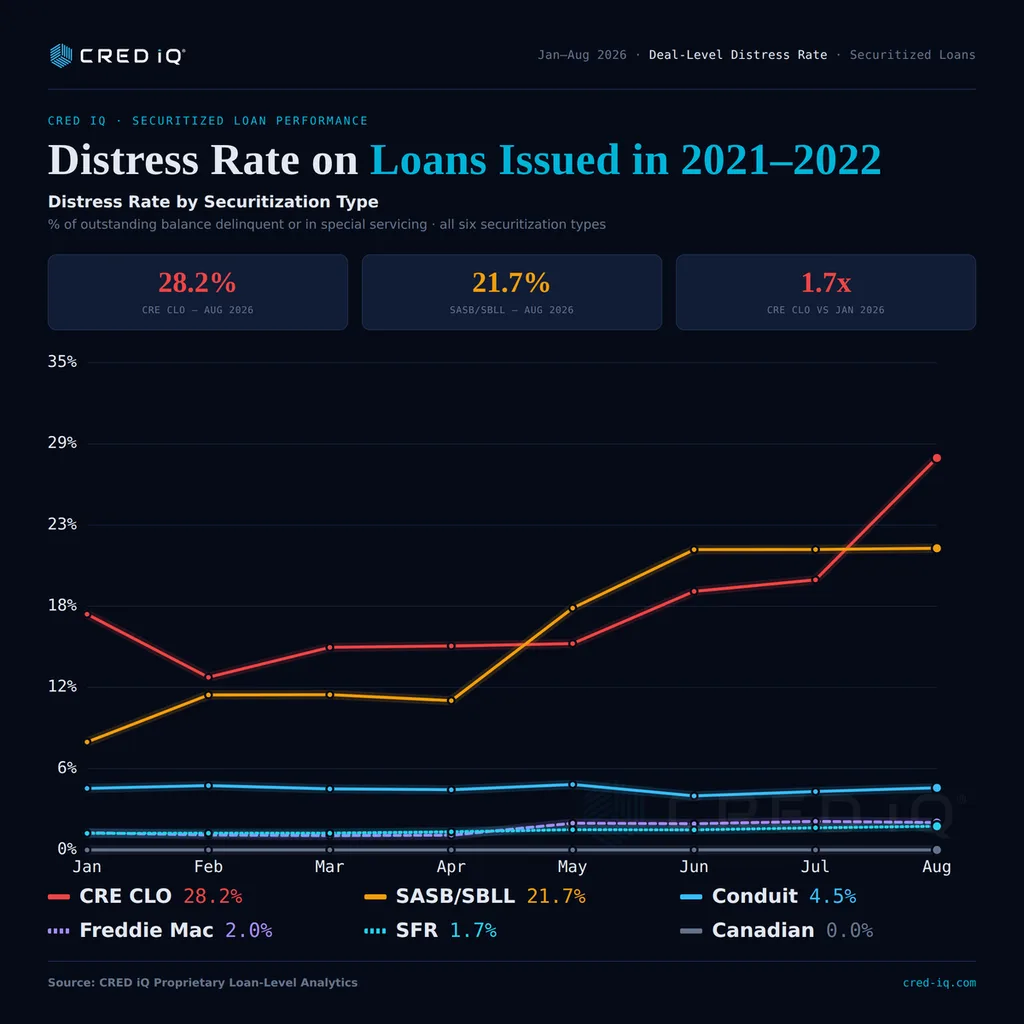
SASB loans from the same 2021 and 2022 vintages carry about $1.7B of special servicing against $17B outstanding. The comparison shows that both high-distress categories are concentrated in a limited set of older transactions.
FSRIA 2021-FL3 is the largest contributor. Seven multifamily loans totaling $353M are now in special servicing. The deal has added a new default about every eight weeks during 2026. August brought River Crossing at Roswell at $49M and Grace Abernathy Apartments in Sandy Springs, Georgia, at $42M. Both are tied to 2026 balloon maturities.
August Adds More Bridge-Loan Stress
CRE CLO distress reached 28% in August after climbing sharply as maturities moved more loans into special servicing.
FSRIA 2021-FL3 also saw the $40M 415 Premier Apartments in Evanston, Illinois, transfer in July. That brings the deal’s newly distressed balance since spring to $131M.
ARCLO 2022-FL1 added more pressure in August. The Sun Belt bridge-loan CLO transferred the $27M Residences at Medical in San Antonio and the $12M Pebblebrook Apartments in Redlands, California. CRED iQ says the deal added $210M of newly distressed collateral during the month.
The August jump is the sharpest one-month move among securitization types in 2026. That makes the composition of the distressed balance important. A small number of large bridge-loan deals can move the headline rate quickly even when other securitized categories remain stable.
Sun Belt Exposure Is Concentrated
Texas, Florida, and Georgia together represent 44% of the distressed CRE CLO balance. The common thread is bridge lending based on rent growth assumptions that did not materialize before floating-rate business plans ran out of time.
That concentration helps separate the current stress from the broader securitized market. Conduit, Freddie Mac, and SFR distress rates have barely moved during the first eight months of 2026. The double-digit readings are concentrated in CRE CLO and SASB collateral originated during 2021 and 2022.
SASB Stress Centers on Office and Lab Portfolios
SASB distress is concentrated in four single-borrower office and lab transactions. Together they account for 64% of the category’s $1.7B distressed balance. BXHPP 2021-FILM, a $525M loan on seven Hollywood studio and office properties, transferred in July.
ALEN 2021-ACEN, backed by Three Allen Center in Houston, carries $203M. LIFE 2021-BMR adds $190M across life-science properties in Cambridge, San Diego, and the Bay Area. The newest transfer is BSREP 2021-DC, a $162M loan on eight Washington-area office buildings that moved on Aug. 10.
California, New York, and Washington, D.C., now hold two-thirds of SASB’s distressed balance. The August BSREP transfer roughly offset balances resolved elsewhere, leaving the overall SASB distress rate near 22%.
These SASB transfers involve office, studio, and life-science collateral rather than the Sun Belt multifamily exposure driving much of the CRE CLO stress. The common issue is still maturity and refinancing pressure on loans originated near the peak of the prior cycle.
What Comes Next
Refinancing conditions remain difficult for the collateral now reaching maturity. CRED iQ says office and mixed-use loans maturing over the next nine months are pricing 170 to 180 basis points above their existing notes. That is the widest refinancing gap among property types.
CRE CLO borrowers face a similar maturity wall from a different structure. Their floating-rate plans were often built around 2021 and 2022 rent growth assumptions. The next test is whether those loans can refinance, extend through negotiation, or move into further distress as maturity dates arrive.