





- Q2 2026 earnings show major differences among community banks with multifamily exposure, influenced by risk strategy and geography.
- Banks with similar multifamily concentrations produced sharply different results, highlighting the limits of concentration as a risk metric.
- Outcomes in New York rent-regulated multifamily underline the outsized impact of local policy and underwriting discipline on loan performance.
Strategy Drives Outcomes, Not Just Multifamily Exposure
Second-quarter results from community banks with large multifamily portfolios reveal sharp performance differences. Those gaps also stand out against larger super-regional banks. Trepp’s Q2 review shows banks with similar balance sheets followed very different strategies.
Merchants Bancorp continued expanding its multifamily portfolio. Mechanics Bancorp kept reducing its exposure. Trepp and CRE analysts say strategy and risk appetite matter more than loan concentration alone. Business models, risk transfer, and regulation now shape performance more than portfolio size.
Government policies also influenced results this quarter. Trepp says income-based programs squeezed margins, while supply-focused federal programs supported selected lenders. Meanwhile, bank mergers reduced the number of community lenders. As a result, isolated losses now carry greater weight across the sector.
Get Smarter about what matters in CRE
Stay ahead of trends in commercial real estate with CRE Daily – the free newsletter delivering everything you need to start your day in just 5-minutes
The Details
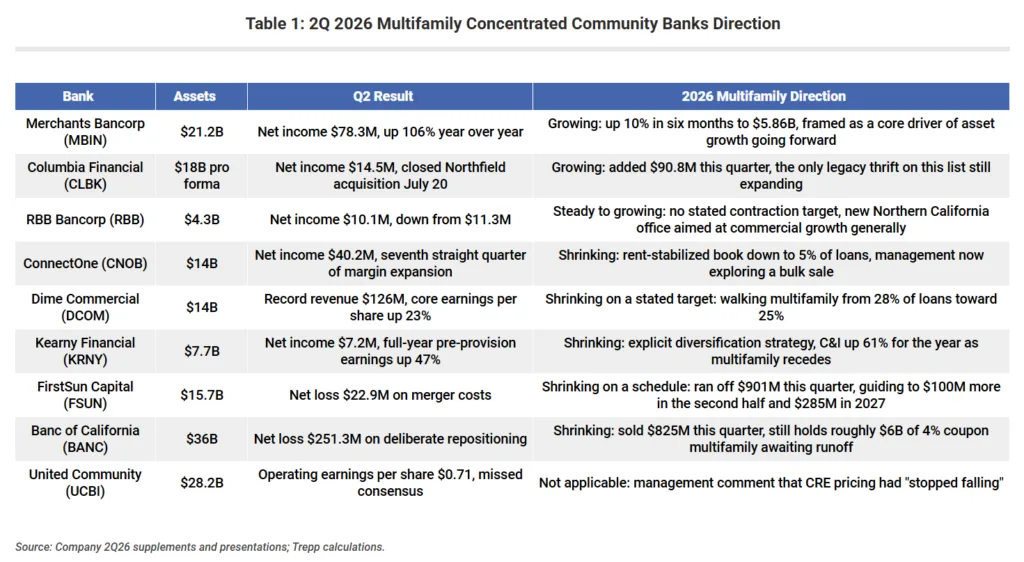
Trepp reviewed 10 banks with meaningful multifamily exposure. Results and lending pipelines varied widely. Merchants Bancorp increased net income by 106%. It also posted its 30th consecutive record quarter for tangible book value.
The bank expanded its multifamily portfolio by 10% to $5.86B. That portfolio now represents 47% of total loans receivable. Meanwhile, Bank of California reported a $251.3M loss. It sold $2.3B of lower-yielding securities and started selling $827M of CRE and multifamily construction loans.
Most banks reported their strongest net interest margins in years. However, six banks continued reducing multifamily exposure. Legacy thrifts tied to New York’s rent-stabilized market led that trend. Only Merchants and Columbia expanded their portfolios.
Dime is lowering multifamily exposure toward 25% of its portfolio. Kearny continues shifting toward C&I and construction lending. Mechanics kept its multifamily portfolio flat through a conservative runoff strategy. It also maintained strict underwriting and avoided nondepository exposure. These approaches produced very different risk and return profiles across similar banks.
Bank Models and Local Regulations Shape Lending Trends
Exposure alone does not explain performance differences. Trepp says ConnectOne, with large New York rent-stabilized holdings, recorded a $13.8M charge-off on troubled loans. Reserve releases partly offset those losses. The bank is also considering a bulk sale of its rent-stabilized portfolio.
Merchants uses sophisticated risk distribution strategies. Criticized loans and provisions declined sharply. However, its non-performing loan ratio remains 1.67%. Mechanics follows a hold-to-maturity model with low leverage. It has not reported multifamily losses since 2016.
Loan performance also varies by financing structure. Trepp reports agency multifamily special servicing rates at 0.36%. Conduit CMBS reached 2.06%, while CRE CLOs hit 3.58%. Those figures show multifamily risk depends on loan structure and investment strategy.
Geography also shapes outcomes. Legacy New York thrifts face mounting pressure from the 2019 rent law. A citywide rent freeze begins for most leases in October 2026. Similar regulatory pressures have also reshaped commercial property performance, especially for retail landlords navigating New York’s evolving rent rules. That policy has already sparked litigation from affected banks. Meanwhile, Los Angeles lenders like Mechanics continue reporting low non-performing loan rates through conservative underwriting and modest leverage.
Why It Matters
Q2 2026 earnings reinforce a key point. Multifamily exposure alone does not determine bank risk. Trepp’s data shows underwriting discipline, portfolio seasoning, risk transfer, and local housing policy drive results.
Legacy New York thrifts face ongoing pressure. The 2019 Housing Stability and Tenant Protection Act limits rent growth. A citywide rent freeze for 2026 and 2027 adds further pressure. Those policies compress margins and increase loss reserves.
ConnectOne and Dime responded with charge-offs, additional provisions, and, in one case, a proposed portfolio sale. Meanwhile, Merchants spreads risk through GSE securitizations, credit default swaps, and warehouse lending. Those strategies help contain losses despite relatively high non-performing loan ratios.
Mechanics demonstrates a different path. Conservative runoff, seasoned loans, and low leverage continue protecting asset quality. Those factors help reduce volatility despite meaningful multifamily exposure.
For CRE investors and lenders, headline concentration ratios rarely tell the full story. Community bank mergers have reduced the number of comparable lenders. Consequently, one bank’s losses can shift sentiment across the entire segment. Trepp argues investors should evaluate business models, risk management, and local legislative risks before judging multifamily credit exposure.
What’s Next
Community bank mergers continue shrinking the sector. That trend increases the market impact of each bank’s quarterly results. New York’s rent freeze begins for most leases in October 2026. Litigation over rent regulations also remains unresolved.
Banks outside legacy rent-stabilized markets appear better positioned. Lenders that distribute risk through securitizations and swaps also have stronger prospects for stable margins and asset quality. Investors should expect continued segmentation across multifamily lending. Underwriting standards will receive closer scrutiny. Market concentration will likely increase among institutions able to tailor strategies to specific portfolios and local markets.