








- David Levine and Giovanni Cutaia now run Blackstone real estate after Nadeem Meghji announced his exit, with the unit’s profit tracking at half its 2022 peak and a $30 billion fundraise delayed.
- Nearly a third of the group’s senior managing directors have left in three years, as weaker fund returns shrank the carried interest that once paid senior dealmakers up to $15 million a year.
- Data center demand and AI-driven leasing offer relief, but rate-hobbled deal markets mean the new leaders must deploy capital before they can raise the next fund.
Blackstone has handed its real estate business to a new pair of leaders at a tough moment, according to a Bloomberg.
David Levine and Giovanni Cutaia take over a unit whose profit is tracking at half its 2022 peak.
Get Smarter about what matters in CRE
Stay ahead of trends in commercial real estate with CRE Daily – the free newsletter delivering everything you need to start your day in just 5-minutes
A Shock Leadership Change
Nadeem Meghji became sole head in January and announced in September that he would leave by year-end, less than 10 months after co-head Kathleen McCarthy departed. Bloomberg reported that Jon Gray tried and failed to talk him out of it, citing colleagues.
A firm statement said Meghji plans to take time with his young family. People familiar with his thinking told Bloomberg he eventually wants to start his own venture.
A Broader Exodus
The top job is not the only one that has turned over. Nearly a third of the group’s senior managing directors have left in three years, according to the Wall Street Journal.
Two top real estate credit executives joined Starwood Capital, and the head of strategic investments in the Americas started his own firm. Former senior managing director Tyler Henritze has since raised $1.9B for the second fund at the firm he co-founded.
A Blackstone spokeswoman told the Journal the number of senior partners in the group is unchanged and pointed to 45 partners with an average tenure of 14 years.
The Numbers Behind the Slide
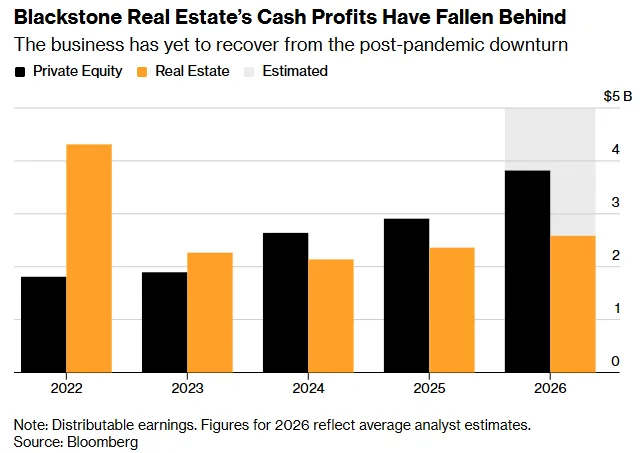
Blackstone’s latest results showed a 10% annual drop in real estate distributable earnings. Its assets also sit $30B below their peak. Opportunistic strategies lost 3.2% during the quarter. Meanwhile, private equity has overtaken real estate as the firm’s most profitable business.
The flagship BREP IX fund began investing in 2019. Since then, it has returned 3% annualized net, according to Bloomberg. KKR’s comparable fund returned 3.3%, Carlyle’s 1% and Brookfield’s 3%.
The $20.5B fund fell below its return hurdle for carry as of June, The Wall Street Journal reported. The paper also found that four of 13 funds with completed investment periods missed their thresholds in Blackstone’s 2025 annual report. By contrast, a fund that closed in 2012 with $13.3B has earned 14% annualized. It also generated about $3B in carry, according to compensation experts cited by the Journal.
The Pay Problem
Senior real estate executives typically earn about $2M annually in salary and regular bonuses. That estimate comes from recruiters and former executives cited by the Journal. In strong years, carried interest added as much as $15M for a senior managing director. Business heads could earn even more.
However, weaker fund returns have reduced that upside. Darin White Eydenberg of Highridge Search told the Journal that many top dealmakers feel their opportunities have plateaued. As a result, they want to prove they can build something themselves.
The Fundraising Clock
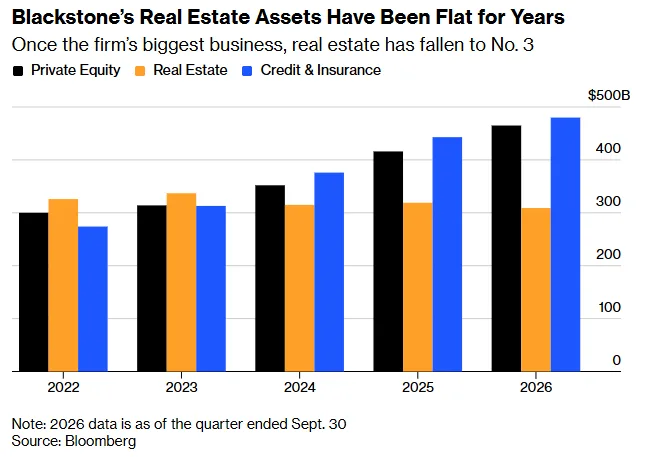
The unit manages about $309B, including nearly $47B in uninvested capital. Bloomberg reported that Blackstone must deploy at least 70% of its $30B tenth flagship fund before pitching a successor.
Levine and Cutaia see opportunities in warehouses, hotels and grocery-anchored retail. These sectors have benefited from limited new development. They also see data center financing as a source of large deals.
AI Gives Some Relief
Gray said a June sale of three fully leased Northern Virginia data centers lifted real estate returns to a four-year high in the second quarter. Nearly 15% of Blackstone’s large warehouses now serve hyperscalers as equipment storage sites. In addition, second-quarter leasing volume rose 30% year over year, per Bloomberg.
AI tenants are also supporting office and life science holdings. Blackstone recently leased a 25-story San Francisco tower to Anthropic. We saw a similar shift when BREIT put $7B of sale proceeds into data centers, according to AltsWire.
Still, the gains remain uneven. In a February filing, Blackstone said data center gains in 2025 partly offset weaker fundamentals in life sciences office, student housing and select logistics.
Why It Matters
Levine told Bloomberg that the firm will remain disciplined. It will not rush deals if transactions slow. Cutaia added that capital markets still face rate volatility, although fundamentals are improving.
Property values have fallen since the Fed began hiking rates in early 2022. However, many potential sellers are waiting. As a result, lower prices have yet to produce bargains. Blackstone is also running a secondary process for Blackstone Property Partners. Additionally, it has reduced management fees for some investors who stayed.
Investors are watching closely. Greg MacKinnon of the Pension Real Estate Association told the Journal that limited partners have reason to worry when so many executives leave a firm.
What’s Next
The midterms could test Blackstone’s AI conviction. Gray told Bloomberg TV that the firm has high confidence in long-term contracts with hyperscalers. However, Democrats won partly on voter concerns about AI. Sen. Elizabeth Warren is also expected to chair the Senate Banking Committee. We covered how Democratic wins threaten the data center boom, with about half of proposed additions facing greater scrutiny.
Meanwhile, rival Starwood has also targeted AI-driven sectors. The firm hired the credit executives and, as we noted, closed its $10.2B fund.