






- Major US banks, including JPMorgan and Citi, are dedicating hundreds of billions to affordable housing initiatives through 2035.
- These programs target both homeownership and rental supply, alongside policy advocacy and innovation grants.
- Banks are motivated by a shrinking mortgage market and broader economic impacts tied to the national housing shortage.
Housing Initiatives Ramp Up
Major US banks are doubling down on their role in tackling the ongoing housing crisis. According to Realtor.com, JPMorgan Chase launched a $750B, decade-long plan this summer aimed at building or preserving 1M affordable housing units and supporting 500,000 home purchases, 200,000 of which are for first-time buyers. Citi, Wells Fargo, and Bank of America are fielding similar programs, each pledging tens of billions as part of what has become a coordinated sector response. These moves come amid growing supply shortages and eroding homebuyer confidence, especially among younger Americans priced out of even entry-level housing.
Of note, Bank of America has extended $15B in loans and grants since 2019, working with 300 housing counseling groups to help buyers cover down payments and closing costs. The scale of commitment across the largest lenders signals that housing supply and affordability are no longer social or political issues alone—they’re at the heart of banks’ business strategy and future growth.
Get Smarter about what matters in CRE
Stay ahead of trends in commercial real estate with CRE Daily – the free newsletter delivering everything you need to start your day in just 5-minutes
The Details
JPMorgan’s “American Dream Initiative” stands out for its scale, dedicating $750B through 2035 to housing projects and mortgage assistance programs. The goal includes building or preserving 1M affordable homes and supporting 500,000 home purchases. Citi has made affordable housing a similar priority, committing $60B to finance 250,000 homes nationwide. In 2025 alone, Citi funded $7B to support 30,000 units. It also provided housing nonprofits with $50M in seed funding for pre-development activities.
Wells Fargo has awarded $53M for innovative housing solutions and contributed $830M since 2019 through its foundation. Collectively, the “big four” banks are deploying capital while aligning financial products, grants, and policy advocacy nationwide.
Banks Respond to Mortgage Market Challenges
Behind these headline commitments is a strategic response to the challenges facing the traditional mortgage business. Mortgage originations at major banks have dropped below 500,000 annually for the past three years per the Philadelphia Fed, a sharp reversal from pre-pandemic levels north of 1M. High interest rates, competition from specialized lenders, and the so-called “lock-in effect”—which keeps homeowners from moving due to favorable existing mortgages—have chilled transaction volume.
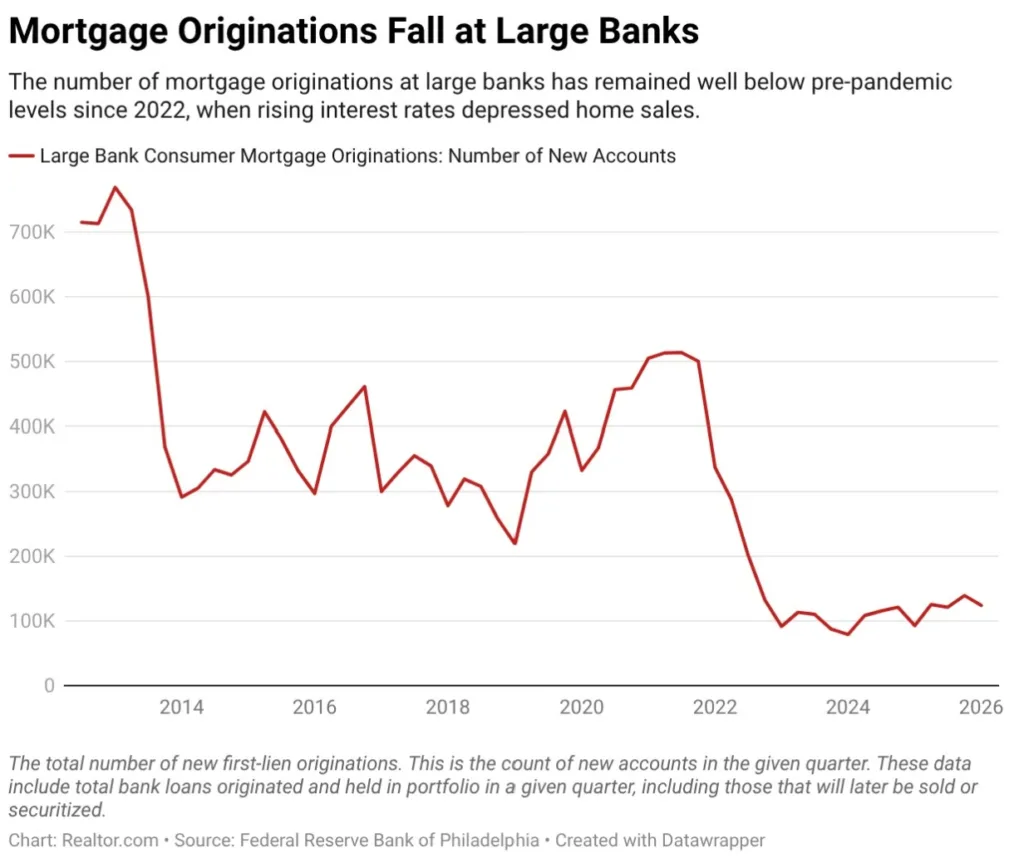
According to iEmergent data, only 581,000 home purchase loans originated in Q1 2026, down 19% quarter-over-quarter and the lowest in over a decade. With younger buyers largely priced out and older owners reluctant to move, banks are turning toward supply-side interventions as a lever to reinvigorate both origination pipelines and the broader market.
Why It Matters
For banks, the crisis in housing is not only a societal challenge but a business imperative. The $49T US housing market underpins national economic stability, personal wealth-building, and, crucially, the growth trajectory of consumer lending portfolios. A sustained shortage—counted in the millions of homes nationwide—directly constrains the volume of future mortgages and deposits. Per Realtor.com, the rising cost burden for American households is stifling investment and mobility, which in turn suppresses economic output and limits opportunities for banks to deepen customer relationships. Dennis Shea, co-leader of BPC’s Terwilliger Center for Housing Policy, highlights how housing constraints restrict labor mobility and productivity, echoing the logic underpinning the banks’ multifaceted strategies.
Policy dimensions add another layer. Banks like JPMorgan and Citi are now backing zoning reform, building code modernization, and modifications to the Low Income Housing Tax Credit (LIHTC), hoping to unlock development bottlenecks and expand affordable supply. JPMorgan’s recent support for manufactured housing innovation and Citi’s push for transferable LIHTC credits underscore a shift from simple lending to active policy engagement. The alignment of private capital with public policy marks a new phase in how the financial sector seeks to catalyze real change in the housing ecosystem.
What’s Next
With hundreds of billions pledged through at least 2035, these banking initiatives will take years to play out—but the immediate focus is on increasing the housing pipeline and reforming regulatory barriers. Expect further announcements from big lenders as new policy proposals move through local and federal channels, and as results from early investments shape subsequent funding rounds. For the CRE industry, the mobilization of large financial institutions marks a significant tide shift, positioning banks not just as lenders but as hands-on partners in housing development. Their ability to deliver supply and drive innovation may determine the path for both affordability and future mortgage growth in the US.