






- US super regional banks saw significant Q2 2026 growth in commercial and industrial (C&I) lending, overtaking non-banks.
- Loan growth stemmed from banks reclaiming market share from private credit, not a surge in AI-related lending.
- Rising line utilization rates point to rising underlying borrower demand, indicating potential for sustained C&I growth.
Non-Banks Lose Ground on C&I Lending
Commercial and industrial (C&I) lending drove Q2 2026 loan growth at US super regional banks. Trepp reached that conclusion after reviewing earnings calls and regulatory filings.
Banks spent two years losing ground to private credit and other non-bank financial institutions (NBFIs). Now they are reclaiming market share. The shift marks a clear reversal after quarters dominated by bank pullbacks and private credit growth.
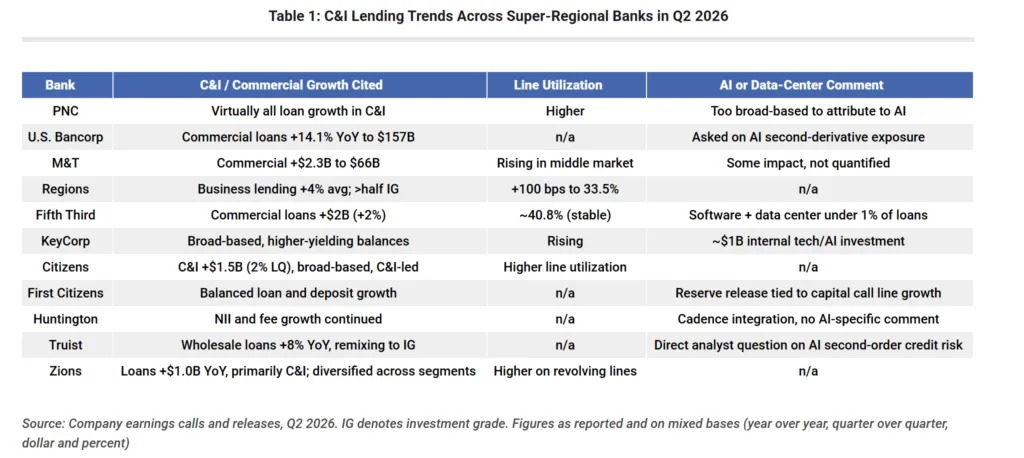
US Bancorp increased commercial loans 14.1% year over year to $157B. Regions, M&T, PNC, and others also reported strong commercial lending momentum. This quarter, banks focused less on lending to NBFIs. Instead, they worked to win back core business borrowers.
Get Smarter about what matters in CRE
Stay ahead of trends in commercial real estate with CRE Daily – the free newsletter delivering everything you need to start your day in just 5-minutes
The Details
Company earnings releases and transcripts showed broad C&I gains across regional banks. PNC credited nearly all loan growth to C&I lending. Regions increased average business lending 4%. M&T grew commercial balances by $2.3B to $66B.
More than half of Regions’ new C&I production came from investment-grade borrowers. Fifth Third, KeyCorp, and Citizens also reported broad commercial strength. Analysts repeatedly asked about AI lending exposure. However, executives mostly discussed market share gains from private credit competitors.
Line utilization also increased. Regions reported a 100-basis-point jump to 33.5%. Other banks reported similar trends. Companies are not only securing credit lines. They are actively drawing on them.
Private Credit Under Pressure
The rebound follows a period when private credit and NBFI lenders consistently outgrew banks. Last quarter, banks emphasized lending to NBFIs. This quarter, they highlighted recapturing traditional corporate borrowers.
M&T and KeyCorp both said they were winning back market share. They also described weaker competition from private credit firms. Meanwhile, private credit markets faced early stress and redemption pressure during 2026.
Banks used stable deposit funding and stronger balance sheets to compete more aggressively. As a result, they regained ground in corporate lending. Increased competition also limited further spread tightening in bank C&I loans.
Why It Matters
Stronger bank-led C&I lending signals where broader CRE and corporate credit markets may expand next. Federal Reserve reporting frameworks and Trepp’s T-ALLR data show higher line utilization often precedes stronger capital spending, acquisitions, and economic activity.
This expansion does not appear driven by AI lending. Despite repeated analyst questions, banks either avoided the topic or could not isolate AI-related lending volumes. Instead, executives consistently highlighted gains from private credit competitors.
The shift also supports market stability. As private credit firms face outflows and portfolio pressure, regulated banks can fill the gap. That trend also follows broader signs that banks are expanding lending capacity for commercial real estate as balance sheets improve. Continued line utilization growth could support several quarters of stronger C&I lending.
For CRE professionals, the trend could expand financing options. Middle-market and large borrowers may rely less on non-bank lenders if banks continue increasing loan activity.
What’s Next
Banks could maintain C&I lending momentum through the second half of 2026 if borrower demand remains healthy. Trepp and other industry data providers will help distinguish AI-related lending from broader credit growth.
If line utilization keeps rising and private credit faces additional pressure, banks will likely strengthen their position in corporate lending. Investors will closely watch upcoming earnings for asset quality, credit standards, and loan demand as economic conditions evolve.