








- AI adoption among US businesses rose to 21.7% by July 2026 but lags behind initial projections, per Census Bureau data.
- Larger firms and knowledge industries like Information, Professional Services, and Finance now lead in AI uptake, widening the adoption gap.
- Flexible workspace demand may increase as companies seek agility while AI reshapes operations unevenly across regions and sectors.
AI Growth Cools Despite Broader Uptake
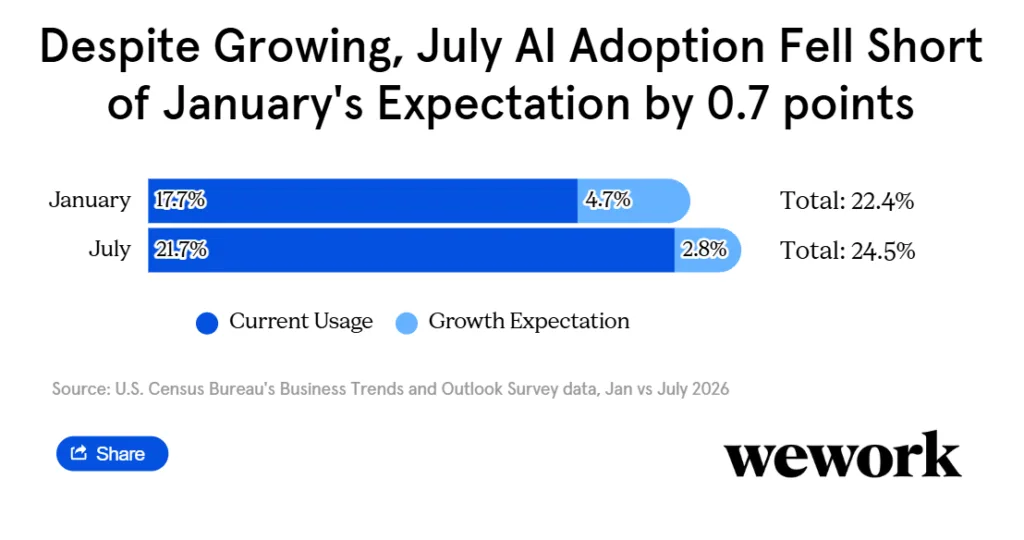
By mid-2026, about one in five US businesses had implemented artificial intelligence for their operations. According to WeWork’s analysis of the Census Bureau’s Business Trends and Outlook Survey, AI usage climbed from 17.7% in January 2026 to 21.7% in July. This steady progress, however, masks a deceleration: expectations for further near-term AI adoption moderated from 4.7 percentage points forecast in January to just 2.8 percentage points by July. In several major metros and across most business size groups, actual implementation fell short of prior forecasts, signaling that operationalizing AI is proving harder than companies expected.
The trend underscores a growing divide, with adoption concentrating among the largest companies and certain sectors. Larger organizations—those with 250+ employees—report 38.8% adoption, nearly doubling the rate among firms with fewer than five employees (20.8%). This split illustrates both the promise and the practical barriers of enterprise AI scale-up.
Get Smarter about what matters in CRE
Stay ahead of trends in commercial real estate with CRE Daily – the free newsletter delivering everything you need to start your day in just 5-minutes
The End of Runaway Optimism
January’s bullish adoption forecasts did not materialize for many regions or company segments. Firms in 28 of 48 reporting states and 14 of the 25 largest metros ended up using less AI in July than they’d previously projected. The largest gaps appeared among mid-to-large and multi-market firms: those with 100–249 employees fell 8.7 percentage points short of forecast, the steepest drop of any cohort. State-level outliers included New Mexico (−17.5 points) and Nebraska (−12.4), per Census data. Enthusiasm remains, but execution lags.
The city-level picture is equally uneven. Tampa posted the biggest metro jump, up 14.9 points to a 32.0% adoption rate, with Detroit close behind. Notably, previous leaders such as Phoenix saw usage drop sharply (down 8.6 points to 21.5%), signaling rapid swings in adoption hot spots. New York and Los Angeles, the nation’s two largest metros, both reported below-average uptake—suggesting that density and size alone don’t guarantee leadership in digital transformation.
Knowledge Sectors Take the Lead
AI use is most prevalent among office-driven sectors. Information leads with a 43.7% adoption rate, followed by Professional, Scientific & Technical Services (37.6%) and Finance & Insurance (36.0%). Among the largest Information firms (250+ employees), adoption soared to 77.0%—the highest of any group in the survey. Real Estate and Health Care trail, with respective usage rates of 29.0% and 24.7%.
An unexpected reversal appeared in Finance & Insurance: for companies with 100–249 staff, AI adoption surged by 10.9 points to 62.7%, while firms over 250 employees actually saw a 10.2-point decline, falling to 42.2%. This suggests mid-sized financial outfits are ramping up faster than their enterprise-scale peers, defying the general tendency toward size-driven adoption advantages.
Why It Matters
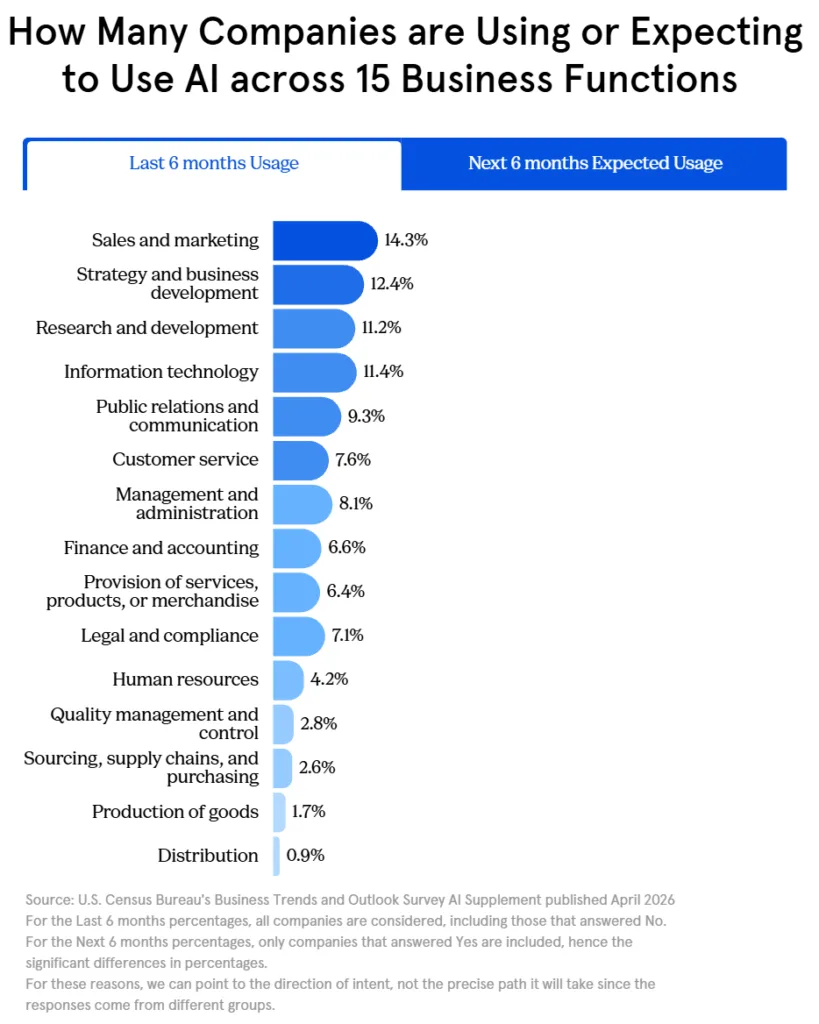
The uneven, sector-skewed adoption landscape is reshaping commercial office expectations. Technology uptake clusters around sales, marketing, business development, and R&D. These functions are closely associated with knowledge work. That shift is already influencing office markets, with AI-driven employment growth supporting demand in hubs such as Miami.
Within firms using generative AI, document editing is the most common application, at 85.4%. Information search follows at 49.9%, while 44.6% use AI for summarizing content. The shift is overwhelmingly additive: 43.7% of businesses report AI as a supplement to human work, while only 2% cut jobs as a direct result. For companies with 250+ employees, 3.0% reported workforce additions tied to AI.
But barriers persist. Nearly two-thirds of future non-adopters say AI simply isn’t relevant to their business, with knowledge gaps (22%) and data privacy (21%) also cited. These hurdles dominate among smaller firms, while large enterprises express more concern about data protection and technological maturity. Such ambivalence tempers the narrative that AI will soon blanket the economy or obliterate white-collar roles.
This patchwork adoption blunts the impact of AI on overall workforce trends and underscores a need for adaptability. Flexible office solutions are gaining traction as firms hedge against regulatory uncertainty, workflow shifts, and fluctuating headcount. Per Cushman & Wakefield, 55% of global occupiers adopted flexible offices by 2025, and JLL research echoes the value of agility in the face of AI-driven organizational change. WeWork executives say optionality is now a top priority for clients navigating this uncertain terrain.
What’s Next
Looking ahead, adoption forecasts are cooler but steady. Businesses now expect only modest near-term increases in AI use, signaling a period of slower, more thoughtful integration across sectors. Knowledge industries and large organizations will likely remain the testing ground for enterprise-scale AI deployment, while significant portions of the economy continue to take a cautious approach—or sit on the sidelines entirely.
As CRE tenants recalibrate office footprints, demand may increasingly favor flexible, adaptive space over long-term traditional leases. With the application of AI concentrated around knowledge functions and high-skill workforces, urban centers with deep talent pools could eventually benefit—if adoption hurdles can be overcome. For now, flexibility and adaptability look poised to define the next phase of AI-driven office demand.