







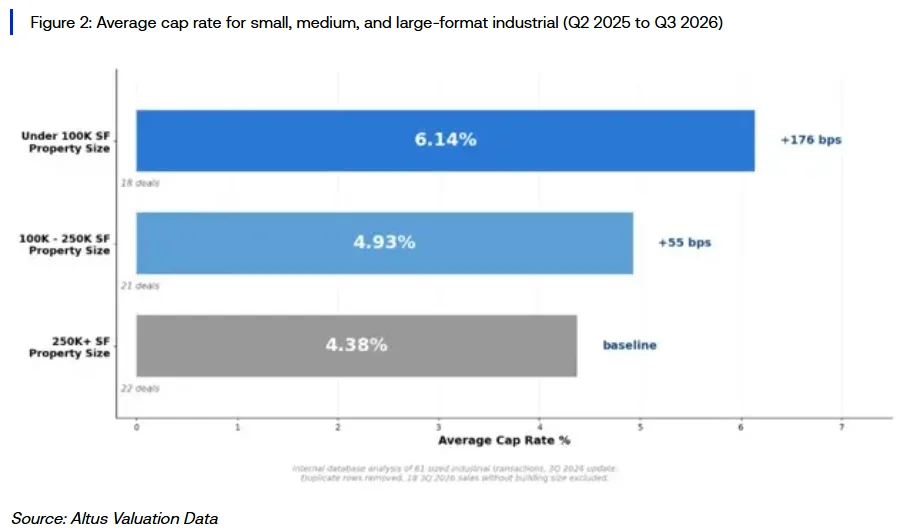
- A review of 61 industrial sales found buildings under 100,000 SF trading at a 6.14% average cap rate, against 4.38% for properties of 250,000 SF or more.
- Just 0.5% of small-bay inventory was under construction in Q3 2026, compared with 3.0% for large-bay, while small-bay leases usually last only three to five years.
- With 10-year CMBS debt priced near 6.3%, borrowing adds little at a 6% cap rate, so returns depend on rent growth after turnover costs and on the exit price.
Buyers of small industrial buildings are collecting a 176-basis-point premium over big-box buyers, according to a new Altus Group analysis.
The firm’s question is whether that gap prices in weaker real estate or pays owners for doing harder work.
Get Smarter about what matters in CRE
Stay ahead of trends in commercial real estate with CRE Daily – the free newsletter delivering everything you need to start your day in just 5-minutes
By the Numbers
Altus studied 61 industrial sales spread over 36 metros. Buildings smaller than 100,000 SF traded at a 6.14% average cap rate, while those at 250,000 SF and up came in at 4.38%.
The sample splits fairly evenly: 18 small deals, 21 mid-size and 22 large.
The gap grew from roughly 169 bps in 2025 to 192 bps in 2026. Altus cautions that just seven large buildings sold in the 2026 sample, so it treats the widening as a direction and not a conclusion.
What Small-Bay Industrial Is
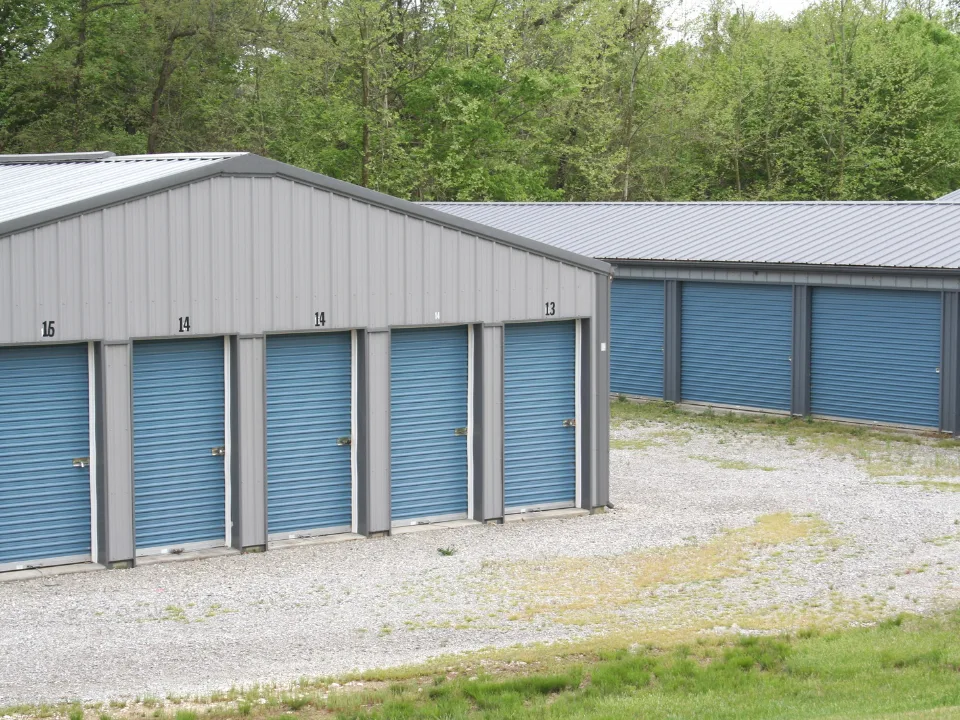
Think neighborhood warehouses. The segment covers buildings below 100,000 SF, often carved into suites of about 2,000 to 15,000 SF for tradespeople, local manufacturers, service firms and last-mile operators.
Big money is showing up. BKM Capital Partners and Kayne Anderson set up a $1.5B joint venture for the segment in 2025, then paid Link Logistics $1.81B this year for 51 multi-tenant properties totaling about 8.5M SF.
Altus doesn’t read that deal as proof every small building is a buy. It does see evidence that scale and operating skill can carry a long-term strategy.
Supply Is the Edge
Almost nobody is building this product. BKM data cited by Altus shows 0.5% of small-bay inventory under construction in Q3 2026, versus 3.0% for large-bay.
Vacancy favors small buildings too, though by less than before. They averaged 4.9% in Q4 2025, about half the large-building rate back then.
By Q3 2026, Cushman & Wakefield had vacancy for buildings of 500,000 SF and up at 7.4%, a 280 bps drop in a year.
Rent growth isn’t what sets the segment apart right now. Cushman & Wakefield had national asking rents up 4% from a year earlier in Q3 2026, and JLL put growth at 12.1% for Class A space in buildings above 1M SF. Altus says the small-bay case leans more on tight supply and deep tenant demand.
The whole sector is tightening. Marcus & Millichap’s November outlook, which we covered Nov. 12, had U.S. industrial vacancy falling to 7.6% in Q3, the first quarterly drop since 2022.
The Catch
Leases are short: three to five years is typical, against five to ten for many big warehouses. That means more downtime and more leasing costs, but also a faster reset when in-place rents trail the market.
A long tenant roster cuts concentration, not credit risk. Losing one tenant hurts less, yet those tenants are small firms, often with thinner credit, and each one takes leasing effort.
Scarcity has limits as well. Altus says an obsolete building in a weak location doesn’t turn attractive just because nothing new is going up nearby.
Why It Matters
Debt costs are the squeeze. Treasury 10-year yields sat near 4.5% when June began and hit 5.31% on Oct. 5, Altus notes.
By mid-October, the median coupon on 10-year fixed-rate loans in this year’s CMBS pools was roughly 6.3%.
At a cap rate around 6%, debt at that price doesn’t add much return on day one.
Rates are weighing on the mood across the market. As we covered Nov. 23, The Real Estate Roundtable’s sentiment index fell 10 points to 53 in Q4, with the survey blaming rising interest rates and geopolitical uncertainty.
What’s Next
Altus pushes the answer down to the property. Its checklist: measure income concentration by tenant, industry and lease year, and stack rolling rents against the market, net of downtime, concessions and tenant improvements.
Then ask who buys it next. A future owner may discount for management intensity, and the exit has to pencil in a pricier capital market.
One more caution from Altus: outside research often says “shallow bay,” which overlaps with small bay but isn’t the same thing, so market comparisons need care.