






- Families spent over $40B on kids’ sports in 2024, up 46% since 2019, and tournaments generated $149B in total economic impact, according to CBRE.
- CBRE’s framework tells cities to set goals, count every public cost, test feasibility against true comparables, and structure ownership and risk before committing land, grants or tax breaks.
- Institutional capital is flowing into facilities, academies and software, so municipalities face a pitch cycle in which developer attendance and room-night forecasts need independent testing.
Youth sports are now big business, and cities are being asked to help pay for the venues. CBRE says families put more than $40B into their kids’ sports in 2024, up 46% from 2019, in a new look at youth sports facilities.
A typical family spent over $1,000 on one child’s main sport.
Get Smarter about what matters in CRE
Stay ahead of trends in commercial real estate with CRE Daily – the free newsletter delivering everything you need to start your day in just 5-minutes
Tourism and Capital Follow
Events drawing amateur and youth athletes produced more than $60B of direct spending, CBRE says, which rolled up to a $149B economic impact and $11B in state and local tax revenue.
Institutional investors have joined in through facilities, academies, tournament operators and software. That gives municipalities a shot at using sports for development and placemaking.
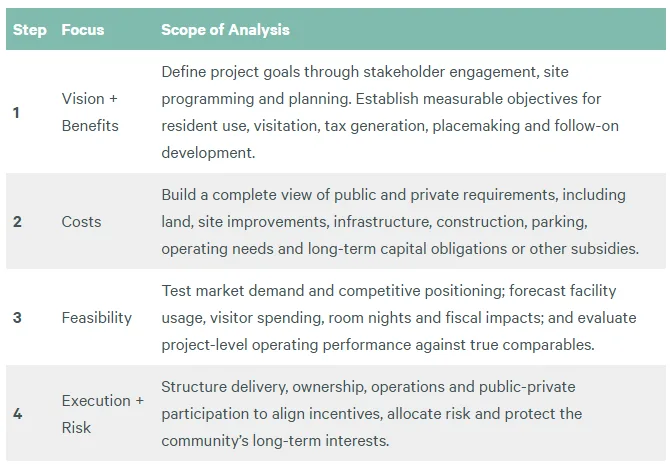
The Four-Step Test
CBRE proposes a four-part review: set the vision and measurable benefits, build a complete cost picture, test feasibility, and structure delivery so risk lands in the right place.
The cost step should capture land, infrastructure, parking, construction and operating needs, plus long-run capital obligations, not just the headline subsidy.
Feasibility means testing demand and competitive position, projecting usage, visitor spending, room nights and fiscal impact, and measuring operations against true comparables. The final step covers delivery, ownership and public-private structure, so incentives line up and the community’s long-term interests are protected.
CBRE notes that modern facilities often require significant infrastructure and subsidies such as grants, tax deferrals and land contributions.
Six Forecasting Checks
Its six considerations start with keeping community-wide economic impact separate from a facility’s own financial feasibility. Planners should also stress-test demand against competing supply, seasonality, where participants come from and hotel capacity.
CBRE adds that cities should define success targets early, weigh indoor against outdoor space and food and hospitality offerings, and assign construction, demand and replacement risk to whoever can handle it best.
Zoom Out
The scale is already visible. Our brief on youth sports development covered Montierre’s $1B Dynasty in Ocoee, Florida, a 159-acre complex with 17 multi-use fields, two hotels and 350K SF of retail and entertainment.
That piece cited the Aspen Institute’s $40B family spending figure for 2024, which matches CBRE’s number.
Why It Matters
Public-private deals often hinge on projections supplied by the developer. CBRE’s advice is to verify them against the market before committing public land, grants or tax deferrals.
The venues can support hotels, restaurants and nearby development, but only where demand and sites actually line up.
What’s Next
For cities weighing proposals, the first checkpoint is CBRE’s step one: define targets for attendance, local usage, hotel stays and tax revenue before any public money is committed.