






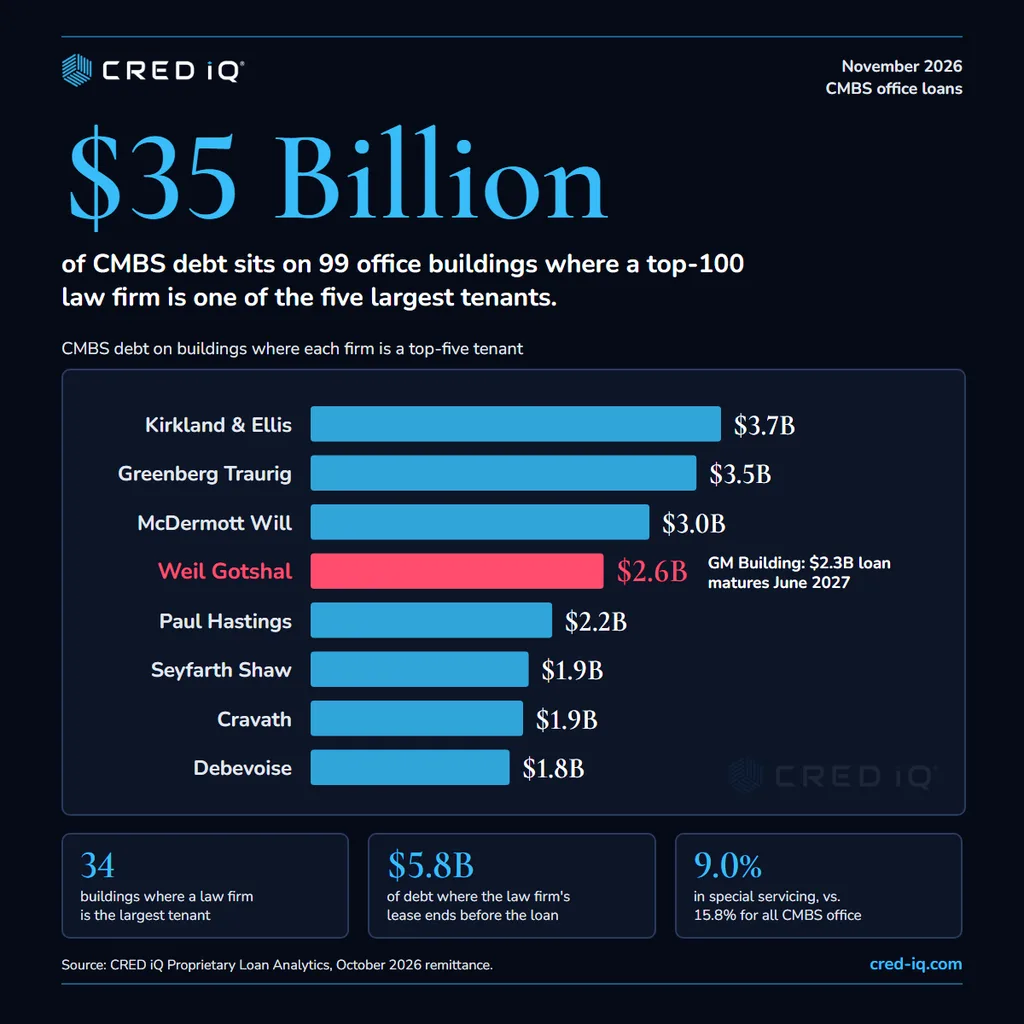
- Top-100 law firms rank among the five largest tenants in 99 office buildings backing $35.4B of CMBS, and in 34 of them, holding $15.9B, a firm is the top tenant.
- Law-firm buildings enter special servicing less often, 9.0% of balance versus 15.8% for CMBS office, but one departure can leave a big hole, as at the Times Building.
- Twenty-seven of these buildings, carrying $10.5B, have loans due by the end of 2027, so lenders will soon learn whether anchor firms stay, relocate or shrink.
Big Law quietly props up a meaningful slice of the office CMBS market. CRED iQ counted 99 office buildings where a top-100 firm ranks among the five largest tenants, and together those properties back $35.4B of debt in 192 deals. The firm’s analysis covers law firm tenants across the conduit and large-loan markets.
In 34 of the buildings, with $15.9B of debt, a law firm holds the top tenant spot. The 69 firms involved occupy 16.5M SF, and New York holds 55% of the balance.
Get Smarter about what matters in CRE
Stay ahead of trends in commercial real estate with CRE Daily – the free newsletter delivering everything you need to start your day in just 5-minutes
Weil Is the Warning Sign
Weil, Gotshal & Manges has occupied the General Motors Building since it opened in 1968. The firm has 447K SF under lease through August 2034. When the tower’s $2.3B loan was packaged into bonds in 2017, Weil accounted for 19.4% of gross rent.
The loan sits in BXP 2017-GM and 10 conduit transactions. It matures in June 2027. However, Weil’s wind-down creates a refinancing puzzle lenders didn’t expect a year ago.
The firm’s exposure also extends beyond New York. In Dallas, it secured an early renewal at The Crescent for 2028 to 2039. The deal carries $54 per SF triple net, up 67% from today’s $32.21.
Leases Outlast the Debt
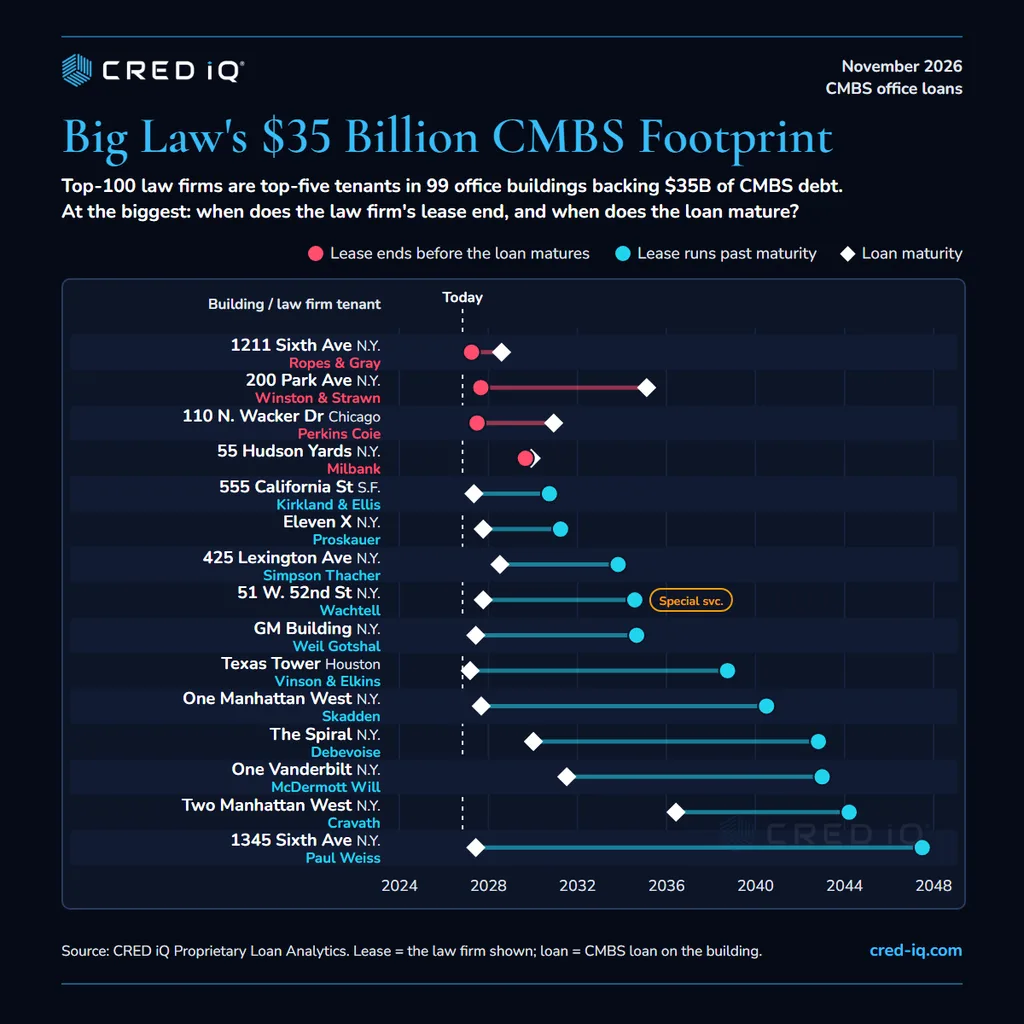
Recent trophy leases often extend beyond their loans. For example, Cravath’s 519K SF lease at Two Manhattan West runs through 2044. That’s almost eight years beyond the $1.9B mortgage’s maturity.
Similarly, Debevoise’s 531K SF at The Spiral runs through 2042. McDermott’s One Vanderbilt lease does too. Meanwhile, Paul, Weiss holds 766K SF at 1345 Avenue of the Americas through 2047. That is two decades past the loan’s maturity.
Where Leases End First
In 24 buildings carrying $5.8B of debt, a top-100 firm’s lease expires before the loan. One example is Ropes & Gray’s 345K SF at 1211 Avenue of the Americas. Its lease ends in March 2027, roughly 17 months before $1.04B comes due.
At 425 Lexington, the lender has also held back cash since this year’s loan closing. That’s because Simpson Thacher expects to leave when its 643K SF lease ends in 2033.
Fewer Defaults, Bigger Holes
Nineteen of these buildings carry $3.2B of debt and sit in special servicing. That’s 9.0% of the balance, compared with 15.8% across CMBS office loans.
However, a major tenant’s departure can still hurt. Covington & Burling left 197K SF vacant at the New York Times Building. Its $635M loan then defaulted at its December 2025 maturity.
In Los Angeles, Skadden’s lease at One California Plaza was set to end in November 2024. The loan missed its payoff that same month. A receiver now runs the tower, which is just 55.1% occupied.
Still, retaining major firms doesn’t guarantee a healthy loan. Wachtell and Orrick extended at 51 W. 52nd St., yet the loan remains in special servicing with 0.64x coverage. Likewise, Kirkland anchors 555 California Street, but the building is only 74.3% occupied. Coverage fell to 0.47x in June, ahead of the $1.2B loan’s May 2027 maturity.
Zoom Out
We’ve been tracking the Weil situation. In our brief on Weil’s collapse, we relayed the Wall Street Journal’s report. The firm’s roughly 450K SF at the GM Building is in play. Its rent sits near $121 per SF under a 2014 renewal, while brokers say tenants would pay $200-plus today.
Meanwhile, CRED iQ’s October data provides a broader view. Our CMBS distress report found that office was 16.4% distressed. It also accounted for 44% of the troubled balance.
Why It Matters
Firms typically commit to long leases and reliably cover rent. As a result, these buildings have a better default record. However, risk builds when maturities cluster.
In fact, 27 of these buildings carry $10.5B of debt due by the end of 2027. That group includes the GM Building.
Lenders will want to know whether each anchor tenant plans to stay, move into a new tower or disappear. Ultimately, those decisions will shape refinancing terms.
What’s Next
The first major test comes with the GM Building’s June 2027 maturity. Next are the 24 buildings where a lease expires before the loan. Together, these deals will show how much credit lenders give to anchor tenants.