






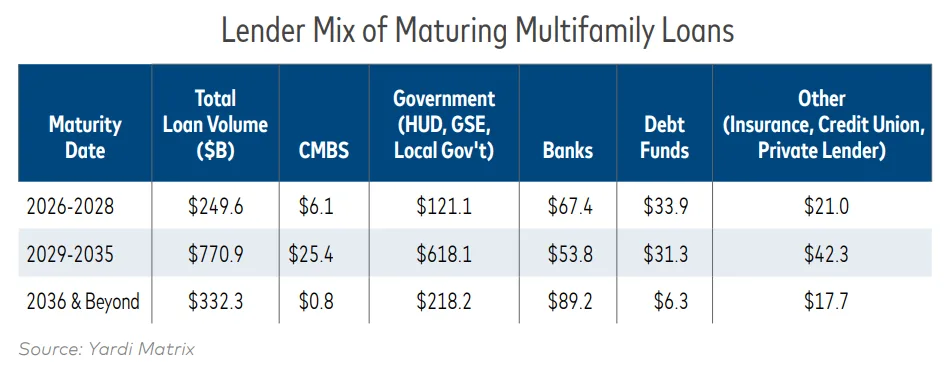
- About $116 billion of multifamily loans mature by the end of 2027 and nearly $250 billion by 2028, within a Yardi Matrix database tracking $1.4 trillion of debt.
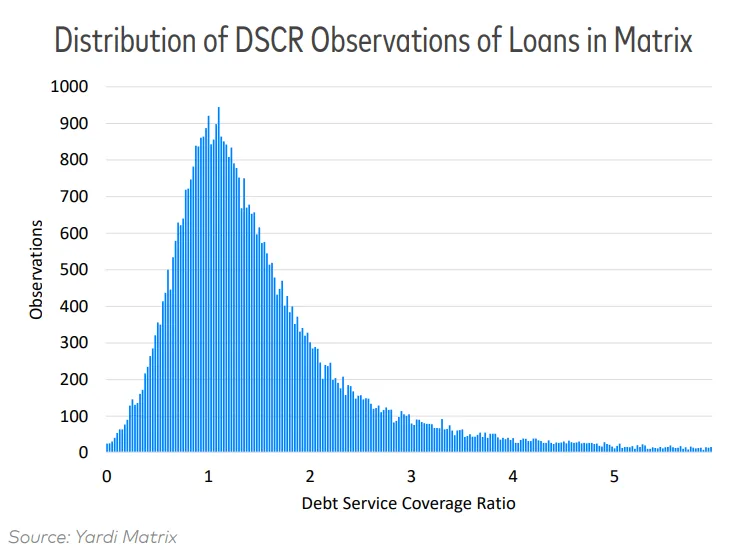
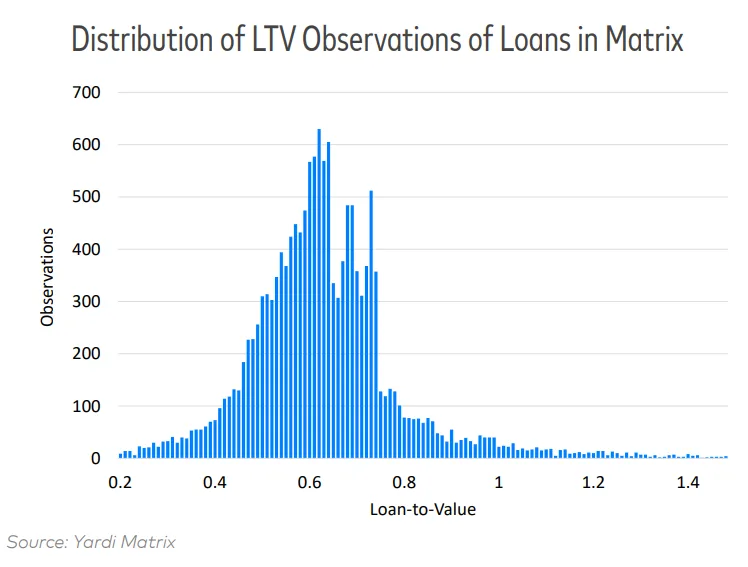
- Roughly 8% of loans show a DSCR below 0.6 or an LTV above 85%, with distress concentrated in floating-rate loans originated from 2020 through 2022.
- Yardi expects gradual extensions and restructurings rather than a default wave, though multifamily rates above 6% hit loans written at 3% to 4% hardest.
About $116 billion of apartment loans come due through 2027 and nearly $250 billion through 2028, according to a new Yardi Matrix analysis of the $1.4 trillion of multifamily debt in its database.
The good news: the stress is narrow. Roughly 8% of loans show an estimated DSCR below 0.6 or an LTV above 85%.
Get Smarter about what matters in CRE
Stay ahead of trends in commercial real estate with CRE Daily – the free newsletter delivering everything you need to start your day in just 5-minutes
Where the Risk Sits
Market-rate properties hold about $230 billion of the 2028 total, and fully affordable ones about $19 billion.
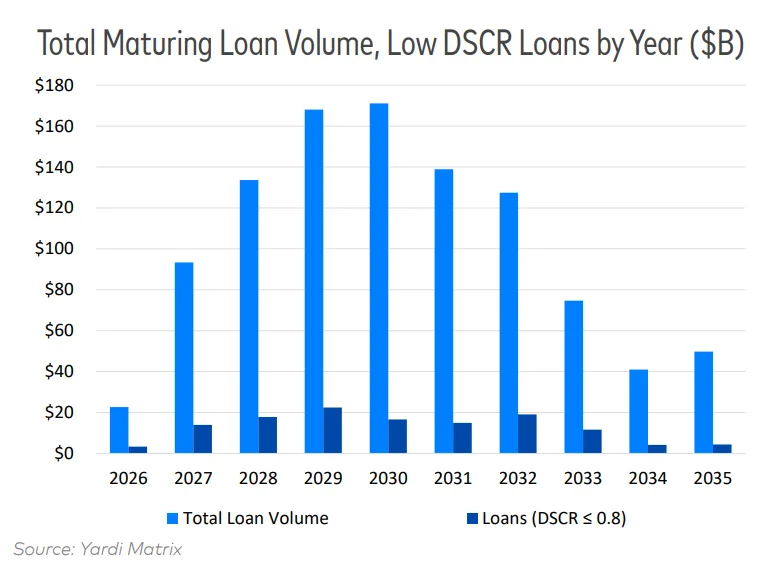
Through 2028, $9.9 billion of loans with coverage at or below 0.8x are due: $8.3 billion fixed-rate across 315 properties and $1.6 billion floating across 49. Fixed-rate borrowers have more protection until maturity, but weak cash flow can still make a refinance hard.
Stretch the window to 2030 and that low-coverage pile grows to $74.1 billion across 2,367 properties.
The worst pocket is $31.5 billion maturing by 2030 with both thin coverage and very high leverage. Yardi calls them strong candidates for default or restructuring.
The 2020-2022 Floaters
Yardi sees the most distress in floating-rate loans written in 2020-2022, ahead of the Fed’s 525-basis-point hiking cycle that ended in July 2023.
Of $52.5 billion in those loans still outstanding, more than a quarter, or $13.5 billion, sit on properties with coverage of 0.8x or less.
Construction debt adds another $41.5 billion due before 2029, including $4.3 billion on properties with weak coverage. Slow lease-up in high-supply markets is a likely culprit.
A Solid Market-Rate Cushion
Market-rate debt totals $949 billion through 2035. Of that, $107 billion comes due in the next two years and $124 billion the year after. About 57% shows coverage over 1.2x, and nearly nine in ten loans sit at 80% LTV or lower.
Still, almost 30% of market-rate loans show coverage of 1.0x or less, and 16% are at 0.8x or less. Only about 11% have an LTV above 80%.
That split matters at refinance. Weak coverage means a smaller new loan and more equity, even at moderate leverage.
Atlanta Faces the Earliest Wave
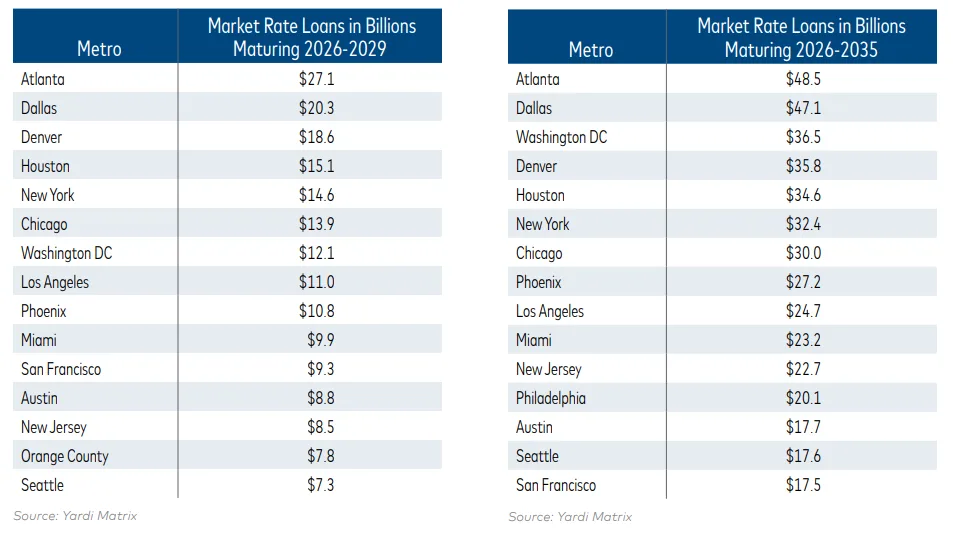
Atlanta has the most market-rate debt due in 2026-27 among Yardi’s top 30 metros at $9.7 billion. Dallas and Denver follow with about $6.0 billion each, then Houston at $4.2 billion and Chicago at $3.9 billion.
Atlanta’s schedule is also the most front-loaded: 20.1% of its $48.5 billion through 2035 comes due in two years. Austin (17.3%) and Denver (16.9%) are next.
Who Holds the Paper
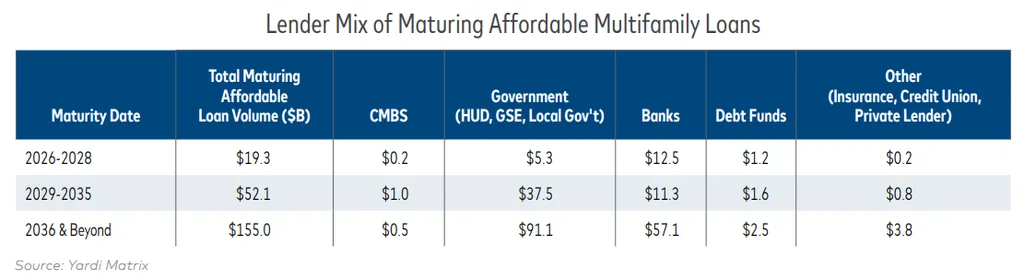
Government sources account for about 40% of 2026-27 market-rate maturities, banks 31% and debt funds 17%. Yardi notes that longer-dated agency loans benefit from cash flow growth, while shorter bank and debt fund loans had less time to build income.
The delinquency gap is wide. The Mortgage Bankers Association put the Q2 2026 CMBS multifamily rate at 6.5%, versus 1.2% at banks and 0.6% at GSEs and insurers. That backdrop is why bank multifamily lending rebounding matters: our August brief cited CBRE data showing banks up about 30% year over year.
Affordable Housing Is Different
Of $9.5 billion in affordable debt due in 2026-27, banks hold $6.2 billion, or 65.7%. By 2030-35, government lenders take 78.4% of maturities.
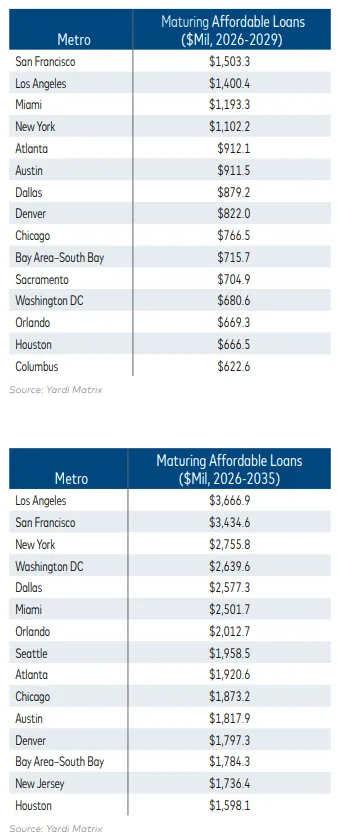
New York City has the most affordable debt due near term among the top 30 metros at $561 million. Restricted rents and complex capital stacks that combine senior debt with LIHTC equity can make those refis harder than the numbers suggest.
Why It Matters
Yardi describes a slow grind, not a cliff. Lenders and borrowers have renegotiated underwater loans for years to avoid foreclosure, and the incentive to extend and pretend remains. That fits the broader $733B debt wall we covered on October 27, where Trepp estimated that much commercial debt matures in 2027.
Multifamily rates above 6% are the pressure point, especially for loans written at 3% to 4% in 2020 through early 2022.
What’s Next
Expect extensions, equity injections and modified loans rather than a wave of foreclosures. Yardi’s Paul Fiorilla and Jacob Gonzalez wrote that each loan’s outcome will hinge on how the property performs, what capital it needs and whether financing is available.