







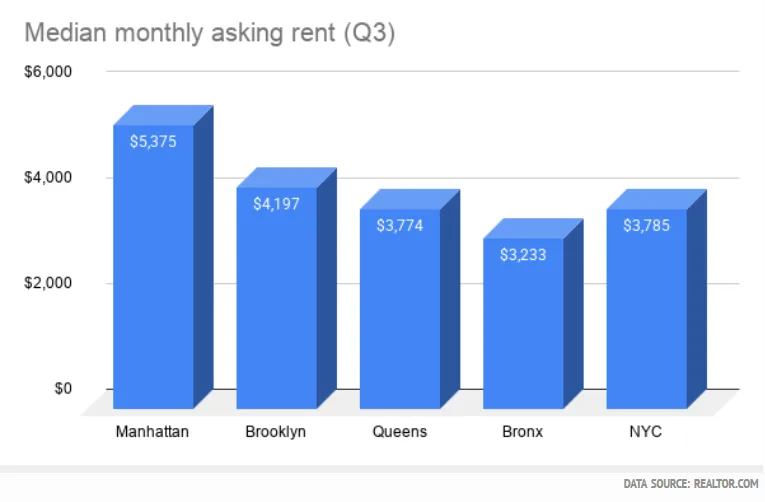
- New York City’s median asking rent reached a record $3,785 in the third quarter, up 4.5% year over year and 27.5% above pre-pandemic levels.
- Manhattan rose 8.3% to $5,375, Brooklyn 4.9% to $4,197, Queens 3.9% to $3,774 and the Bronx 2.7% to $3,233, while studios to two-bedrooms rose 7.1%.
- Climbing small-unit rents and mortgage rates above 7% squeeze would-be buyers and renters at once, since buying a typical home costs nearly three times renting.
New York City’s median asking rent hit a record $3,785 a month in the third quarter, up 4.5% year over year, according to Realtor.com data reported by Commercial Observer.
That is the highest reading since Realtor.com began tracking in 2019, and $816, or 27.5%, above the pre-pandemic level of roughly $2,970.
Get Smarter About What Matters in New York
Subscribe to our free newsletter covering the biggest commercial real estate stories across the five boroughs — delivered in just 5 minutes.
Manhattan Leads the Boroughs
Manhattan posted the biggest jump, with median rent rising 8.3% to $5,375. That is nearly double the citywide pace. Meanwhile, Brooklyn rose 4.9% to $4,197, Queens climbed 3.9% to $3,774 and the Bronx increased 2.7% to $3,233.
As a result, Manhattan’s median rent now runs about 66% above the Bronx figure.
However, the ranking depends on the dataset. Chandan Economics’ Zillow-based numbers, which we covered in our look at NYC rent growth, had the Bronx leading through September at 6.2%. Also, Staten Island is excluded from the Realtor.com data.
Small Units Take the Hit
Across the four boroughs it tracked, Realtor.com found studio-to-two-bedroom rents rose 7.1% to $3,662. By comparison, rents for units with three or more bedrooms increased just 2.9% to $5,089.
Realtor.com senior economist Jiayi Xu said the sharpest gains are in smaller units. That’s where affordability-minded renters compete for limited options.
Why It Matters
Renters can’t easily turn to homeownership instead. According to Xu, buying a typical home costs close to triple the monthly rent. We also covered the 184% gap between owning and renting, based on the same data.
Additionally, Realtor.com chief economist Danielle Hale said mortgage rates above 7% can quickly erase the relief from modest home price declines. This leaves renters saving for a down payment under even more pressure.
What’s Next
Commercial Observer noted that the 30-year mortgage rate crossed 7% in September. If rates stay there, buying will remain out of reach. Consequently, renters will keep competing for the same small units.