



Apartment Borrowing Conditions Hit Their Worst Level Since 2023
Apartment owners can keep their buildings full yet still struggle to refinance or sell them.

Nina Dale
October 26, 2026
In partnership with

Good morning. For apartment owners, the pressure has moved from the leasing office to the loan desk. NMHC’s latest survey shows borrowing conditions are at their worst since 2023, even as buildings stay full.
🎙️ This Week on No Cap: Former 7-Eleven and Blockbuster CEO Jim Keyes reveals what really led to Blockbuster’s collapse, the deals that could have saved it, and how 7-Eleven reinvented retail.

CRE Trivia 🧠
Which San Francisco landmark, converted into a retail complex in 1964, is called America's first major adaptive reuse project?
IN PARTNERSHIP WITH CRE SEARCH PARTNERS
Your Next Great Hire Is Out There

CRE Daily and CA Search Advisors combine direct access to the industry's top decision-makers with 25+ years of retained executive search experience to identify, recruit, and place proven leaders across commercial real estate.
*This is a paid advertisement. Please see the full disclosure at the bottom of the newsletter.
Market Snapshot
|
|
||||
|
|
*Data as of 10/23/2026 market close.
Capital Markets
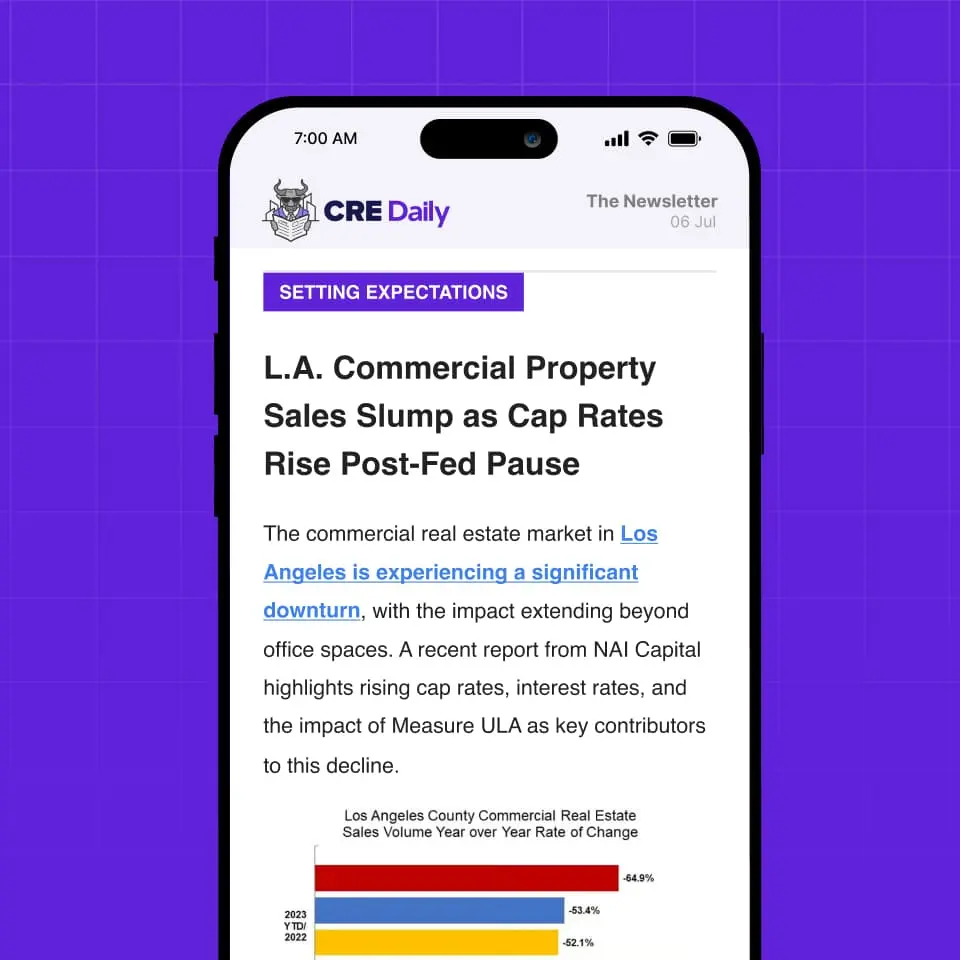
Apartment Borrowing Conditions Hit Their Worst Level Since 2023
Apartment owners spent this cycle fretting over empty units, but the harder problem now is getting a loan, as borrowing conditions sink to a three-year low.
By the numbers: NMHC’s October 2026 survey found all four apartment market indexes below 50, signaling worsening conditions. Debt financing, equity availability, and sales activity saw the steepest declines, while rental conditions softened only slightly.
The financing squeeze: The Debt Financing Index plunged from 46 in July to 10 in October, while the Equity Financing Index fell from 44 to 17. Meanwhile, 81% of respondents reported worsening borrowing conditions, and 66% saw reduced equity availability, making acquisitions, refinancing, and new development more challenging.

Source: NMHC Quarterly Survey of Apartment Conditions, October 2026.
Deals hit the brakes: Apartment sales are losing momentum as financing tightens. The Sales Volume Index dropped from 46 to 22, with 61% of respondents reporting fewer transactions and just 4% seeing an increase. Tighter capital conditions appear to be making it harder for buyers and sellers to close deals.
Rental fundamentals hold their ground: Despite capital markets turbulence, apartment operations remain relatively resilient. The Market Tightness Index slipped from 57 to 47, signaling modest softening. Still, 53% of respondents reported unchanged rental conditions, while 26% saw loosening and 21% reported tightening. Apartment demand remains steadier than investment activity.
A widening divide: Stable rental income isn't translating into easier financing or stronger sales activity. The survey of 130 multifamily executives suggests access to capital, rather than weakening rental demand, is becoming the industry's bigger concern.
➥ THE TAKEAWAY
Capital is king: Multifamily's biggest challenge isn't filling apartments, but financing them. Tighter capital markets could mean fewer deals, tougher refinancing, and opportunities for well-capitalized investors. Stable occupancy alone won't keep deals moving.
✍️ Editor’s Picks
-
Louisville multifamily returns: Highgates’ 166-unit Willard at Preston Crossing delivered a 13.8% average annual cash yield to a limited partner from 2022–2025, including refinancing proceeds. (sponsored)
-
Risk repriced: Blackstone's opportunistic funds fell 3.2% in Q3 while its core-plus vehicles rose 1.6%, a split showing investors still pay up for stabilized income and charge more for risk.
-
Patient money: Family offices are turning choosier on real estate, hunting steep discounts and quick rent resets while capping fund leverage near 65% as they wait for rates to fall.
-
SASB leads: Single-asset, single-borrower deals are dominating 2026 CMBS issuance, outpacing conduit pools as large borrowers drive the market and reshape where bond buyers take risk.
-
REITs steady: With about 90% of their debt fixed-rate, low-leverage listed REITs are weathering higher-for-longer rates far better than private owners staring down refinancing stress.
🏘️ Multifamily
-
Supply thins: US builders delivered about 82,000 apartments in Q3, the biggest quarter of 2026 yet the smallest Q3 since 2019, leaving owners a far lighter pipeline than two years ago.
-
Recovery stalls: Single-property apartment sales trail last year by 6% through August as the 10-year Treasury near a 25-year high keeps the multifamily rebound slow and uneven across metros.
-
Fallbrook trade: Colliers brokered a $36.65M sale of two Fallbrook, California apartment communities totaling 206 units, a sign value-add buyers still chase supply-constrained Southern California submarkets.
-
Tenant leverage: Habitability defenses are surging in eviction court as more renters get lawyers, pushing owners toward $10K to $15K settlements that lift legal and insurance costs, especially for independents.
🏭 Industrial
-
Big-box take-out: Hillwood landed a $138.6M Barings refinancing on a fully leased 656,000 SF Inland Empire logistics park, showing stabilized big-box product can still clear a large permanent loan.
-
Columbus ground: Ambrose broke ground on a roughly 1.06M SF speculative warehouse west of Columbus, adding big-box supply to a Midwest logistics hub even as national construction slows.
-
Carrier bets: Carrier will invest more than $600M to convert a 1.2M SF Fort Worth building into an advanced manufacturing hub, adding 1,500 jobs in the booming AllianceTexas corridor.
🏬 Retail
-
JV route: Institutional investors are leaning on joint ventures with seasoned operators for grocery-anchored retail, with one recent partnership assembling about 3M SF across 19 centers as listings stay scarce.
-
Grocery premium: Buyers keep paying up for grocery-anchored centers, with JLL pegging 2025 cap rates near 6.7%, though the premium really hinges on store sales and the anchor's lease terms.
-
Mall exit: Lennar is buying the Boynton Beach Mall to build housing, taking a 91-acre South Florida site zoned for 1,700 units as another fading mall turns into homes.
-
Corridor comeback: Open-air and high-street retail corridors are drawing more foot traffic into the holidays, a sign shoppers are returning to walkable shopping districts as spending holds up.
🏢 Office
-
Manhattan lift: SL Green's Q3 FFO rose to $122.1M as two Manhattan office sales and hedging offset slower leasing, underscoring that balance-sheet moves, not deal flow, carried the quarter.
-
Chrysler buy: Tishman Speyer and Bouwinvest launched a US office fund targeting top-tier towers, opening with the Chrysler Building and its 150-year ground lease as they bet office sits in an early-cycle window.
-
Expiration wave: A wave of Chicago office lease expirations is set to drive downtown tenant moves, with occupiers increasingly waiting until their lease year to commit and reshaping which towers win.
🏨 Hospitality
-
Clubs loosen: Country clubs are loosening their old exclusivity, adding pickleball, wellness and social perks to court younger members even as initiation fees keep climbing.
-
Austin district: A developer pitched a 535-acre hospitality, sports and maker-space district south of Austin, anchored by a 500-key hotel and conference center, targeting a 2029 first phase.
-
Openings slip: Los Angeles hotel construction is slowing as a wave of delayed projects pushes openings further out, with rising costs and labor shortages stretching timelines by many months.
📈 CHART OF THE DAY

Just 2% of firms account for more than half of corporate AI spending, highlighting a highly concentrated market despite rising investment and expectations for modest productivity gains.
CRE Trivia (Answer)🧠
Ghirardelli Square. The former chocolate factory reopened as an integrated restaurant and shopping complex.
More from CRE Daily
-
📬 Newsletters: Stay ahead of the market with local insights from CRE Daily Texas and CRE Daily New York.
-
🎙️Podcast: No Cap by CRE Daily delivers an unfiltered look at the biggest trends—and the money game behind them.
-
🗓️ CRE Events Calendar: The largest searchable calendar of commercial real estate events—filter by city or sector.
-
Market Reports: A centralized hub for brokerage research and market intelligence, all in one place.
-
Fear & Greed Index: A fully interactive sentiment tracker on the pulse of CRE built in partnership with John Burns Research & Consulting.